Joseph Isangura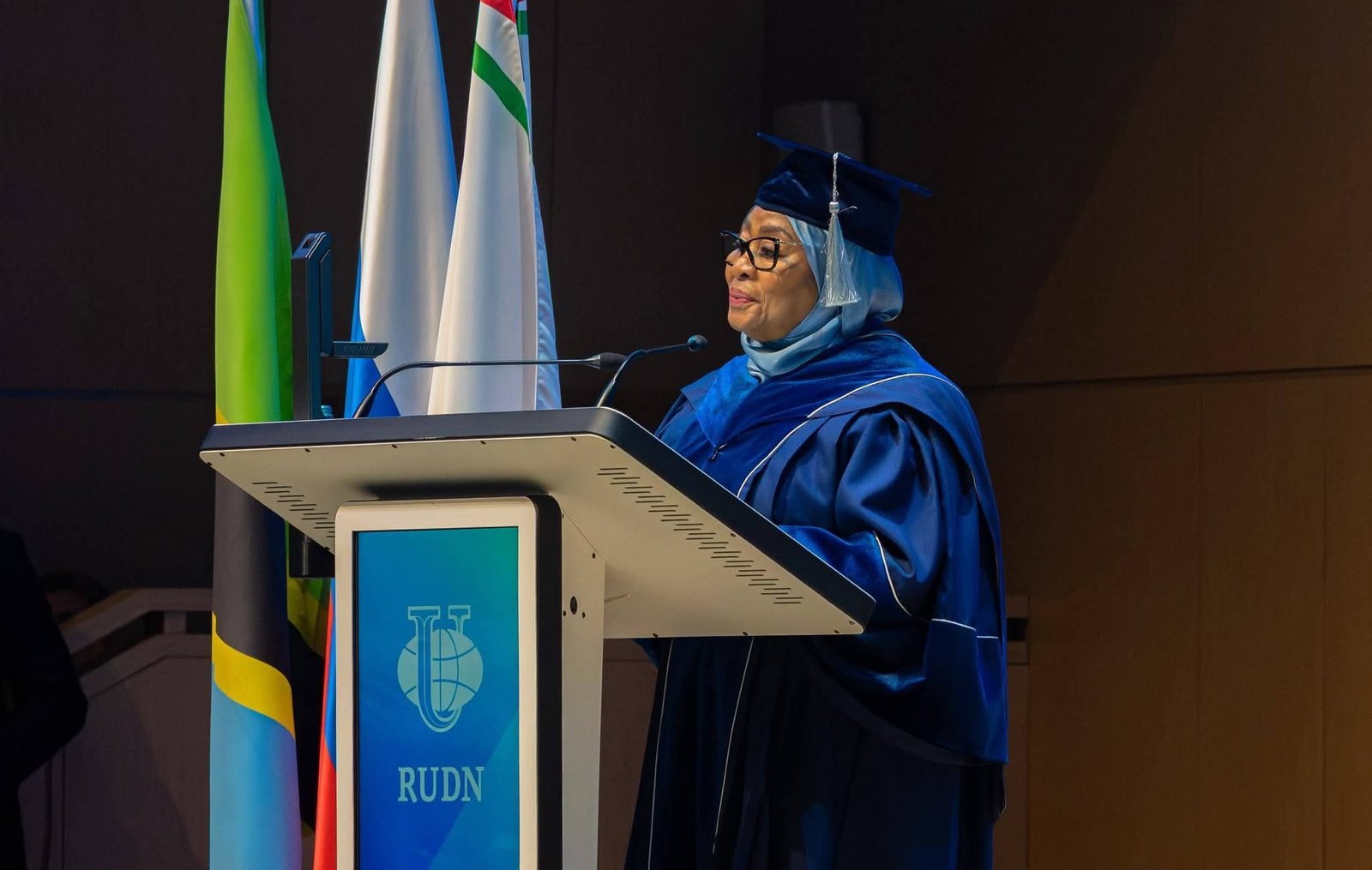
Inside one of Russia’s most historically symbolic universities an institution built during the Cold War to educate future leaders from Africa, Asia, and Latin America Tanzanian President Samia Suluhu Hassan stood Thursday at the centre of a ceremony that reflected far more than academic recognition.
As she received an honorary doctorate from Russia’s Peoples’ Friendship University (RUDN University) in Moscow, the moment became a powerful geopolitical statement about Africa’s changing place in global diplomacy and Tanzania’s growing international visibility under her leadership.
The honor, awarded during President Samia’s state visit to Russia, comes at a time when global powers are intensifying competition for influence across Africa, turning the continent into one of the most strategically contested regions in international politics.
For Russia, honoring Samia was not simply a ceremonial gesture.
It represented an effort to revive and modernize relationships built decades ago during the Soviet era, when Moscow cultivated strong political and educational ties with newly independent African states fighting colonialism and seeking international allies during the Cold War.
RUDN University itself occupies a unique place in that history.
Founded in 1960 under Soviet leader Nikita Khrushchev, the university became internationally known as a centre for educating students from developing nations, particularly African liberation-era elites. Thousands of African doctors, engineers, diplomats, military officers, and political leaders passed through its classrooms during decades when the Soviet Union sought influence across the Global South.
Tanzania was among the African countries deeply connected to that relationship.
Under founding president Mwalimu Julius Nyerere, Tanzania maintained close diplomatic ties with Moscow while positioning itself as a leading voice in African liberation politics, non-alignment, and anti-colonial solidarity. Soviet educational scholarships and technical cooperation played a significant role in training generations of African professionals, including Tanzanians.
Nearly six decades later, President Samia’s appearance in Moscow reflects how dramatically the geopolitical landscape has changed.
Where Nyerere’s relationship with the Soviet Union was shaped largely by ideology and liberation struggles, Samia’s diplomacy is rooted in economics, investment, technology, energy partnerships, and strategic positioning in a multipolar world increasingly defined by competition between global powers.
Political analysts say the honorary doctorate therefore carried layered symbolism: recognition of Samia personally, acknowledgment of Tanzania’s historical relationship with Russia, and a broader message about Africa’s rising geopolitical relevance.
The award also arrives during an important period in President Samia’s international leadership profile.
Since becoming Tanzania’s first female president, Samia has pursued an aggressive diplomatic outreach strategy aimed at reopening Tanzania economically, attracting foreign investment, strengthening trade partnerships, and increasing the country’s international influence after years of more cautious external engagement.
During her Moscow visit, Samia has held talks with Russian President Vladimir Putin focused on expanding cooperation in sectors considered central to Tanzania’s future economic ambitions, including mining, energy, agriculture, science and technology, higher education, infrastructure, and tourism.
Observers note that Russia’s renewed engagement with African leaders comes as Moscow seeks stronger alliances beyond Europe amid intensifying geopolitical confrontation with Western nations.
At the same time, African governments are increasingly leveraging competition between Russia, China, the United States, Europe, and Gulf powers to negotiate investment and development opportunities while maintaining diplomatic flexibility.
For many African observers, the image of Samia receiving one of Russia’s most prestigious academic honors represented something larger than state diplomacy alone.
It symbolized a continent gradually moving from the margins of international politics toward the centre of global strategic calculations — with African leaders increasingly treated as influential actors in shaping the future balance of global power.