MWE Correspondent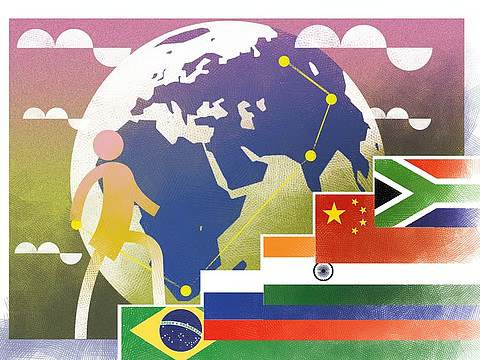
For decades, the global financial system has revolved around institutions, currencies and payment networks largely shaped by Western economies.
But inside conference rooms from Beijing to Brasília, a different conversation is gaining momentum.
The question is no longer whether emerging economies want a greater role in global finance.
The question is how quickly they can build the institutions needed to achieve it.
Throughout 2026, the BRICS grouping has continued expanding discussions on financial cooperation, trade settlements and alternative economic mechanisms as member states seek to reduce vulnerabilities created by dependence on traditional global financial structures.
The movement reflects a broader shift taking place across the developing world.
Countries across Asia, Africa, the Middle East and Latin America are increasingly calling for a more balanced international financial system where emerging economies have greater influence over decisions affecting global trade, investment and development.
At the centre of the debate is the role of the United States dollar.
The dollar remains the world’s dominant reserve currency and continues to play a central role in international trade and finance.
However, some governments argue that excessive dependence on a single currency creates economic risks, particularly when geopolitical tensions influence access to financial markets.
Also Read, US-Iran Conflict Escalates as Strait of Hormuz Faces New Crisis
This has encouraged discussions around De-dollarisation.
De-dollarisation does not necessarily mean replacing the dollar completely.
Instead, it refers to efforts by countries to increase the use of alternative currencies, regional payment systems and financial arrangements that reduce dependence on one dominant currency.
BRICS members have explored various approaches, including expanding trade conducted in local currencies, strengthening financial cooperation and increasing the role of institutions such as the New Development Bank.
For many developing countries, the attraction is strategic.
Greater financial flexibility could provide more options when accessing investment, managing trade and responding to global economic shocks.
Africa has become an important part of this conversation.
Several African countries have expressed interest in stronger economic cooperation with BRICS members, viewing the group as a potential partner in trade, infrastructure financing and development investment.
The continent’s large consumer markets, natural resources and young population have increased its importance within emerging economic networks.
However, economists caution that alternative financial systems require strong foundations.
Currency stability, transparent institutions, productive economies and effective governance remain essential for any financial framework to gain international confidence.
A new financial order cannot be created through political agreements alone.
It requires economic strength.
This has placed Financial Sovereignty at the heart of the debate.
Financial sovereignty means countries having greater control over their economic decisions, including how they trade, invest and manage financial risks.
For African economies, this includes strengthening domestic industries, improving regional trade and reducing dependence on exporting raw materials while importing finished products.
The African Continental Free Trade Area has become a major part of this strategy.
By increasing trade between African countries, policymakers hope to build stronger regional markets and create a foundation for greater economic independence.
The challenge, however, remains significant.
Many African economies still face infrastructure gaps, limited industrial capacity and dependence on global commodity markets.
Addressing these issues will require long-term investment, not only new financial partnerships.
The rise of BRICS also reflects a wider transformation in global politics.
Economic influence is increasingly spreading beyond traditional centres of power as emerging economies demand greater representation in institutions that shape international finance.
Supporters argue that a more multipolar financial system could create greater opportunities for developing nations.
Critics warn that new systems must demonstrate transparency, stability and practical benefits rather than simply becoming political alternatives.
The future of global finance is therefore entering a period of transition.
The question is not whether the international financial system will change.
It is who will shape that change.
As BRICS and other emerging economic partnerships expand, countries across the Global South are seeking a larger voice in defining the rules of tomorrow’s economy.
For Africa, the opportunity is clear.
The continent’s economic future will depend not only on attracting investment, but also on building the financial strength and industrial capacity needed to negotiate from a position of confidence.
The global financial map is shifting.
And emerging economies are determined to have a hand in drawing it.