MWE Correspondent
On a recent morning overlooking the Great Rift Valley, conservation officials at Lake Manyara National Park were discussing an unusual challenge: how to entertain football fans.
The visitors they are preparing for are not traditional safari-goers.
They are expected to arrive in East Africa in June 2027 carrying team jerseys, tournament tickets and match schedules.
Tanzania hopes many will leave carrying something else entirely — memories of elephants moving through ancient forests, flamingos feeding along alkaline shores and lions sleeping in trees.
As Kenya, Tanzania and Uganda prepare to jointly host the 2027 Africa Cup of Nations, the first time Africa’s premier football tournament will be staged in East Africa, tourism authorities are mounting an ambitious effort to convert sports spectators into wildlife travelers.
The monthlong tournament, scheduled from June 19 to July 17, 2027, is expected to draw hundreds of thousands of visitors across the region.
For Tanzania, whose famed northern safari circuit begins just beyond the host city of Arusha, the competition represents more than a sporting event. It is being viewed as a once-in-a-generation opportunity to showcase the country’s conservation assets to a new international audience.
“We are enhancing visitor services, preparing official watch zones and managing capacity to accommodate the expected growth in sports tourism,” said CPA (T) Mussa Nasoro Kuji, the Conservation Commissioner of the Tanzania National Parks (TANAPA).
Among the parks expected to receive some of the largest spillover from the tournament is Lake Manyara National Park, a protected area established 66 years ago and situated about 126 kilometers, or 78 miles, southwest of Arusha.
The park is close enough to make a convenient excursion between matches.
Visitors can drive there in roughly two hours or fly from Arusha Airport to the Manyara airstrip in about 20 minutes.
But proximity alone, officials say, will not guarantee success.
At the park headquarters, planners are rushing to complete a collection of adventure attractions designed specifically with active travelers in mind.
“Our experts are working extra time to finalize new tourism activities that resonate with sports enthusiasts in addition to the park’s traditional attractions,” Mr. Kuji said.
The initiative reflects a broader shift underway in African tourism, where destinations increasingly seek to attract younger travelers interested not only in wildlife viewing but also in outdoor adventure.
Reinventing the Safari
Lake Manyara has long occupied a unique place in Tanzania’s safari landscape.
Though smaller than neighboring Serengeti National Park or Ngorongoro Conservation Area, it packs extraordinary ecological diversity into a relatively compact area. Visitors encounter dense forests, open grasslands, floodplains, freshwater springs, dramatic escarpments and the alkaline waters of Lake Manyara itself within a single day.
The park is known for its large elephant herds, sprawling troops of baboons and more than 400 recorded bird species.
Flamingos, pelicans and numerous waterbirds congregate along the lakeshore.
It is also home to one of Africa’s most unusual lion populations.
Unlike most lions, which spend nearly all their lives on the ground, Manyara’s lions frequently climb trees.
Why they do so has fascinated visitors and researchers for decades.
Conservationists believe the behavior is partly a response to the region’s climate.
Elevated branches provide cooler air and shade in the humid conditions around the lake while helping lions avoid biting insects that concentrate closer to the ground.
Trees also offer strategic lookout points from which the animals can spot prey or detect threats.
Researchers say the habit appears to be socially learned rather than genetically inherited.
Lion cubs observe adults climbing and replicate the behavior, allowing the practice to be transmitted across generations.
The result is a phenomenon so rare that Manyara’s tree-climbing lions have become one of Tanzania’s most recognizable wildlife attractions.
Now park officials hope visitors arriving for football will stay long enough to see them.
“We have created adventure activities specifically for tourists with a sporting mindset who will be attending AFCON,” said Dr. Yustina Kiwango, Lake Manyara’s commanding officer.
Five new experiences are being finalized: a zip line, a giant swing, canoeing excursions, a canopy walk and hiking trails along the escarpment overlooking the lake.
The additions will complement existing activities that include daytime and nighttime game drives, guided nature walks, birdwatching and excursions through the Marang’ Forest.
“Lake Manyara offers almost every experience found elsewhere in Tanzania’s tourism destinations,” Dr. Kiwango said.
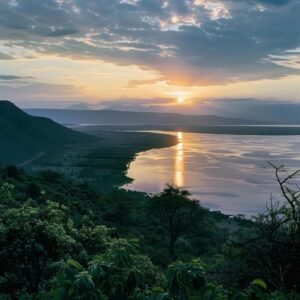
Standing near the escarpment, she gestured toward a panorama stretching from the forest canopy to the distant shoreline.
“No matter which direction you approach from, the landscape is breathtaking,” she said. “You see the face of the Rift Valley, the cliffs, the lake and the green terrestrial landscape.”
A Forest That Never Sleeps
Beneath the park’s celebrated scenery lies one of its most important ecological features: a groundwater forest sustained by underground flows emerging from the Rift Valley escarpment.
Even during prolonged dry seasons, the forest remains lush and green.
Towering sycamore figs, African mahogany trees, Trichilia emetica and Croton macrostachyus form a dense canopy that shelters wildlife and preserves moisture.
For many species, the forest serves as a refuge when surrounding habitats become dry.
Elephants, monkeys, birds and countless smaller creatures congregate here, drawn by dependable water and cooler conditions.
The forest also supports plant and animal species that cannot tolerate drought, increasing biodiversity within a relatively small area.
Conservationists describe it as the ecological engine of Lake Manyara.
Its roots stabilize soil, regulate water cycles and sustain habitats throughout the park.
The Chemistry of Survival
Also Read: Rural Revival Powers Tanzania’s Next Growth
Lake Manyara itself tells a story of adaptation.
The lake is alkaline because it occupies a closed basin. Rivers and springs carry minerals from the surrounding Rift Valley, but the water has no outlet. Intense tropical sun evaporates water while leaving salts and minerals behind.
Over time, salinity increases.
The result is an environment that excludes many species while allowing highly specialized organisms to flourish.
Fish diversity is limited compared with freshwater lakes, but algae, salt-tolerant microorganisms and specialized bacteria thrive.
These microscopic organisms form the foundation of a food web that supports vast numbers of flamingos and other birds.
Rainfall patterns continually reshape the system. Wet years dilute salinity and can boost biological productivity. Severe drought increases salt concentrations, reducing some populations while favoring organisms adapted to extreme conditions.
“It is survival of the fittest in a very literal sense,” one conservation officer remarked.
Seven Ecosystems in One Park
Despite its modest footprint, Lake Manyara contains approximately seven distinct ecosystems.
There is the groundwater forest near the park entrance; acacia woodlands and grasslands; seasonal floodplains; the alkaline lake ecosystem; permanent freshwater springs; the escarpment habitats along the Great Rift Valley; and the Marang’ Forest, a dry woodland ecosystem added to the park in 2009.
The Marang’ Forest is particularly significant because it introduces species associated with East Africa’s miombo woodlands, including trees from the Brachystegia and Julbernardia genera.
Together, these habitats create an unusually concentrated mosaic of biodiversity.
For conservationists, the park serves as a reminder that ecological richness is not always measured in size.
Looking Past the Final Whistle
TANAPA officials view AFCON not as a one-month event but as a catalyst for longer-term tourism growth.
Dr. Kiwango is already courting investors interested in developing high-end accommodation within the Marang’ Forest area.
She believes the landscape could eventually support luxury tourism ventures, including the possibility of a golf course integrated into the forest environment.
Whether football supporters will embrace those ambitions remains uncertain.
What is certain is that Tanzania sees the tournament as an opportunity to introduce itself to visitors who might otherwise never venture beyond the stadium.
If officials succeed, some of the most memorable moments of AFCON 2027 may take place not under floodlights but beneath acacia trees, where lions rest above the grass and flamingos gather along the shimmering edge of an ancient lake. ends