MWE Correspondent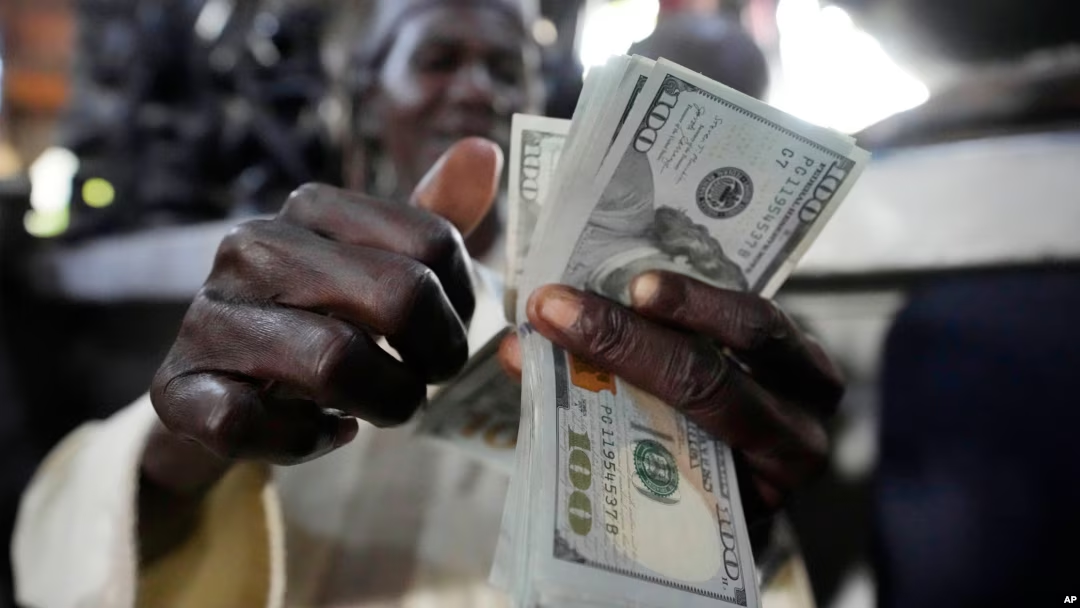
For decades, a single currency has dominated the rhythm of international commerce.
From oil purchases and major infrastructure projects to international loans and cross-border trade, the United States dollar has remained the foundation of the global financial system.
But across Africa, a new conversation is emerging.
Governments, financial institutions and economic policymakers are increasingly exploring ways to strengthen local currencies, expand regional payment systems and reduce excessive dependence on external financial structures.
The goal is not simply to replace one currency with another.
It is to build a financial system that gives African economies greater flexibility and control over their own economic decisions.
The shift reflects a broader transformation taking place across the global economy.
As emerging economies expand cooperation through platforms such as BRICS, discussions around alternative financial systems, local currency settlements and stronger regional financial institutions have gained momentum.
For Africa, these debates carry particular significance.
Also Read, The Arctic Is Redefining Global Geopolitics
Many African economies rely heavily on foreign currencies for international trade, debt payments and major investments. While access to global financial markets provides important opportunities, economists argue that excessive dependence on external currencies can expose countries to exchange-rate shocks and global monetary decisions made beyond their borders.
This has placed Financial Sovereignty at the centre of economic discussions across the continent.
Financial sovereignty does not mean isolation from the global economy.
Instead, it focuses on building stronger domestic financial systems, improving regional trade, developing local capital markets and ensuring that countries have greater influence over their own economic futures.
One of the biggest opportunities lies in expanding trade within Africa itself.
The African Continental Free Trade Area (AfCFTA) was created to increase intra-African commerce by reducing barriers and encouraging businesses to trade more easily across borders.
However, experts argue that successful continental trade requires efficient payment systems that reduce transaction costs and strengthen the role of African currencies.
Several initiatives are already exploring how digital payment platforms and regional financial networks can improve cross-border transactions.
For small businesses, this could mean faster payments, lower costs and greater access to markets beyond national borders.
For governments, it could strengthen economic resilience.
The changing financial landscape is also connected to the rise of the Global South.
Countries across Asia, Africa, Latin America and the Middle East are increasingly calling for greater representation in international financial institutions and a larger role in shaping global economic rules.
Supporters of reform argue that the global financial system should better reflect the economic importance of emerging markets.
However, economists caution that creating alternative financial systems requires strong foundations.
Stable institutions, effective regulation, transparent governance and productive economies remain essential for any currency or payment system to gain international confidence.
A country cannot achieve financial independence through currency policy alone.
It also requires investment in industries, exports, technology, education and infrastructure.
Also Read. The Arctic Is Redefining Global Geopolitics
This has strengthened calls for Economic Transformation across Africa.
The continent’s long-term financial strength will depend on its ability to produce competitive goods and services, expand regional markets and capture greater value from its resources.
The global financial debate is therefore not only about currencies.
It is about economic power.
For decades, many developing economies have operated within financial structures largely shaped by major global institutions and powerful economies.
Today, a new generation of policymakers is seeking a more balanced system where African nations have greater influence over decisions affecting their economic future.
The transition will not happen overnight.
The dollar remains the world’s leading reserve currency, supported by deep financial markets and international confidence.
But history shows that global economic systems evolve as new powers emerge and new partnerships develop.
Africa’s financial future will depend on how effectively the continent combines regional cooperation, domestic reforms and strategic international partnerships.
The question is no longer whether the global financial system will change.
It is how much influence Africa will have in shaping what comes next.
As the world moves toward a more multipolar economic order, Africa is seeking a seat not only at the trading table—but also at the centre of financial decision-making.