
 Elizabeth Normino
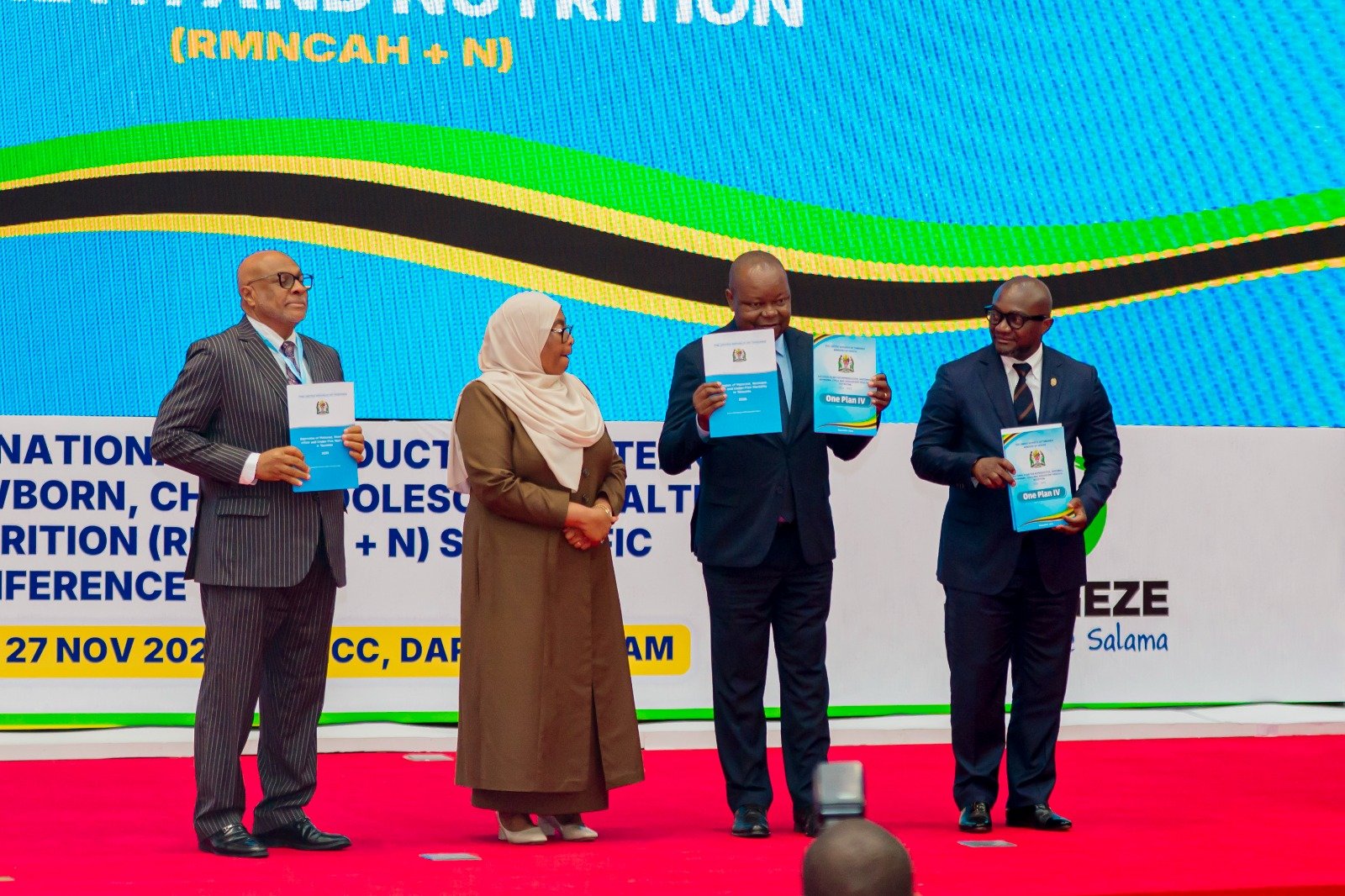
Tanzania has launched a new five-year national plan aimed at improving reproductive, maternal, newborn, child and adolescent health services, as President Samia Suluhu Hassan handed over key implementation documents to government ministers and regional authorities.
The President presented the National Plan for Reproductive, Maternal, Newborn, Child, Adolescent Health and Nutrition (2026–2030) to the Minister of State in the Prime Minister’s Office responsible for Regional Administration and Local Government (TAMISEMI), Prof. Riziki Shemdoe, during the opening of the Third National Scientific Conference on Reproductive, Maternal, Newborn, Child, Adolescent Health and Nutrition in Dar es Salaam on November 26, 2026.
The documents also included the 2026 Report on Estimated Maternal, Neonatal, Infant and Under-Five Mortality in Tanzania, which is expected to guide policy decisions and strengthen interventions aimed at reducing preventable deaths.
President Samia also handed over the documents to the Minister for Health, Mohamed Mchengerwa, and Zanzibar’s Minister for Health, Nassor Ahmed Mazrui, tasking them with overseeing implementation within their respective areas of responsibility.
As part of efforts to strengthen accountability, the President signed implementation agreements with regional commissioners, represented by their chairperson, Manyara Regional Commissioner Martine Shigela. The agreements are intended to ensure that the national health strategy is implemented effectively through local government authorities across the country.
The new plan comes as Tanzania seeks to consolidate progress in maternal and child survival while addressing persistent challenges in access to quality healthcare, particularly in underserved communities.
Also Read: Algeria Strengthens Gas Exports and Energy Cooperation with Russia
Figures presented during the conference indicated that maternal mortality had declined to 76 deaths per 100,000 live births, while neonatal mortality stood at 17 deaths per 1,000 live births. Under-five mortality was estimated at 28 deaths per 1,000 live births.
The figures indicate progress towards the United Nations Sustainable Development Goals for 2030, which target reducing maternal mortality to below 70 deaths per 100,000 live births, neonatal mortality to below 12 per 1,000 live births and under-five mortality to below 25 per 1,000 live births.
Speaking at the conference, President Samia emphasised the importance of ensuring equitable access to healthcare, regardless of people’s economic circumstances or geographical location. She called for stronger collaboration between the government, healthcare professionals, development partners and other stakeholders to accelerate improvements in health services.
The three-day conference, held from November 25 to 27 at the Julius Nyerere International Convention Centre, brought together policymakers, researchers, healthcare professionals and development partners to discuss evidence-based approaches to improving maternal and child health.
Discussions have focused on strengthening antenatal and postnatal care, improving emergency obstetric and newborn services, addressing shortages of skilled healthcare workers, improving nutrition and expanding access to essential medical equipment and technologies.
The new 2026–2030 plan is expected to provide a framework for coordinating these interventions, with regional and local government authorities playing a central role in translating national commitments into improved services at health facilities.
Its success will ultimately depend on effective implementation, adequate financing, availability of skilled health workers and consistent monitoring to ensure that improvements reach mothers, newborns, children and adolescents across Tanzania.