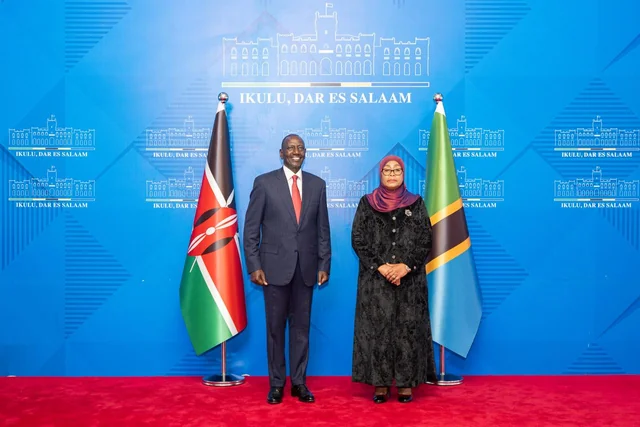
The President of the United Republic of Tanzania, Samia Suluhu Hassan, and the President of Kenya, William Ruto, have overseen the signing of eight bilateral cooperation agreements aimed at strengthening economic integration, improving infrastructure connectivity, and expanding cross-border trade between the two East African economies.
The agreements were signed on May 4, 2026, at State House in Dar es Salaam during an official state visit by President Ruto, marking one of the most significant recent steps in bilateral cooperation between the two neighbouring countries.
According to officials, the agreements cover key sectors including railway management, maritime transport, agriculture, public service capacity building, standards harmonization for goods, recognition of seafarers’ certificates, and legal cooperation in criminal matters.
A central element of the package is a feasibility study for a proposed natural gas pipeline linking Dar es Salaam and Mombasa, a project viewed as potentially transformative for regional energy connectivity if implemented.
The agreements are also expected to streamline transport systems, reduce trade barriers, and improve regulatory coordination across sectors that are critical to regional commerce.
Speaking during the ceremony, the two leaders described the agreements as part of a broader effort to accelerate East African integration and unlock new investment opportunities across infrastructure, energy, and trade.
Analysts say the developments reflect growing momentum within the East African region to strengthen economic ties at a time of increasing global competition for investment, energy security, and supply chain resilience.
The railway and maritime cooperation frameworks are expected to ease long-standing logistical bottlenecks that have affected cross-border trade, while harmonization of standards and certifications could improve labour mobility and industrial competitiveness.
Also Read; Botswana–South Africa Crisis Over Migrant Abuse
The proposed pipeline feasibility study has drawn particular attention from economic observers, who say enhanced energy connectivity between Tanzania and Kenya could significantly reduce transport costs and improve regional energy security in the long term.
The agreements come as East African economies seek to position themselves more competitively within global markets, amid shifting international trade patterns and rising demand for infrastructure-linked investment opportunities.
While no binding construction commitments were announced, officials indicated that the agreements establish a structured framework for long-term cooperation and future project development.
Experts note that successful implementation will depend on sustained political coordination, regulatory alignment, and financing strategies capable of supporting large-scale cross-border infrastructure projects.
The signing ceremony concluded President Ruto’s state visit to Tanzania and was followed by a joint press briefing, where both leaders reaffirmed their commitment to deepening bilateral relations and advancing regional integration objectives.
As East Africa continues to pursue closer economic alignment, the agreements are being viewed as a significant step toward building a more unified and competitive regional market capable of attracting greater global investment and strengthening intra-African trade flows.

 MWE Correspondent