 Hassan Magulumali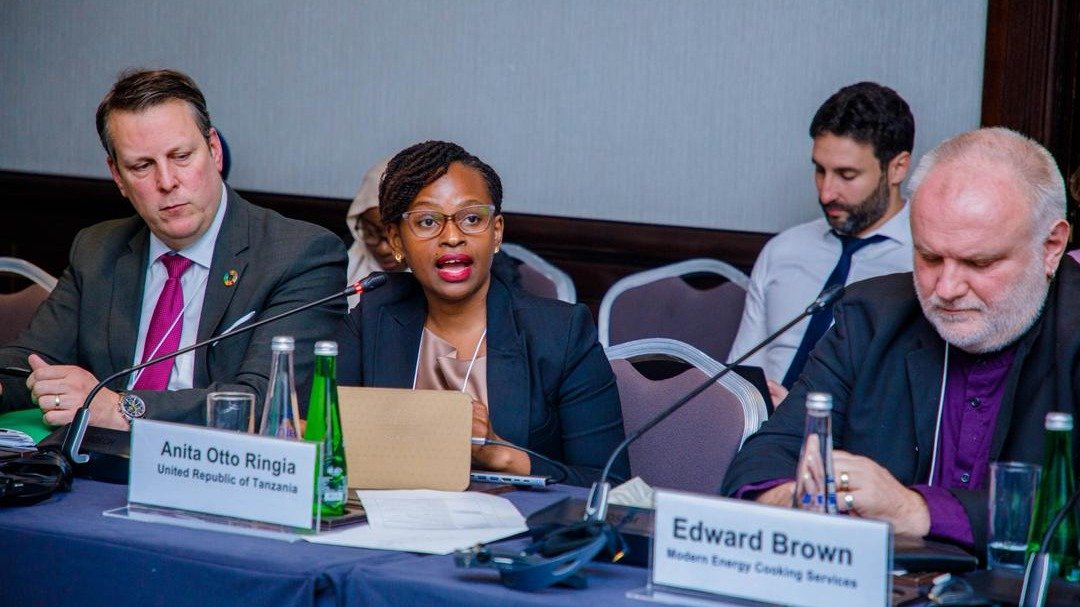
Tanzania has reaffirmed its commitment to expanding access to clean, safe, and affordable cooking energy by mobilizing financing from government institutions, the private sector, development partners, and international organizations supporting the global clean cooking agenda.
Speaking during a side event at the 2026 International Renewable Energy Agency (IRENA) meeting in Abu Dhabi, Engineer Anita Ringia from Tanzania’s Ministry of Energy highlighted the country’s significant progress in implementing its Clean Cooking Energy Agenda through increased investment and policy support.
Ringia said access to clean cooking energy in Tanzania has risen from 6.9 percent in 2021 to 23.2 percent in 2025, more than tripling within just four years.
She attributed the achievement to strong government leadership under President Dr. Samia Suluhu Hassan, who has elevated clean cooking energy to a national priority and a key pillar of Tanzania’s Vision 2050 development agenda.
As part of ongoing efforts in the 2025/26 fiscal year, Tanzania is implementing several initiatives, including the distribution of 200,000 subsidized improved cookstoves, a pilot project with TANESCO that allows households to acquire electric cookers through electricity bill payments, and the distribution of more than 450,000 subsidized LPG cylinders.
Ringia also noted that the government has prohibited the use of firewood and charcoal in institutions serving more than 100 people daily. The move is expected to accelerate the transition to clean cooking energy across more than 31,000 public institutions nationwide, an investment estimated to require over US$1 billion.
In addition, the government is strengthening public awareness campaigns while supporting small and medium-sized enterprises operating in the clean cooking energy sector.
Also Read: Tanzania’s Prisons Embrace Clean Energy Transition
The private sector has also played a growing role in supporting the agenda. According to Ringia, local financial institutions, including NMB Bank and CRDB Bank, have begun offering affordable financing to clean cooking entrepreneurs to help expand distribution networks across the country.
During the meeting, Tanzania showcased a range of investment opportunities, including the development of infrastructure for receiving, storing, and distributing clean cooking fuels, the establishment of local manufacturing facilities for cookstoves, cylinders, and related equipment, as well as innovative consumer financing models such as pay-as-you-go (PAYGO) systems, low-interest financing, and electricity bill payment schemes.
On international financing, Ringia emphasized Tanzania’s support for stronger collaboration among governments, private investors, financial institutions, and development partners to close the clean cooking financing gap, particularly in Africa, where nearly one billion people still lack access to clean cooking solutions.
The Tanzanian delegation also participated in technical discussions on renewable energy policy, regulation, planning, and investment opportunities. The sessions were led by renewable energy experts, including Assistant Commissioner for Renewable Energy Imani Mruma.
During the discussions, Tanzania outlined measures being taken to increase the contribution of renewable energy to the national grid in line with Sustainable Development Goal 7 (SDG 7), which seeks to ensure access to affordable, reliable, sustainable, and modern energy for all.
The country reported that renewable energy currently contributes approximately 68 percent of electricity supplied to the national grid. Further expansion is underway, including the 150-megawatt Kishapu Solar Power Project, which is expected to begin generating its first 50 megawatts of electricity by February.
Tanzania is also advancing geothermal energy projects at Lake Ngozi (70MW), Songwe (5MW), Kiejo-Mbaka (60MW), Natron (60MW), and Luhoi (5MW), further diversifying the country’s renewable energy portfolio.
Opening the first day of the IRENA 2026 meeting, Deputy Director-General Gaun Singh urged member states to accelerate investments in renewable energy projects. He noted that the global target is to achieve 11,000 gigawatts of renewable energy capacity by 2030.
The IRENA 2026 meeting is being held under the theme, “Powering Humanity: Renewable Energy for Shared Prosperity.”