MWE Correspondent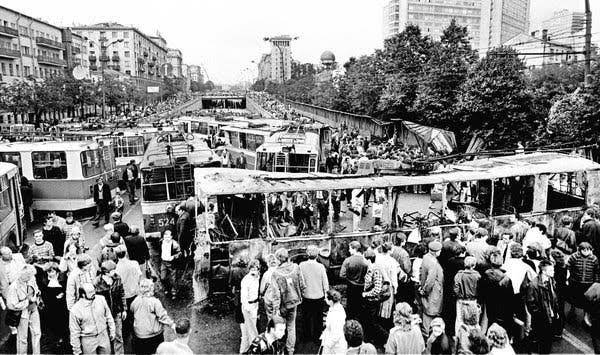
On the evening of December 25, 1991, the Soviet flag was lowered from the Kremlin for the final time, marking the official end of the Soviet Union, one of the most powerful political and military forces of the 20th century.
For many around the world, the collapse represented the end of the Cold War and the victory of a new global order. But for millions of ordinary Russians, it marked the beginning of a period of uncertainty, economic hardship, and social transformation that would reshape almost every part of daily life.
The fall of the Soviet Union was not simply the collapse of a political system. It was the sudden disappearance of an economic structure that had controlled employment, prices, industries, and social services for generations. The transition from a state-planned economy to a market-based system created opportunities for some, but it also produced one of the deepest crises in Russia’s modern history.
After 1991, Russia embarked on a rapid economic transformation aimed at replacing Soviet-style central planning with a market economy. The reforms were designed to encourage private ownership, attract investment, increase competition, and modernise the economy.
However, the speed and scale of the changes created severe disruptions.
The government introduced a strategy known as “shock therapy”, which involved removing price controls, reducing state subsidies, and quickly transferring many state-owned assets into private hands.
While supporters argued that these reforms were necessary to break away from an inefficient economic system, the immediate consequences were painful for millions of citizens.
Between 1991 and 1998, Russia’s economy contracted dramatically, with estimates suggesting a decline of around 40 to 45 percent in gross domestic product (GDP). Industrial production fell sharply as many factories struggled to survive in a competitive market environment for which they were unprepared.
For ordinary workers, the economic crisis was felt in everyday life. Salaries lost much of their purchasing power, unemployment increased, and many employees experienced months of delayed wages.
Industries that had once provided stable employment under the Soviet system were suddenly unable to guarantee jobs, leaving many families searching for new ways to survive.
One of the most painful experiences for ordinary Russians was the collapse of personal savings.
In 1992, inflation reached extraordinary levels, rising to approximately 2,500 percent. Money that families had saved for years under the Soviet system rapidly lost its value.
For many citizens, savings that were meant for buying homes, supporting children’s education, or securing retirement became almost worthless.
The financial shock created a deep sense of insecurity. People who had spent decades believing in the stability of the state suddenly found themselves facing a future they could not predict.
The economic collapse quickly became a wider social crisis.
During the early years after the Soviet collapse, Russia experienced a sharp decline in living conditions. Average life expectancy among Russian men fell from around 64 years in 1990 to approximately 57 years by 1994.
Researchers have linked this decline to several factors, including economic stress, weakening social protection systems, health challenges, increased alcohol abuse, and the psychological pressure caused by sudden social change.
At the same time, poverty expanded rapidly. From extremely low levels during the final years of the Soviet era, poverty rose dramatically during the mid-1990s, affecting tens of millions of people.
For many families, the transition meant losing the security they had known for decades.
Also Read, Africa’s Critical Minerals Are Redefining Global Power
The crisis also changed Russia’s population trends.
Economic uncertainty affected decisions about marriage and having children. By 1999, Russia’s fertility rate had fallen to around 1.16 children per woman, among the lowest levels recorded globally at the time.
Many young families delayed having children because they faced unstable employment, rising living costs, and uncertainty about the future.
Studies have also suggested that the decade following the Soviet collapse was associated with millions of excess deaths, although researchers continue to debate the exact causes and how much of the impact was directly linked to economic reforms, social changes, or other factors.
One of the most controversial parts of Russia’s transition was the privatisation of state assets.
As the government moved to create a capitalist economy, thousands of state-owned companies were transferred into private ownership. The intention was to improve efficiency and create a new class of entrepreneurs.
However, critics argue that the process was poorly managed and allowed a small number of individuals to gain control of valuable national assets at relatively low costs.
This period gave rise to Russia’s powerful oligarchs — wealthy businessmen who gained enormous influence in the economy and, in some cases, political affairs.
While some viewed them as symbols of a new entrepreneurial Russia, others saw them as evidence that the transition had created extreme inequality.
More than three decades later, historians and economists continue to debate how the 1990s should be remembered.
Some describe the period as a major humanitarian crisis, pointing to declining life expectancy, widespread poverty, economic collapse, and social instability.
Others argue that the difficulties were part of the painful process of dismantling a failing economic model and creating the foundations of a modern market economy. They say the crisis was caused not only by reforms themselves but also by weak institutions, political instability, corruption, and poor implementation.
The truth may lie somewhere between these perspectives. The transition was neither a simple success story nor only a failure. It was a complex historical moment shaped by difficult decisions, global pressures, and the struggle to build a new system from the remains of an old one.
By the early 2000s, Russia began experiencing economic recovery, helped significantly by rising global energy prices and stronger state revenues.
Living standards improved for many citizens, government finances stabilised, and Russia regained greater influence on the international stage.
However, memories of the 1990s remain deeply personal for many Russians. For those who lived through the period, the collapse of the Soviet Union was not only a geopolitical event discussed by world leaders — it was a transformation that affected their jobs, families, savings, health, and hopes for the future.
Today, more than 30 years later, the legacy of the Soviet collapse remains one of the most debated chapters in modern history.
For some, it represents the difficult birth of a new Russia. For others, it remains a reminder of the heavy human cost of rapid political and economic transformation.
But one fact remains clear: the collapse of the Soviet Union did not only redraw the map of the world — it changed the lives of millions of people who had to rebuild their future from the uncertainty that followed.