Agencies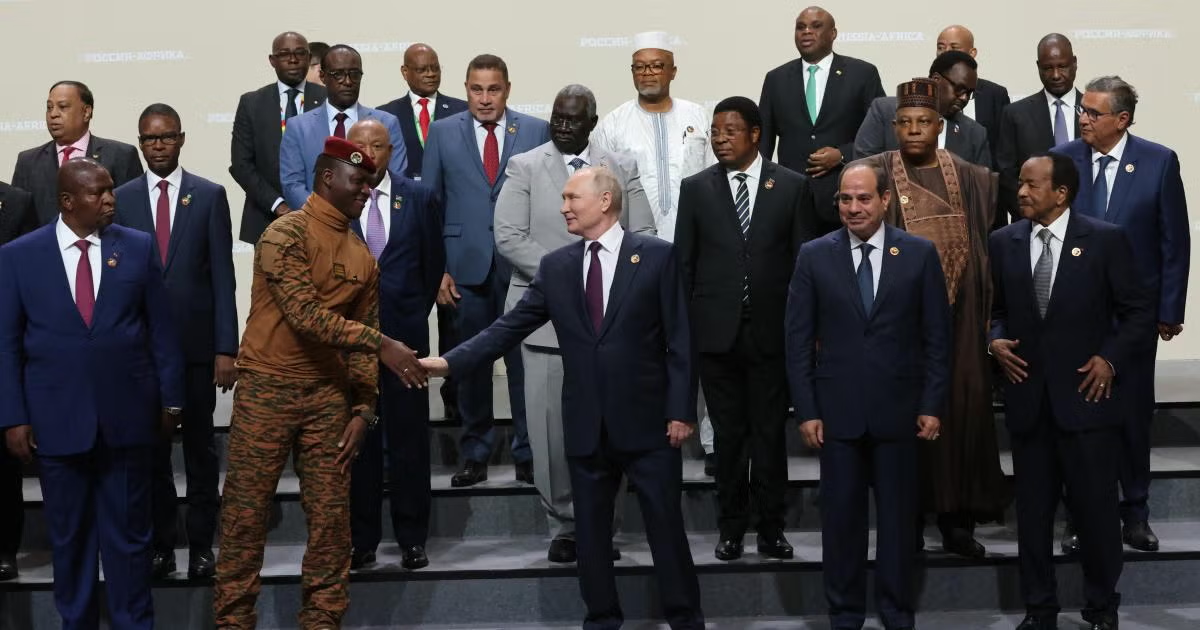
Russian President Vladimir Putin has said Russia will continue expanding its cooperation with Africa, but insisted that Moscow’s approach should be based on joint development rather than the model he associated with colonial powers.
Speaking on Thursday, October 1, during the plenary session of the 23rd Annual Meeting of the Valdai Discussion Club, Putin said Russia wanted to work with African countries as partners pursuing shared economic development.
“We want to work with Africa, we are working with Africa and we will continue to do so. But not as the colonial powers did — to make money or steal something from Africa, but to develop together,” Putin said, according to reports of his remarks.
Putin said Africa’s young and growing population makes the continent an important area for future investment and economic cooperation. He argued that African countries would increasingly seek to improve living standards for their growing populations, creating opportunities for investment and partnerships.
Read More: Could Africa Build Collective Protection Against Political Coercion?
The remarks come as Russia seeks to deepen its economic, political and diplomatic engagement across Africa. Russia and African states have identified areas including energy, industry, trade, healthcare, education, agriculture and security as potential areas of cooperation.
The Russian president also pointed to an upcoming Russia-Africa summit scheduled to take place in Moscow on October 28–29, where specific areas of cooperation are expected to receive further attention.
Putin’s message places the idea of “mutual benefit” at the centre of Russia’s Africa strategy, presenting Moscow as a partner seeking shared development rather than a power extracting resources from the continent.
However, the substance of such partnerships will ultimately depend on how agreements are implemented and whether African countries secure measurable benefits through investment, employment, technology transfer, infrastructure development and local participation.
Russia’s expanding presence in Africa has attracted different assessments. Analysts at the Center for a New American Security, for example, have argued that Moscow’s engagement also serves broader strategic interests, including access to natural resources, security relationships and greater Russian influence on the continent.
That makes the economic terms of future agreements particularly significant for African governments. Statements about partnership and shared development do not by themselves determine who controls projects, where profits are generated, how resources are valued or how much technology and capacity remain within African economies.
For African countries, the broader challenge is therefore to turn growing competition among global powers into partnerships that support national development priorities. Russia’s latest message signals its intention to remain part of that competition, while Putin is presenting Moscow’s model as cooperation based on developing together rather than repeating what he describes as the colonial approach.
The upcoming Russia-Africa summit is expected to provide a further platform for translating that political message into specific economic and development agreements.