MWE Correspondent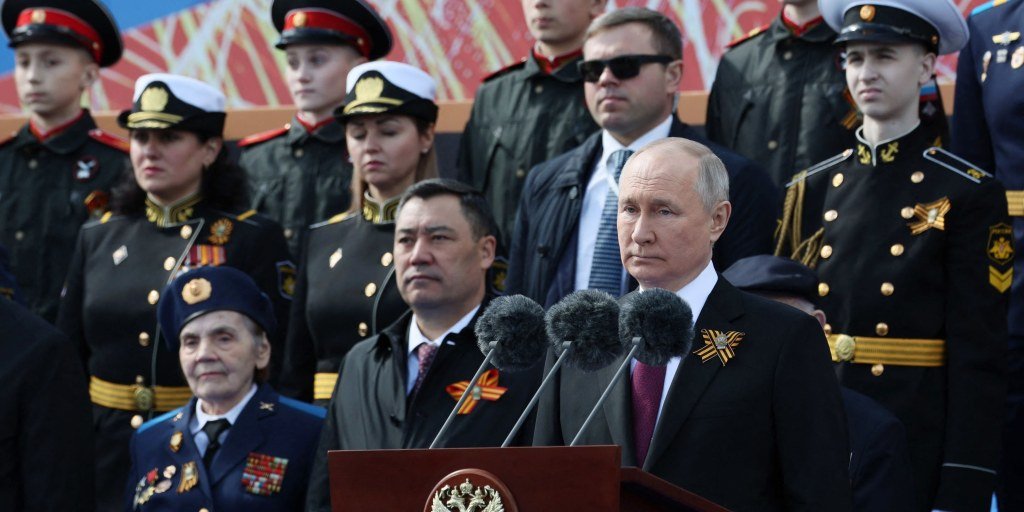
Russian President Vladimir Putin used Russia’s annual Victory Day ceremony in Moscow’s Red Square to deliver one of his strongest public defenses yet of the country’s military campaign in Ukraine, portraying the conflict as part of a broader struggle against Western pressure and Nato expansion.
Addressing thousands gathered in the heart of the Russian capital, Putin told military personnel, veterans and invited foreign dignitaries that Russia was engaged in what he described as a “just” and necessary fight to protect its sovereignty and national security. He accused Ukraine of becoming what he called an aggressive force supported militarily, financially and politically by the entire Nato alliance.
The annual Victory Day celebrations, among Russia’s most symbolic national events, commemorate the Soviet Union’s victory over Nazi Germany during World War II. For decades, the occasion has been used not only to honor veterans but also to project Russian military strength and national unity. This year’s ceremony, however, unfolded under unusually tight security and amid continuing international tensions linked to the war in Ukraine.
Despite the traditional atmosphere of patriotism and military pride, this year’s parade reflected the realities of the ongoing conflict. For the first time in recent years, no major armored vehicles or ballistic missile systems rolled through Red Square during the televised parade. Military analysts and political observers viewed the absence as a significant shift from previous celebrations, where displays of tanks, missile launchers and heavy weaponry were central features of Russia’s public military image.
Immediately after Putin concluded his speech, ceremonial cannons fired repeated salutes across Red Square while military brass bands performed patriotic music before assembled troops. Russian state television later broadcast scenes from front-line positions involving Russian soldiers, reinforcing the Kremlin’s narrative that the military operation remains at the center of the country’s strategic priorities.
Putin’s speech also carried strong historical symbolism. He repeatedly linked modern Russia’s actions to the sacrifices made by Soviet forces during World War II, arguing that the country once again faces external threats requiring unity and determination. Russian officials have increasingly framed the Ukraine conflict through the lens of historical memory and national defense, themes that were clearly emphasized throughout the ceremony.
The event drew a smaller group of international leaders compared to previous years, reflecting the continuing geopolitical divisions surrounding Russia. Among the foreign guests attending were Belarusian President , Malaysian King , and Uzbek President . Slovak Prime Minister was also present, becoming the only leader from the European Union to attend this year’s parade.
Ahead of the ceremony, Fico was photographed meeting Putin at the Kremlin, a move likely to attract attention across Europe as divisions remain over how Western governments should engage with Moscow. Last year’s Victory Day event featured a much larger international presence, including Chinese President and Brazilian President , highlighting how diplomatic alignments continue to shift as the conflict continues.
Also Read: International Justice Debate Intensifies Across Global Institutions
The ceremony also took place shortly after Russia and Ukraine agreed to observe a temporary three-day ceasefire announced by US President . The pause in fighting was viewed internationally as a rare opportunity to reduce tensions, even temporarily, during one of Russia’s most sensitive national holidays.
However, only hours after the parade ended, Russia’s Defence Ministry accused Ukrainian forces of violating the ceasefire agreement. Russian officials did not immediately provide evidence or operational details supporting the accusations, while Ukrainian authorities had not publicly responded at the time of reporting.
Beyond the military symbolism, the Victory Day ceremony highlighted the broader political reality facing Russia as the war continues to reshape international relations, European security debates and global diplomatic alliances. While Moscow insists it is defending its strategic interests against growing Western influence, Ukraine and its allies continue to argue that Russian military actions threaten regional stability and international law.
While, celebrations concluded in Red Square, the message from the Kremlin remained clear: Russia intends to present itself not as isolated, but as resilient, determined and prepared for a prolonged geopolitical confrontation with the West.