MWE Correspondent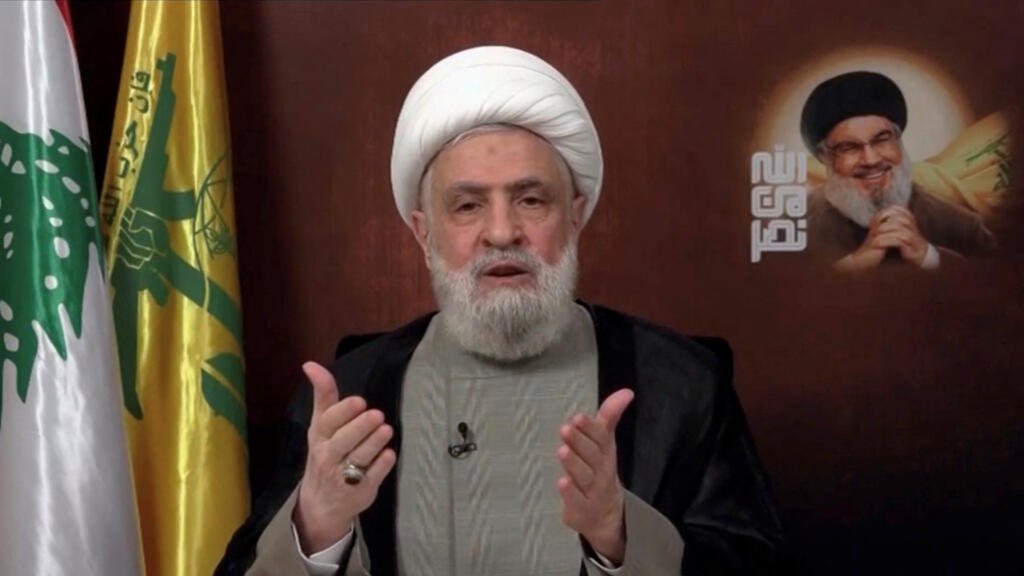
Hezbollah Secretary-General Naim Qassem has claimed that Israel and the United States failed to achieve their military objectives against Iran, arguing that Washington’s willingness to support a ceasefire reflects what he described as the collapse of their wartime strategy.
Speaking during a televised address, Qassem said the recent ceasefire negotiations were not the result of diplomatic goodwill but rather an acknowledgment by the United States and Israel that continued military operations had failed to produce the outcomes they had sought.
“The United States accepted a ceasefire because it realized that neither it nor Israel had achieved its objectives,” Qassem said, portraying Iran’s response to the conflict as a strategic success for what he called the “Axis of Resistance.”
His remarks come amid heightened regional tensions following weeks of military exchanges involving Iran, Israel and the United States, a confrontation that raised fears of a wider Middle East conflict before international mediation efforts helped secure a fragile truce.
Qassem also renewed Hezbollah’s demand for a complete Israeli military withdrawal from southern Lebanon, insisting that Israel has “no alternative” but to leave all Lebanese territory it continues to occupy.
The Hezbollah leader argued that any lasting regional stability depends on Israel fully implementing its obligations under international agreements and ending what he described as continued violations of Lebanese sovereignty.
Israel has repeatedly maintained that its military operations along the Lebanese border are necessary to counter security threats posed by Hezbollah, while accusing the Iran-backed group of escalating tensions through cross-border attacks and military activities.
The competing narratives underscore the deep divisions that continue to shape the regional security landscape despite recent diplomatic efforts to reduce hostilities.
Also Read, Tanzania Moves To End Annual Elections
Political analysts note that Qassem’s speech was aimed not only at domestic supporters but also at reinforcing Hezbollah’s image as a central member of Iran’s regional alliance at a time when the balance of power in the Middle East remains under intense international scrutiny.
His comments are also likely to complicate ongoing diplomatic efforts involving the United States, regional governments and international mediators seeking to preserve the ceasefire and prevent another escalation.
While both Washington and Israel have defended their military operations as necessary to protect national security and deter Iranian influence, Hezbollah continues to frame the outcome as evidence that military pressure cannot achieve lasting political objectives.
As negotiations over regional security continue, Qassem’s remarks highlight the competing interpretations of the recent conflict—one side presenting the ceasefire as a strategic necessity, the other portraying it as proof of military failure.
The conflicting claims illustrate that although the guns may have temporarily fallen silent, the political battle over the narrative of the war is far from over.