MWE Correspondent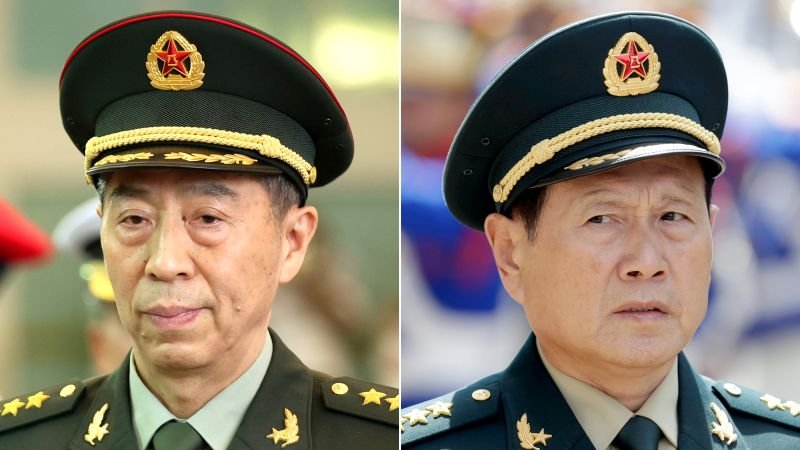
China has sentenced two former defence ministers to death with a two-year reprieve in one of the most dramatic escalations yet of President Xi Jinping’s sweeping anti-corruption campaign, as the country’s military leadership faces an unprecedented political and institutional purge.
State news agency Xinhua reported on Thursday that former defence ministers Wei Fenghe and Li Shangfu were convicted on corruption charges involving massive bribery schemes and abuse of power inside the military establishment.
The sentences mark one of the harshest punishments handed down to senior military officials in modern Chinese political history and signal the intensifying pressure within the upper ranks of the People’s Liberation Army (PLA), particularly at a time when Beijing is rapidly expanding and modernising its military capabilities.
Under Chinese law, a death sentence with a two-year reprieve is typically commuted to life imprisonment if the individual does not commit further offences during the suspension period. However, state media said both men would remain imprisoned for life without the possibility of parole or future sentence reduction after commutation.
The convictions are the latest chapter in a far-reaching anti-corruption drive launched by Xi Jinping shortly after he came to power in 2012. While the campaign has been publicly framed as an effort to restore discipline and loyalty within the ruling system, analysts say it has also become one of the defining mechanisms through which Xi has consolidated control over the Chinese state and military apparatus.
China’s armed forces have emerged as one of the central targets of the campaign, with investigations reaching some of the country’s most sensitive military institutions, including the elite Rocket Force, which oversees China’s nuclear arsenal and advanced missile systems.
The crackdown intensified sharply in 2023 when multiple senior Rocket Force commanders disappeared from public view before being removed or investigated. Earlier this year, the purge escalated further with the reported removal of top PLA general Zhang Youxia, a Politburo member long viewed as a close ally of Xi Jinping.
The fall of such senior figures has fueled speculation about deep internal fractures within China’s military hierarchy at a time of rising geopolitical tensions involving the United States, Taiwan, and the South China Sea.
Also Read; US Intercepts Iranian Oil Tanker Amid Rising Tensions
According to previous reports by Xinhua, Li Shangfu was accused of accepting “huge sums of money” in bribes and manipulating personnel appointments for personal and political gain. Investigators also alleged that he failed to uphold political responsibilities expected of senior Communist Party officials.
Wei Fenghe, who came under investigation in 2023, was similarly accused of accepting large amounts of money and valuables in exchange for improper influence in military personnel arrangements. Chinese authorities described the offences as “extremely serious in nature” and damaging to the integrity of the armed forces.
Security experts say the widening purge is likely having a profound impact on the operational structure of the PLA. The International Institute for Strategic Studies warned earlier this year that the anti-corruption campaign is creating significant disruptions within China’s military command system and may be undermining combat readiness during a critical period of military expansion.
The campaign comes as China seeks to project itself as a global military power capable of competing with the United States in both conventional and technological warfare. Beijing has invested heavily in advanced missile systems, naval expansion, cyber capabilities, and artificial intelligence-driven defence infrastructure.
However, the repeated removal of top commanders has raised concerns among analysts over internal mistrust, weakened leadership continuity, and growing instability within the upper echelons of the military.
Political observers say the latest sentences send a powerful message that no figure within the Chinese system — regardless of rank or past influence — is beyond the reach of Xi Jinping’s anti-corruption drive.
At the same time, critics argue that the campaign has blurred the line between anti-graft enforcement and political consolidation, with loyalty to Xi increasingly viewed as central to survival within the ruling establishment..