Joseph Isangura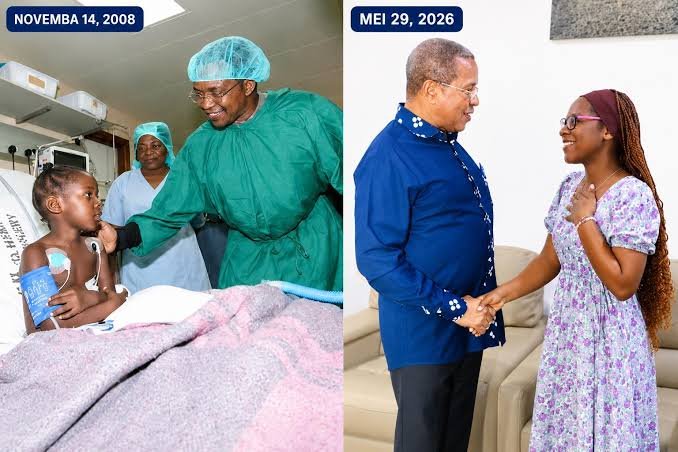
Eighteen years after surviving one of Tanzania’s earliest pediatric heart surgeries, a young woman who once lay in a hospital bed fighting for her life has returned to meet the president who helped transform the country’s cardiac healthcare system — this time as a future doctor.
In a deeply symbolic reunion blending medicine, leadership, and survival, former Tanzanian President Jakaya Kikwete recently welcomed Catherine Conrad, now a medical student at Kairuki University, to his office nearly two decades after first meeting her as a four-year-old patient recovering from heart surgery at Muhimbili Orthopaedic Institute (MOI).
The emotional meeting, held on May 29, 2026, has resonated widely across Tanzania as a rare human story illustrating the long-term impact of public investment in specialized healthcare and the transformative power of medical access in developing nations.
When Kikwete first met Catherine on November 14, 2008, she had just undergone a life-saving cardiac operation as one of the earliest children treated through Tanzania’s expanding local heart surgery programme — a breakthrough that marked a turning point in the country’s healthcare history.
At the time, access to advanced heart treatment inside Tanzania remained extremely limited, forcing many families to seek expensive treatment abroad or face devastating outcomes due to lack of specialized care. The development of local cardiac services during Kikwete’s administration was widely viewed as part of broader efforts to modernize Tanzania’s healthcare infrastructure and reduce dependence on foreign medical referrals.
Nearly two decades later, Catherine returned not as a patient, but as a young woman pursuing a medical degree — fulfilling a promise she reportedly made to Kikwete as a child that she would one day become a doctor herself.
According to those familiar with the meeting, the former president expressed pride and emotion after seeing Catherine healthy, academically successful, and preparing to enter the same profession that once saved her life.
For many observers, the reunion represented more than a personal milestone. It became a powerful reflection of how long-term healthcare investment can reshape individual destinies and inspire future generations within societies where access to specialized medicine has historically remained unequal.
Health experts say stories like Catherine’s demonstrate the broader social impact of localized medical infrastructure, particularly in African countries where healthcare systems continue to face pressure from population growth, limited resources, and shortages of specialized personnel.
Also Read: Samia Revives Historic Tanzania–Russia Diplomatic Legacy
The Jakaya Kikwete Cardiac Institute, which later emerged as one of East Africa’s leading heart treatment centres, has since handled thousands of patients and advanced cardiovascular procedures, significantly expanding treatment opportunities for children and adults who previously had limited access to life-saving care.
Beyond politics and policy, the reunion has captured public attention because of its deeply human dimension — a child once given a second chance at life returning years later as a symbol of resilience, gratitude, and national progress.
Analysts note that in an era often dominated by political conflict and economic uncertainty, stories centered on survival, education, and healthcare transformation continue to resonate globally because they reflect universal themes of hope and human potential.