MWE Correspondent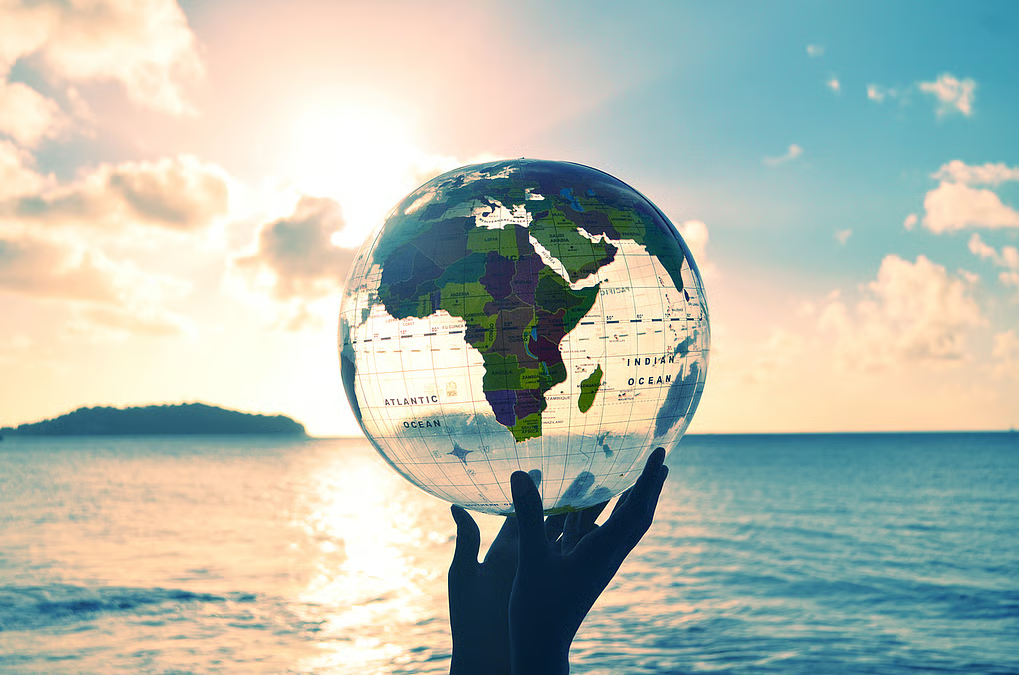
In the global debate about the future balance of power, discussions often focus on major nations, military alliances and economic giants.
Yet one of the most important geopolitical transformations of the twenty-first century may not involve a single country at all. Instead, it may involve an entire continent whose influence is growing across economics, technology, diplomacy and strategic resources.
Africa is entering a period that could redefine its place in world affairs.
For decades, international discussions about Africa often centered on aid, conflict or development challenges. Today, however, global powers are increasingly viewing the continent through a different lens. Africa is becoming a strategic partner, an investment destination, a technological frontier and a critical source of resources required for future industries.
This shift is occurring at a moment when the international system itself is changing.
Economic influence is becoming more distributed. Emerging economies are expanding their reach. New trade corridors are developing. Technological innovation is reshaping traditional industries. As these changes unfold, Africa’s significance within global affairs continues to grow.
One of the most important drivers of this transformation is demographics.
By the middle of this century, Africa is expected to account for a substantial share of global population growth. Its cities are expanding rapidly, consumer markets are growing and a new generation of entrepreneurs is entering the workforce.
For many analysts, Africa’s young population represents one of the most important strategic assets in the world economy.
However, demographic growth alone does not guarantee prosperity.
The key challenge is converting population growth into economic strength through education, industrialization and innovation. This is where Economic Sovereignty becomes increasingly important.
Governments across the continent are seeking ways to create jobs, strengthen local industries and reduce excessive dependence on imported goods and services. The objective is not isolation but participation in global markets from a position of greater strength.
Also Read. The Battle Beneath Africa’s Soil
Technology is emerging as a powerful tool in this effort.
Across Africa, digital platforms are transforming commerce, financial services and communication. Start-ups are attracting international investment. Local innovators are developing solutions tailored to African realities.
The digital economy is creating opportunities that previous generations could scarcely imagine.
At the same time, the continent’s vast natural resources continue to attract global attention.
Critical minerals essential for electric vehicles, renewable energy systems and advanced manufacturing are found across several African countries. These resources have elevated discussions about Resource Sovereignty as governments seek to ensure that mineral wealth supports long-term industrial development rather than short-term extraction.
The challenge is no longer simply owning resources.
The challenge is controlling the industries, technologies and supply chains built around those resources.
This transformation is also reshaping Global Diplomacy.
Major powers increasingly recognize that Africa’s decisions matter. Whether the issue involves energy security, trade routes, technology cooperation or international governance, African nations are playing a more visible role in global discussions.
China continues expanding economic engagement across the continent. Russia has strengthened cooperation in areas including energy, trade and strategic partnerships. Western nations are increasing investments and diplomatic outreach. Regional powers from the Middle East, Asia and Latin America are also pursuing stronger relationships.
The growing competition reflects Africa’s rising strategic importance.
Yet the continent’s future influence will depend less on external interest and more on internal choices.
Strong institutions, regional integration, infrastructure investment and educational development will determine whether Africa fully capitalizes on its opportunities.
The African Continental Free Trade Area represents one example of how regional cooperation could strengthen economic resilience and expand intra-African commerce.
If successful, such initiatives could help create one of the world’s largest integrated markets.
History shows that global influence is rarely permanent.
Economic power shifts. Technologies evolve. New regions emerge as centers of growth and innovation.
Today, Africa stands at the beginning of one of those historic moments.
The continent possesses the resources, population, entrepreneurial energy and strategic relevance required to shape the future international system.
The question is no longer whether Africa matters.
The question is how much influence Africa will choose to wield in the decades ahead.
The answer could redefine global power for generations.