
 MWE Correspondent
African leaders are calling for greater freedom to determine their international partnerships and economic policies, arguing that national sovereignty, equal treatment and access to global decision-making must be central to relations between countries, as competition among major powers reshapes the international order.
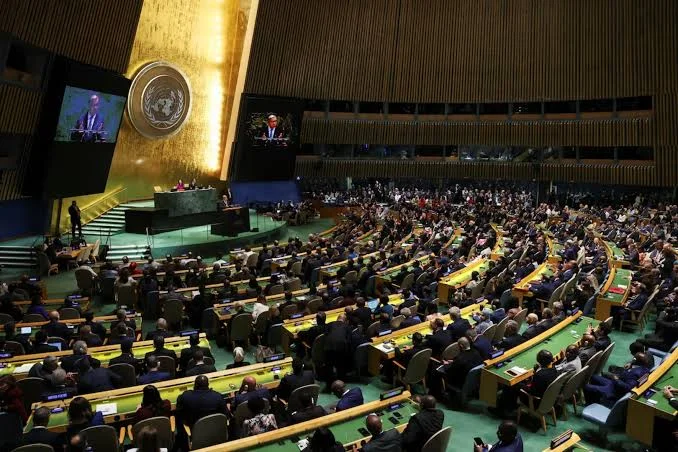
The issue featured prominently at the 81st United Nations General Assembly in New York in September and the Third Russia-Africa Summit in Moscow on October 28–29, where Tanzania, Kenya and the African Union highlighted concerns over unilateral sanctions, economic dependence and Africa’s limited influence in global institutions.
Tanzania’s Vice-President Deogratius Ndejembi, representing President Samia Suluhu Hassan at the UN General Assembly on September 22, delivered one of the strongest statements on the issue, criticising countries that impose unilateral sanctions on other states.
“Tanzania stands against the proliferating trend of some states to assume the responsibility of policing and imposing unilateral sanctions on others, thus undermining the principles of sovereignty and peaceful coexistence,” Ndejembi told the assembly.
He called for the lifting of restrictions affecting Cuba, Zimbabwe and other countries, arguing that such measures create economic hardship, constrain development and undermine human rights.
Ndejembi also questioned inequalities in the international financial system, pointing to high borrowing costs, rising debt burdens and limited access to affordable long-term financing as obstacles facing developing countries.
He called for greater access to concessional financing, private investment and climate funding, alongside stronger participation by developing economies in international financial decision-making.
The Tanzanian position reflects the country’s revised Foreign Policy, launched in May 2025, which identifies economic diplomacy, national sovereignty, non-alignment and South-South cooperation as important principles guiding its international engagement.
The policy also seeks to strengthen Tanzania’s ability to mobilise international resources, attract investment and expand economic cooperation while protecting national interests.
The country’s Development Vision 2050 similarly identifies strategic regional and global engagement as part of its ambition to build a strong, inclusive and competitive economy. It emphasises the importance of partnerships that support technology transfer, investment, trade and the development of domestic productive capacity.
The debate gained further momentum in Moscow, where Kenyan President William Ruto called for international relations based on sovereign equality rather than competing spheres of influence.
“The principles of sovereign equality, territorial integrity and peaceful settlement of disputes must apply consistently to every nation,” Ruto said during the summit.
Also Read: Tanzania-EU Funding Dispute: Who Pays the Economic Price?
He urged Russia and African countries to develop partnerships based on productive investment, technological cooperation and shared prosperity.
Ruto also challenged the continent’s position in global production chains, arguing that African countries must move beyond exporting raw materials and importing manufactured goods.
“Africa cannot continue to be a supplier of raw materials and a consumer of finished products. We now must become a continent that manufactures, innovates, adds value and competes in the global economy,” he said.
His remarks placed industrialisation and local value addition at the centre of the sovereignty debate, suggesting that political independence alone cannot guarantee economic autonomy when countries remain dependent on external markets, technology and manufactured products.
President William Ruto delivers Kenya’s statement at the Third Russia-Africa Economic and Humanitarian Forum, held at the Kremlin Palace, Moscow, Russia, 29th October 2026
#RutoInRussia
Kenya Russia Partnership
Rutos Global Impact https://t.co/zBetEXUutB— Side Quest™ (@sidequest254) November 2, 2026
African Union Commission Chairperson Mahmoud Ali Youssouf reinforced the position, saying the organisation remained committed to respecting the sovereign choices of its member states in pursuing their development priorities.
Addressing the Moscow summit on October 29, Youssouf also called for greater African representation in the United Nations Security Council and stronger cooperation in technology transfer, innovation and industrial development.
The summit adopted a joint declaration covering political, economic, security and humanitarian cooperation. Among its priorities were reforms to international institutions, opposition to unilateral coercive measures, increased African representation in global governance and expanded investment in local processing of natural resources.
The declaration also called for stronger cooperation between Russia and African countries in energy, agriculture, transport, digital technologies and mineral processing.
The positions expressed in Moscow are consistent with the African Union’s longstanding Common African Position on United Nations Security Council reform, known as the Ezulwini Consensus. The position calls for Africa to receive at least two permanent seats and five non-permanent seats in an expanded Security Council.
However, the growing diplomatic engagement also raises questions about whether alternative partnerships can deliver the economic transformation African governments are seeking.
Russia has presented itself as a partner willing to share technology, support local production and expand investment in African infrastructure. President Vladimir Putin told the summit that Africa was increasingly becoming an important player in global politics and the economy, while accusing Western countries of seeking to maintain influence over the continent’s resources.
Reuters reported that the Moscow meeting brought together delegations from 48 African countries, including 22 African leaders, as Russia sought to strengthen its political, economic and military influence on the continent amid Western pressure over the war in Ukraine.
But analysts have cautioned against measuring the success of international partnerships through diplomatic meetings and declarations alone.
Tighisti Amare, director of the Africa Programme at Chatham House, argued in an analysis published ahead of the summit that attendance by African leaders was a poor measure of lasting cooperation.
She noted that Russia’s economic engagement with Africa remained limited compared with its expanding security presence, while the outcomes of its involvement in parts of the Sahel had been uneven.
The assessment highlights a wider challenge for African governments: ensuring that partnerships with Russia, China, Europe, the United States and other powers produce measurable economic benefits rather than simply changing the continent’s geopolitical alignments.
For Tanzania, the issue is also connected to its ambition to strengthen its role in international decision-making. Ndejembi announced the country’s candidacy for a non-permanent seat on the UN Security Council for the 2029–2030 term, with priorities including preventive diplomacy, peaceful conflict resolution and stronger participation by women and young people in peace and security.
The debate over sanctions also requires distinguishing between unilateral restrictions imposed by individual countries and measures authorised by the UN Security Council. Article 41 of the UN Charter allows the Security Council to impose non-military measures, including economic restrictions, as part of its responsibility for maintaining international peace and security.
Ultimately, the statements from New York and Moscow point to an increasingly important African diplomatic objective: securing the freedom to choose international partners while building the economic strength needed to negotiate with them on more equal terms.
The challenge will be translating that ambition into stronger industries, technology transfer, regional trade, financial capacity and greater influence in global institutions. Without these practical gains, calls for greater sovereignty risk remaining diplomatic declarations rather than a foundation for lasting economic independence.


