MWE Correspondent
The debate over development financing, national sovereignty and political conditionality has intensified in Tanzania following disagreements with the European Union over a €156 million development cooperation programme, raising questions about how political differences between international partners can affect economic development and ordinary citizens.
The disagreement emerged after the European Parliament adopted a resolution on June 18, 2026, calling on the European Commission to withdraw and revise its proposed financing programme for Tanzania, citing concerns about democracy, human rights and governance following the October 2025 general election.
However, the European Commission subsequently approved the €156 million allocation on July 24, 2026, under its 2026 Annual Action Plan, although the financing arrangements placed greater emphasis on implementation through non-government and private-sector channels.
Speaking to Tanzania’s Daily News, Marc Stalmans, the European Union’s Head of Cooperation in Tanzania and the East African Community, confirmed that the full allocation had been approved.
“The money is available for Tanzania since the 23rd of July this year,” Stalmans said.
He further explained that the European Commission had considered different options before deciding to maintain the full financial allocation.
“At the end of the day, the European Commission decided to go for the full budget available, for the same kind of action that were foreseen, for the same numbers,” he said.
The financing package authorises €129 million for mineral and agricultural value chains, €20 million for digital economy and connectivity initiatives, and €7 million for a cooperation facility.
Nevertheless, approval does not mean that the entire amount has already been transferred or that it will be provided directly to the Tanzanian government.
View this post on Instagram
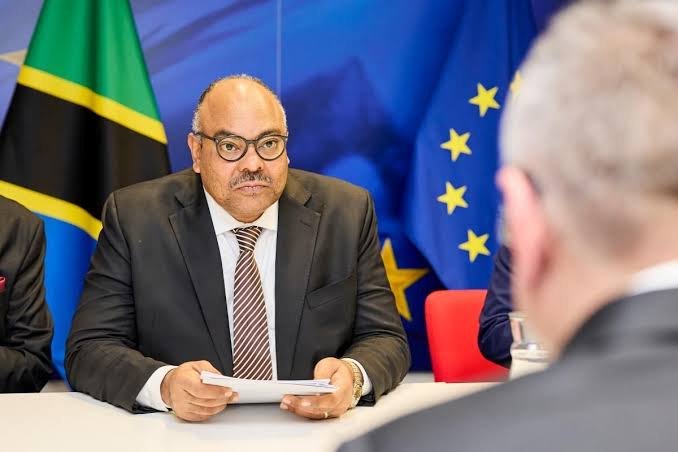
The Tanzanian government had earlier responded to the European Parliament’s position through the Ministry of Foreign Affairs and East African Cooperation, under Minister Mahmoud Thabit Kombo.
In a statement issued on June 19, 2026, the ministry clarified that the European Parliament’s resolution was not the final decision of the European Union.
“The vote taken in the European Parliament is not the final decision of the European Union regarding the 2026 Partnership Programme with Tanzania,” the ministry stated.
The government also explained that only €17 million of the proposed €156 million had initially been planned for implementation through official government systems, while the remaining €139 million was intended to be implemented through EU institutions, member-state agencies and civil society organisations.
Also Read: Prosecution Seeks Stiff Sentence for Tundu Lissu in Incitement Case
The ministry further maintained that Tanzania’s relations with the European Union remained strong, friendly and strategic despite the differences.
The economic implications of the financing arrangements are particularly important for Tanzania’s agricultural and mining sectors, which require investment in processing facilities, technology, infrastructure and skills development.
The shift towards private-sector implementation also raises questions about how Tanzanian businesses, particularly small and medium-sized enterprises, will access the opportunities created by the programme.
On August 26, 2026, Minister of State in the President’s Office for Planning and Investment, Professor Kitila Mkumbo, participated in discussions involving the EU delegation, European business associations and Tanzanian government institutions aimed at strengthening trade and investment cooperation.
According to the President’s Office for Planning and Investment, Professor Mkumbo emphasised the government’s commitment to creating a competitive investment environment capable of attracting productive investment and supporting the country’s Development Vision 2050.
His remarks highlighted the importance of maintaining economic cooperation even when political differences arise between Tanzania and its international development partners.
The European Union, meanwhile, maintains that its development cooperation must support human rights, democracy, good governance and sustainable economic growth.
Its Global Gateway strategy also seeks to expand investment in infrastructure, digital connectivity, energy, agriculture and critical raw materials, creating economic opportunities for both European and African businesses.
For Tanzania, the challenge is to ensure that international financing translates into measurable benefits for local industries, employment creation, technology transfer and improved livelihoods.
The debate also highlights the importance of diversifying development financing. African countries seeking industrialisation and economic transformation need stronger domestic revenue systems, regional financial institutions, private investment and partnerships with multiple international development partners.
Ultimately, the Tanzania-EU funding dispute demonstrates that development cooperation involves more than financial commitments. It also involves negotiations over priorities, implementation arrangements, accountability and the relationship between national sovereignty and international obligations.
The central question remains whether development financing can continue delivering meaningful economic benefits to ordinary citizens even when governments and their international partners disagree over political and governance issues.