 Lyn Frans
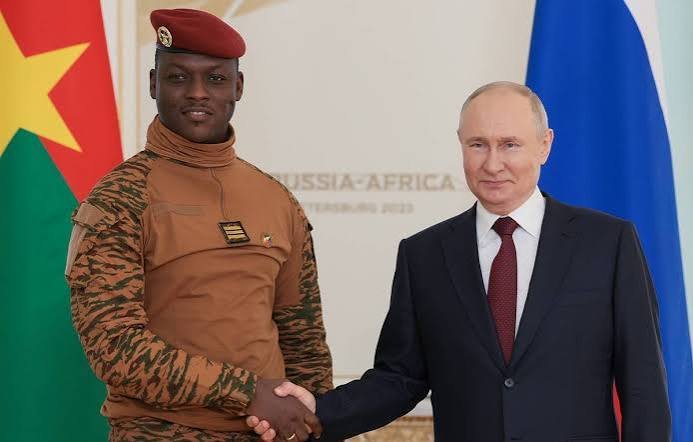
Burkina Faso’s President Ibrahim Traore has called for stronger practical outcomes from cooperation between Russia and African countries, urging both sides to prioritise technology transfer, industrial development and youth training rather than allowing strategic agreements to remain diplomatic commitments.
In a message delivered by Prime Minister Rimtalba Jean Emmanuel Ouédraogo at the third Russia-Africa Summit in Moscow on October 30, 2026, Traore argued that the partnership should produce measurable benefits for African populations, particularly through access to advanced technologies, professional skills and opportunities to develop domestic industries.
The Burkinabe leader said the summit should focus on implementing existing commitments and building cooperation based on mutual respect, reciprocity and the transfer of knowledge.
His message reflects a broader debate about Africa’s position in international economic relations, particularly the need to move beyond exporting raw materials towards developing manufacturing capacity, technical expertise and locally owned industries.
Traore called for more opportunities for African students and professionals to receive training in Russia in advanced technologies and strategic sectors. Such cooperation, if supported by effective programmes and investment, could help African countries strengthen their technical workforce and reduce dependence on imported expertise.
The emphasis on technology transfer is particularly significant for countries seeking to expand electricity generation, agricultural processing, mining, engineering and digital infrastructure. Access to technology alone, however, is insufficient without local research institutions, skilled workers, financing and policies that support domestic production.
Traore also defended Africa’s right to diversify its international partnerships and independently choose countries with which to cooperate. He argued that the continent should not be reduced to a battlefield for geopolitical competition, a source of raw materials or a bloc of votes in international institutions, but should be recognised as an equal participant in global affairs.
The message comes as Russia seeks to expand its economic, diplomatic and technological engagement across Africa, while African governments increasingly explore alternative sources of investment, infrastructure financing and technical cooperation.
Burkina Faso’s own relationship with Russia provides examples of this expanding engagement. In June 2025, the two countries signed an intergovernmental agreement on peaceful nuclear energy cooperation, establishing a framework for developing a proposed nuclear power plant. The agreement was approved by Burkina Faso’s Transitional Legislative Assembly in November 2025. However, the project still requires technical and financial arrangements, feasibility assessments and further implementation steps before construction can proceed.
Read More: Europe’s Political Standards Face Questions Over Consistency
Education is another area of cooperation. On January 12, 2026, Burkina Faso and Russia signed a five-year agreement covering higher education and scientific research. It provides for academic exchanges, student and researcher mobility, joint scientific activities and opportunities for professional training.
The economic dimension also gained momentum during the October 2026 summit. On October 28, the Confederation of Sahel States’ Investment and Development Bank, BCID-AES, signed a memorandum of understanding with Russia’s state development corporation VEB.RF to promote trade, investment and the financing of major development projects.
Burkina Faso’s Prime Minister emphasised that projects under the agreement should be assessed according to their contribution to local value addition, employment creation and skills transfer. The two institutions also discussed identifying priority projects and working towards the signing of an initial project within 12 months.
These developments demonstrate the potential for Russia-Africa cooperation to expand beyond traditional diplomatic and security relations into education, energy, finance and industrial development.
However, the effectiveness of the partnership will ultimately depend on implementation. African countries need transparent financing arrangements, commercially viable projects, environmental safeguards and clear provisions ensuring that local businesses and workers benefit from investments.
For Burkina Faso and other African countries, the challenge is to ensure that cooperation with Russia, Europe, China, India and other international partners contributes to domestic productive capacity rather than simply replacing one form of external dependence with another.
The African Union has similarly emphasised technology transfer, innovation, capacity-building and digital transformation as important areas for international cooperation. Addressing the third Russia-Africa Summit on October 29, African Union Commission Chairperson Mahmoud Ali Youssouf called for stronger collaboration to bridge Africa’s technological divide and improve the continent’s global position.
The summit, therefore, presents an opportunity to connect diplomatic commitments with Africa’s longer-term development ambitions, including industrialisation, energy security, scientific research and employment for its growing young population.
For Traore, the central message is that Africa must be treated as a partner capable of determining its own development priorities, managing its resources and negotiating agreements that serve its citizens.
The success of Russia-Africa relations will not ultimately be determined by the number of summits held or agreements signed, but by factories established, technologies transferred, African professionals trained, jobs created and sustainable economic opportunities delivered.