 Lyn Frans
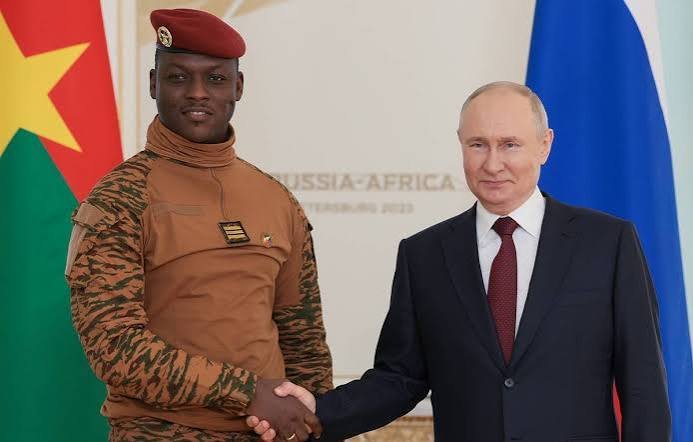
Burkina Faso’s President Ibrahim Traoré has challenged Russia and African governments to move beyond diplomatic commitments and demonstrate measurable results through technology transfer, industrial development and investment in human capital, highlighting a growing African demand for partnerships that strengthen domestic productive capacity.
The message, delivered by Prime Minister Rimtalba Jean Emmanuel Ouédraogo during the Third Russia-Africa Summit in Moscow on October 29, 2026, placed implementation at the centre of future relations between the two sides.
“This third summit must be about implementing this strategic partnership,” Traoré said in a message published by Burkina Faso’s government on October 30. He called for cooperation founded on mutual respect, reciprocity and the effective transfer of knowledge and technical expertise.
𝐒𝐨𝐦𝐦𝐞𝐭 𝐑𝐮𝐬𝐬𝐢𝐞–𝐀𝐟𝐫𝐢𝐪𝐮𝐞 : 𝐥𝐞 𝐦𝐞𝐬𝐬𝐚𝐠𝐞 𝐝𝐮 𝐏𝐫𝐞́𝐬𝐢𝐝𝐞𝐧𝐭 𝐈𝐛𝐫𝐚𝐡𝐢𝐦 𝐓𝐫𝐚𝐨𝐫𝐞́
Le Camarade Premier ministre, Chef du Gouvernement, Rimtalba Jean Emmanuel Ouédraogo, a livré, le jeudi 29 octobre 2026 à Moscou, le message du Président du Faso, le Camarade Capitaine Ibrahim Traoré, lors du panel de haut niveau organisé au deuxième jour du troisième Sommet Russie–Afrique.
Dans la vidéo ci-dessous, découvrez l’intégralité de ce message.
— SIG Burkina Faso (@sigbf) November 1, 2026
The distinction between diplomatic agreements and practical economic outcomes is increasingly important for African countries seeking to transform their natural resources into industrial wealth. For decades, much of the continent’s mineral and agricultural production has entered international markets with limited processing taking place locally, restricting opportunities for manufacturing, technology development and skilled employment.
Traoré argued that African countries should have greater opportunities to train young professionals in Russia, particularly in advanced technologies and strategic industries. The objective, according to his message, is to equip African students and specialists with skills they can apply when they return to contribute to their national economies.
Burkina Faso and Russia have already established an institutional framework for cooperation in education and scientific research. On January 12, 2026, the two governments signed a five-year agreement covering academic exchanges, student and researcher mobility, joint scientific activities and professional training.
Also Read:Russia-Africa Summit Targets Energy, Food and Technology
The agreement provides a foundation for cooperation, although its long-term development impact will depend on the number of students trained, the quality of research partnerships and the ability of participating institutions to translate acquired knowledge into practical industrial applications.
Energy cooperation provides another example. Burkina Faso and Russia signed an intergovernmental agreement on June 19, 2025, establishing a framework for the proposed construction of a civilian nuclear power plant. Burkina Faso’s transitional legislature approved the agreement in November 2025.
However, the agreement should not be confused with an operational power project. Burkina Faso’s energy ministry said technical and financial proposals from Russia’s state nuclear corporation Rosatom would be examined before further negotiations on construction arrangements could proceed. Feasibility, financing, infrastructure and specialist training remain important considerations.
The economic dimension of the relationship also advanced during the October summit. On October 28, the Confederation of Sahel States Investment and Development Bank, BCID-AES, signed a memorandum of understanding with Russia’s state development corporation VEB.RF.
The agreement establishes a framework for promoting trade, investment and the financing of major development projects across Burkina Faso, Mali and Niger.
Burkina Faso’s Prime Minister said projects should be evaluated according to their contribution to local value addition, employment creation and skills transfer. He also proposed that the institutions identify priority projects and work towards signing an initial project within 12 months.
This provides a practical benchmark against which the partnership can eventually be assessed. A memorandum of understanding creates opportunities for cooperation, but does not itself guarantee financing, construction or employment.
The wider continental agenda also reflects Traoré’s emphasis on economic transformation. Addressing the summit on October 29, African Union Commission Chairperson Mahmoud Ali Youssouf called for stronger local processing of agricultural and mineral resources, greater industrialisation and improved access to technology.
He also emphasised the need to bridge Africa’s digital divide through technology transfer, innovation, capacity-building and cooperation with Russia and other international partners.
The Chairperson of the African Union (AU) Commission, H.E. Mahmoud Ali Youssouf this afternoon addressed the plenary session of the Third Russia–Africa Summit in Moscow. The session was co-chaired by H.E. Vladimir Putin, President of the Russian Federation, & H.E. Évariste Ndayishimiye, President of the Republic of Burundi and Chairperson of the African Union.
In his remarks, the Chairperson @ymahmoudali expressed appreciation for the warm & cordial welcome extended to all delegations. He underscored that the participation of African Heads of State & Government in the Summit reflects the importance they attach to strengthening cooperation & advancing mutually beneficial relations with the Russian Federation.
He reaffirmed the AU’s commitment to respecting the sovereign choices of its Member States in pursuing their development priorities, while advancing the vision of an integrated, prosperous & peaceful Africa. He emphasised that these efforts remain guided by Agenda 2063, the continent’s strategic framework for inclusive & sustainable development & the realisation of the aspirations of its people.
Highlighting Africa’s vast agricultural & mineral resources, the Chairperson stressed the importance of ensuring that these resources generate tangible benefits for the continent’s population. He underscored the need to promote local processing, value addition & industrialisation to enable African countries to capture greater value from their natural endowments.
He further emphasised the importance of equitable & favourable access to international capital markets to support Africa’s development ambitions. In this regard, he welcomed the establishment of the African Credit Rating Agency as an important step towards strengthening Africa’s financial sovereignty & addressing persistent challenges in credit ratings.
He also called for comprehensive reform of the international financial architecture to ensure that it is more equitable, inclusive & responsive to the development needs of African countries.
On global governance, the Chairperson reiterated the African Union’s longstanding position on the need for equitable & fair representation of Africa in the UN Security Council, in line with the Ezulwini Consensus & the Sirte Declaration.
He also called for renewed international attention to the historical injustices of colonialism, including efforts to address its legacy & advance recognition of colonialism as a crime against humanity.
Addressing the challenges posed by technological disparities, the Chairperson stressed the need to bridge the digital divide, expand access to technology & strengthen Africa’s digital capabilities. He underscored the importance of enhanced cooperation with the Russian Federation & other international partners in promoting technology transfer, innovation, capacity-building & digital transformation in support of Africa’s development priorities.
President Putin thanked the Chairperson for his remarks & expressed Russia’s appreciation for the partnership & cooperation with the AU Commission. He reaffirmed the strategic nature of #Russia–AU Commission relations & commended the Commission for its role in strengthening this partnership & advancing a shared spirit of cooperation.
Read @ https://t.co/gLHbwxI9Ej
— African Union (@_AfricanUnion) October 29, 2026
The summit adopted a Russia-Africa Partnership Forum Action Plan for 2027–2029, alongside a declaration on cooperation in the civilian application of artificial intelligence. The African Union Commission separately confirmed that its action plan with Russia covers 19 areas of cooperation.
These commitments provide an institutional framework for expanding cooperation, but their success will depend on financing, implementation schedules, accountability and the participation of African businesses and research institutions.
For Russia, deeper engagement with African countries offers opportunities to expand trade, investment, energy cooperation and diplomatic relations. For African governments, the central question is whether such engagement can deliver the technology, capital and industrial expertise required to accelerate economic transformation.
Traoré’s intervention therefore raises a broader issue extending beyond relations with Moscow: Africa’s international partnerships should be judged by their contribution to domestic production, technical independence and employment rather than the number of agreements signed.
Cooperation with Russia, China, Europe, India and other international partners can support development, but African countries will need to negotiate arrangements that build local capabilities and retain greater economic value within their own economies.
Ultimately, the test of the Russia-Africa partnership will be whether it produces operational industries, skilled African professionals, reliable energy infrastructure, stronger research institutions and sustainable jobs. Without those outcomes, strategic declarations risk remaining diplomatic achievements rather than instruments of economic transformation.