MWE Correspondent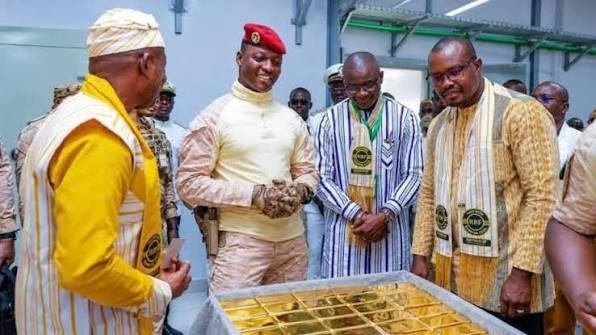
Burkina Faso has taken a major step toward processing more of its mineral wealth at home after President Ibrahim Traoré inaugurated the country’s first national gold refinery, as the West African producer seeks to capture more value from a resource that has historically been exported abroad for processing.
The National Gold Refinery, known as RAFFINOR-BF, was inaugurated in Ouagadougou on September 28, with the government describing the facility as a milestone in its drive for greater economic and mining sovereignty. The project cost more than 11 billion CFA francs, equivalent to about $19 million, and was financed primarily by the state through the National Precious Substances Company (SONASP), alongside national private-sector partners.
The refinery has an initial annual refining capacity of 164 tonnes of gold, with a planned second phase expected to increase capacity to 515 tonnes. The facility includes a foundry, laboratory, secure gold-storage area, jewellery section and administrative facilities, with the government saying it is designed to produce gold bars with purity of 99.99 percent.
Traoré said Burkina Faso no longer wanted to follow a model in which the country simply extracts minerals and sends raw materials abroad.
“Our ambition is no longer to be just a country that extracts and sends its raw materials abroad,” he said during the inauguration, according to the government. “We want to refine all our metals locally” and control the wider value chain.
The move is significant because Burkina Faso is one of Africa’s major gold producers. The country produced more than 94 tonnes of gold in 2025, according to figures cited by the Associated Press, yet much of the value associated with processing and refining has historically been generated outside the country.
The new refinery is intended to change that structure by allowing gold to be refined, tested, certified and stored domestically rather than sending doré gold abroad for further processing.
Also Read: Could Tanzania Miss the Manufacturing Opportunity?
The government says it wants the mining sector to become a driver of industrialisation, employment and domestic economic development. Officials have indicated that the same approach could eventually be applied to other minerals, including manganese, copper and zinc.
The development also reflects a wider shift across parts of Africa, particularly in mineral-rich countries that are seeking to capture more value from their natural resources instead of remaining exporters of largely unprocessed commodities.
Neighbouring Mali, for example, began construction in 2025 of a Russia-backed gold refinery with a planned capacity of 200 tonnes a year. Mali’s government has also moved toward requiring mining companies to process gold domestically under its revised mining framework. Reuters reported that the refinery is part of a broader effort to increase state control and retain more value from the country’s gold resources.
Burkina Faso has taken similar steps to increase state participation in mining. In 2025, the government said it planned to nationalise additional foreign-owned industrial mines and had already taken control of the Boungou and Wahgnion gold mines through the state-owned Société de Participation Minière du Burkina.
The refinery therefore represents one part of a broader attempt to change how mineral wealth contributes to the national economy.
However, building a refinery does not automatically guarantee that a country will capture all the economic benefits of its minerals.
The government must still ensure reliable gold supply to the refinery, maintain international standards, develop skilled technical workers, strengthen certification and traceability systems, and prevent illegal gold from entering the formal supply chain.
Burkina Faso also faces a difficult security environment, with armed extremist violence continuing to affect parts of the country. The mining sector has additionally faced challenges involving informal production, smuggling and state oversight. These factors could complicate efforts to bring the entire gold supply chain under formal domestic control.
Nevertheless, the opening of RAFFINOR-BF signals a broader African debate over who benefits most from the continent’s mineral wealth.
For decades, many African countries have exported crude or semi-processed minerals and then imported finished products made using those same resources. Governments are increasingly arguing that mining alone is not enough and that greater investment in refining, processing, manufacturing and local supply chains is necessary to retain more value within Africa.
With an initial capacity of 164 tonnes and a planned expansion to 515 tonnes, authorities say the facility could eventually process the country’s industrial and artisanal gold production and potentially serve as a regional refining centre.
The bigger test, however, will be whether the refinery becomes part of a broader industrial ecosystem rather than simply another facility at the end of the mining chain.
If Burkina Faso can connect domestic gold production to refining, certification, jewellery manufacturing, financial services, skilled employment and regional trade, the value retained inside the country could extend far beyond the refinery itself.
For other African mineral producers, the development offers a direct challenge to the traditional extract-and-export model.
The message from Ouagadougou is increasingly clear: producing large quantities of gold is no longer being presented as enough; the country wants to control what happens to the gold after it is extracted.
RAFFINOR-BF is now the physical test of whether that ambition can be converted into lasting industrial value for Burkina Faso.