MWE Correspondent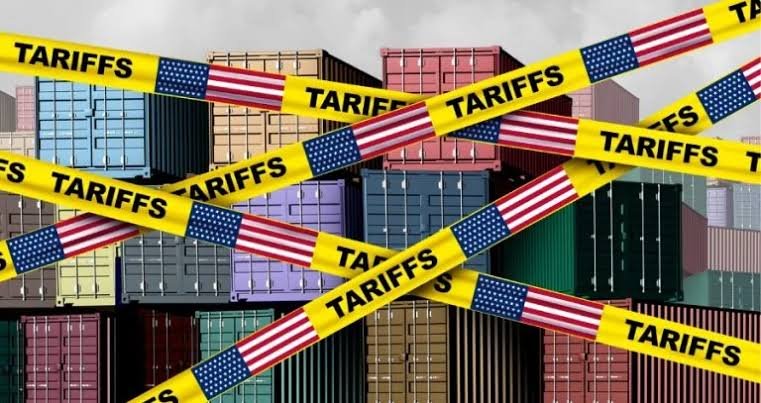
The return of sweeping tariff policies under United States President Donald Trump is rapidly reshaping the architecture of global commerce, triggering renewed fears of a prolonged trade war that could redefine international economic relations for years to come.
What began as a campaign promise to restore American manufacturing has evolved into one of the most consequential shifts in U.S. trade policy in decades, with governments, multinational corporations, financial markets, and developing economies scrambling to assess the long-term consequences.
Since re-entering the White House, President Trump has reaffirmed his commitment to what he describes as an “America First” economic agenda. Central to this strategy is the aggressive use of tariffs—taxes imposed on imported goods—to protect domestic industries from foreign competition. The administration argues that decades of globalization allowed countries such as China to exploit the United States through unfair trade practices, intellectual property theft, state subsidies, and persistent trade deficits that weakened American manufacturing.
Washington insists that higher tariffs will encourage companies to relocate factories back to the United States, create millions of manufacturing jobs, strengthen national security by reducing dependence on foreign supply chains, and generate additional government revenue. Senior administration officials maintain that economic self-reliance has become a national security priority, particularly as geopolitical competition intensifies with China.
However, economists across the world caution that tariffs rarely affect only the targeted country. Instead, they ripple throughout the global economy, increasing production costs, disrupting established supply chains, and creating uncertainty for investors. Modern manufacturing depends on components sourced from dozens of countries. A single automobile, smartphone, or aircraft may contain parts produced across Asia, Europe, Africa, and the Americas. When tariffs are imposed, manufacturers often face higher input costs that are ultimately passed on to consumers through rising prices.
China remains the principal target of Washington’s trade strategy. Beijing has strongly condemned the latest tariff measures, accusing the United States of undermining international trade rules and weaponizing commerce for political purposes. Chinese authorities argue that unilateral trade restrictions threaten decades of economic cooperation that have lifted hundreds of millions of people out of poverty and fueled global growth.
Rather than yielding to American pressure, China has accelerated efforts to diversify its export markets while strengthening economic partnerships across Asia, Africa, Latin America, and the Middle East. Beijing continues expanding the Belt and Road Initiative, increasing investment in transport infrastructure, energy projects, and industrial zones to secure alternative markets for Chinese goods.
The European Union also finds itself navigating increasingly turbulent waters. European manufacturers fear additional tariffs could affect automobiles, pharmaceuticals, machinery, aerospace products, and advanced technologies. Brussels has repeatedly emphasized that trade disputes should be resolved through negotiation rather than escalating protectionist measures. Nevertheless, European policymakers have prepared retaliatory options should further restrictions be imposed on EU exports.
Also Read, Russia Strikes Ukraine’s Power Plant Amid Winter
Beyond the world’s largest economies, developing nations face a complex mixture of risks and opportunities. Countries including Vietnam, India, Mexico, Indonesia, and several African states are positioning themselves as alternative manufacturing destinations for companies seeking to reduce dependence on Chinese production. This global diversification strategy—often referred to as “China Plus One”—has accelerated investment decisions as businesses prioritize resilience over efficiency.
Africa could emerge as one of the unexpected beneficiaries if governments successfully improve infrastructure, energy reliability, transport connectivity, regulatory transparency, and workforce development. The African Continental Free Trade Area (AfCFTA), the largest free trade agreement by participating countries, offers an unprecedented opportunity to transform Africa into a competitive manufacturing hub serving both regional and international markets.
For Tanzania, these developments carry strategic importance. Ongoing investments in the Standard Gauge Railway (SGR), the expansion of the Port of Dar es Salaam, improvements at regional ports, and major energy infrastructure projects are gradually strengthening the country’s position as a logistics and industrial gateway for East and Central Africa. Should multinational corporations seek new production locations outside Asia, Tanzania could attract greater foreign direct investment, particularly in manufacturing, agro-processing, and mineral value addition.
Financial markets have become increasingly sensitive to every announcement from Washington. Stock exchanges across Asia, Europe, and North America often react within hours of major tariff decisions, reflecting investor concerns that prolonged trade disputes could weaken global economic growth. Commodity-exporting countries are particularly vulnerable, as slower industrial production reduces demand for minerals, agricultural products, and energy resources.
The World Trade Organization continues to face mounting pressure as unilateral trade actions test the effectiveness of the multilateral trading system established after the Second World War. Analysts argue that if major powers increasingly bypass international trade institutions in favor of bilateral economic pressure, the rules-based global trading order could become significantly weaker.
Meanwhile, multinational corporations are redesigning supply chains on a scale not seen since the COVID-19 pandemic exposed vulnerabilities in global production networks. Businesses are investing in digital manufacturing, automation, regional production hubs, and strategic stockpiles to reduce exposure to geopolitical disruptions. These adjustments require billions of dollars in investment but are increasingly viewed as necessary for long-term resilience.
As geopolitical rivalry between the United States and China extends beyond trade into technology, artificial intelligence, semiconductors, rare earth minerals, and critical infrastructure, tariffs have become only one component of a broader strategic competition. Economic policy is now inseparable from foreign policy, with governments using trade, investment restrictions, export controls, and industrial subsidies as instruments of national power.
The coming years will determine whether this new era produces stronger domestic industries or fragments the global economy into competing economic blocs. What is already clear is that the age of predictable globalization has given way to a more uncertain world where commerce, diplomacy, and national security are increasingly intertwined. For governments, businesses, and investors alike, adapting to this transformation will be essential in navigating one of the most significant economic realignments of the twenty-first century.