MWE Correspondent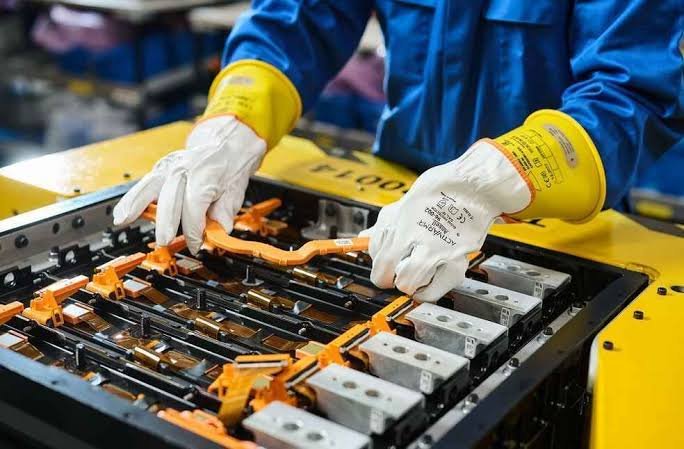
Every day, trucks loaded with copper, cobalt, lithium, graphite and manganese leave mines across Africa, beginning a journey that often ends thousands of kilometres away in battery factories across Asia, Europe and North America.
For years, that supply chain has followed a familiar pattern.
Africa extracted the minerals.
Other regions manufactured the batteries.
The highest-value industries—and the largest profits—were created elsewhere.
Today, that model is being challenged.
Across the continent, governments are pursuing a new industrial strategy aimed at moving Africa beyond its traditional role as a supplier of raw materials. Rather than exporting strategic minerals in their unprocessed form, policymakers are seeking to establish battery manufacturing industries capable of serving the rapidly expanding global market for electric vehicles and renewable energy storage.
The ambition reflects one of the most significant economic shifts in Africa’s recent history.
It is no longer enough to own the minerals powering the clean-energy transition.
The continent now wants to participate in building the technologies that define it.
Global demand is providing a powerful incentive.
The transition toward electric mobility and renewable energy has dramatically increased the need for advanced batteries. Governments around the world are investing in cleaner transport, while manufacturers continue expanding production of electric vehicles, creating sustained demand for minerals in which Africa holds a strategic advantage.
The continent possesses substantial reserves of cobalt, lithium, manganese, graphite and copper—materials that form the foundation of modern battery technology.
Yet despite this resource wealth, most battery manufacturing remains concentrated outside Africa.
That imbalance is increasingly becoming a strategic concern for African policymakers.
Countries including Zambia, the Democratic Republic of Congo, Zimbabwe, South Africa, Namibia and Tanzania are exploring policies designed to encourage local processing, battery component production and industrial investment rather than relying exclusively on raw mineral exports.
The objective extends beyond increasing export revenue.
It is about creating industrial ecosystems capable of generating skilled employment, technological innovation and long-term economic resilience.
This has placed Battery Manufacturing at the centre of Africa’s industrial agenda.
Industry analysts argue that capturing even a modest share of the global battery value chain could transform several African economies by stimulating manufacturing, engineering, research and supporting industries.
Regional cooperation is becoming equally important.
The African Continental Free Trade Area (AfCFTA) provides an opportunity to connect mineral-producing countries with manufacturing centres across the continent, allowing supply chains to develop within Africa rather than ending at international ports.
Supporters believe this integrated approach could strengthen regional competitiveness while reducing dependence on imported industrial products.
Also Read, Africa Courts Gulf Powers For Strategic Investment
International investors are paying close attention.
Companies from China, Europe, the United States, the Gulf and other regions are increasing engagement with African governments as competition intensifies for secure supplies of critical minerals.
Many African leaders, however, are making it clear that future partnerships should extend beyond extraction.
Increasingly, investment negotiations include discussions on technology transfer, workforce training, local procurement and industrial development.
This reflects a broader commitment to Value Addition.
Value addition involves processing raw materials into higher-value products before export, enabling producing countries to retain a larger share of economic benefits generated by global supply chains.
Economists argue that this transition represents one of Africa’s greatest development opportunities.
Countries that successfully combine mineral resources with manufacturing capacity could strengthen exports, diversify their economies and reduce vulnerability to fluctuations in commodity prices.
The challenge, however, remains considerable.
Battery manufacturing requires reliable electricity, modern transport infrastructure, specialised technical skills and significant capital investment.
Governments must also establish predictable regulatory environments capable of attracting long-term industrial partners.
Analysts caution that success will depend not only on policy ambition but also on implementation.
Infrastructure, education, research and regional coordination will be essential if Africa is to compete with established manufacturing centres.
Nevertheless, momentum is building.
The conversation surrounding Africa’s mineral wealth has changed.
The focus is no longer solely on how much the continent can mine.
It is increasingly about what the continent can manufacture.
That shift has elevated Industrial Sovereignty into one of Africa’s defining economic priorities.
Industrial sovereignty means developing domestic production capacity that allows countries to capture greater value from their own resources while strengthening resilience against external economic shocks.
The race to build the batteries powering tomorrow’s economy is accelerating.
Africa already possesses many of the minerals the world cannot do without.
The next challenge is ensuring those minerals do more than leave African shores.
They must help build the industries, technologies and prosperity that remain on the continent.
If that vision succeeds, Africa will not simply supply the clean-energy revolution.
It will help manufacture it.