MWE Correspondent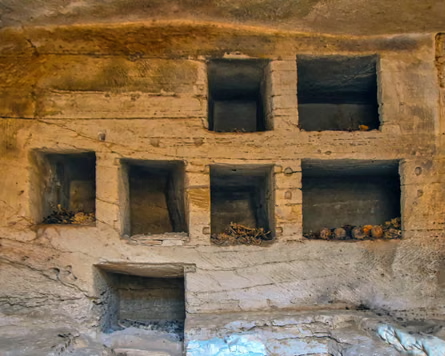
Egypt has announced the discovery of two major archaeological sites, including a remarkably well-preserved Byzantine-era settlement in the Western Desert and a cluster of ancient tombs near Alexandria, shedding new light on life in the region more than 1,500 years ago.
The Egyptian Ministry of Tourism and Antiquities said the discoveries were made in the Dakhla Oasis and the coastal area of Marina el-Alamein, both of which offer significant insights into urban development, daily life and economic activity during the 4th century AD, when Egypt was part of the Byzantine Empire.
Archaeologists uncovered a carefully planned city layout featuring streets aligned north–south and east–west, open public spaces, residential structures surrounded by defensive walls, and the remains of a 4th-century basilica church.
Among the most notable findings was a house believed to have belonged to a church deacon named Tisous. Researchers say the structure may have initially served as a place of worship before the construction of the larger basilica, highlighting the early development of Christian communities in the region.
Excavations also revealed evidence of daily life and economic activity, including baking ovens, food preparation areas, grinding stones used for processing grain, and hundreds of pottery fragments inscribed with records believed to relate to trade and administration.
A collection of coins was also recovered, including bronze coins depicting Byzantine rulers and gold coins from the reign of Roman Emperor Constantius II, offering valuable chronological markers for the settlement.
In a separate discovery at Marina el-Alamein, located about 100 kilometres west of Alexandria, archaeologists uncovered 18 additional tombs, bringing the total number of graves found at the site to 48.
Also Read. Critical Minerals Redefine Global Strategic Competition
Of the newly discovered tombs, 11 were carved directly into rock, while seven were constructed from limestone blocks. The findings also included a 2.5-metre granite sarcophagus containing human skeletal remains.
Researchers further discovered a plaster-made sphinx statue and four gold pieces placed inside the mouths of some of the deceased, a burial practice linked to ancient beliefs about passage into the afterlife.
Experts say the discoveries contribute significantly to understanding burial traditions, religious practices and urban organisation in late antiquity Egypt, a period marked by transition between Roman and early Byzantine rule.
The findings are expected to attract further international archaeological interest and deepen scholarly understanding of one of the world’s most historically rich regions.