MWE Correspondent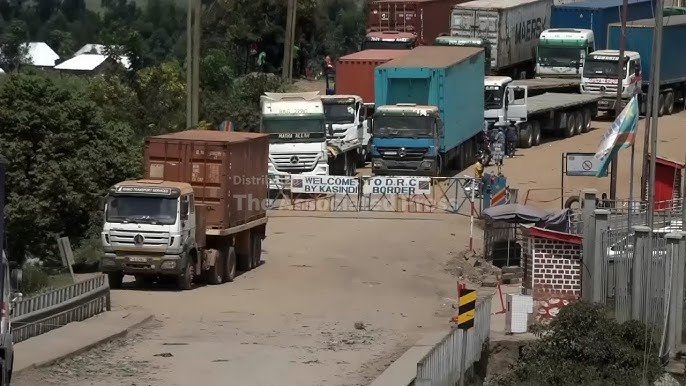
What was once one of East Africa’s busiest commercial crossings has fallen unusually quiet after Uganda temporarily closed its border with the Democratic Republic of Congo (DRC) in an effort to contain the spread of the Ebola virus, leaving thousands of traders and families facing mounting economic uncertainty.
The temporary closure of the Mpondwe border crossing, announced on May 27, has disrupted the daily flow of goods and people between western Uganda and eastern DRC, bringing cross-border commerce to a near standstill.
For years, the border has served as a vital economic lifeline for communities on both sides. Every day, traders transported food, agricultural produce, household goods and manufactured products across the frontier, supporting thousands of small businesses and providing livelihoods for families who depend almost entirely on informal cross-border trade.
Now, that activity has slowed dramatically.
Market stalls that normally bustle with customers remain largely deserted, trucks carrying commercial cargo have been delayed, and many small-scale traders say they have lost their primary source of income since movement restrictions were introduced.
The Ugandan government says the measures are necessary to protect public health following renewed concerns over Ebola cases in neighbouring Democratic Republic of Congo. Health authorities argue that restricting movement at key border points is intended to reduce the risk of cross-border transmission while surveillance, screening and response measures are strengthened.
Officials have stressed that the decision is temporary and forms part of broader regional efforts to prevent another large-scale Ebola outbreak.
However, for residents living along the frontier, the economic consequences have been immediate.
Many traders who rely on daily border crossings now find themselves unable to buy or sell goods, while transport operators, porters, restaurant owners and money exchange businesses have also reported sharp declines in customers.
Some residents say prices of certain commodities have begun to rise because supplies that normally arrive from across the border are no longer moving as freely as before.
Also Read. The Minerals Powering The World’s Future
Health experts acknowledge that border restrictions can help slow the spread of infectious diseases, particularly when combined with screening, testing and public awareness campaigns. However, they also note that prolonged closures can place enormous pressure on border communities whose economies are closely interconnected.
The outbreak has once again highlighted the difficult balance governments must strike between protecting public health and safeguarding economic livelihoods.
Uganda has extensive experience responding to Ebola outbreaks and has often been praised for its rapid surveillance systems and emergency response capacity. Nevertheless, its long and porous border with the Democratic Republic of Congo continues to present significant public health challenges whenever Ebola resurfaces in the region.
Regional health agencies are continuing to monitor the situation closely as authorities work to contain the outbreak and prevent further transmission.
For now, uncertainty remains.
Residents hope the border will reopen soon, allowing commerce to resume and livelihoods to recover.
Until then, communities that have long depended on the movement of people and goods across one of East Africa’s busiest frontiers are being forced to wait—caught between the urgent need to stop a deadly virus and the equally pressing need to earn a living.