MWE Correspondent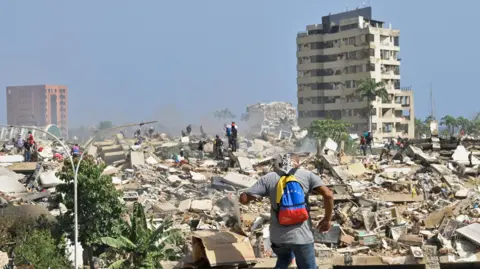
Venezuela is racing against time to rescue survivors after two of the most powerful earthquakes in its modern history struck within 39 seconds of each other, triggering widespread devastation and prompting U.S. scientists to warn that the final death toll could climb into the tens of thousands.
The twin earthquakes, measuring magnitude 7.2 and 7.5, struck northern Venezuela on June 24, with epicentres near San Felipe and Yumare, approximately 160 kilometres west of Caracas. The shallow depth of both quakes intensified the destruction, causing violent ground shaking across much of the country’s densely populated northern region.
The U.S. Geological Survey (USGS) issued a rare orange PAGER alert, warning that the disaster could result in between 10,000 and 100,000 deaths based on its preliminary impact modelling. The estimate is not an official casualty count but a scientific forecast that combines earthquake strength, population density and the vulnerability of buildings in the affected areas.
As emergency workers continue searching beneath collapsed buildings, Venezuelan authorities caution that official casualty figures remain incomplete. Early reports confirmed dozens of deaths and hundreds of injuries, but thousands of people were initially reported missing, raising fears that the human toll could rise dramatically as rescue operations continue.
Entire neighbourhoods suffered severe structural damage, with residential buildings, hospitals and public infrastructure either collapsing or becoming unsafe. Roads were blocked by debris, electricity and communications were disrupted in several areas, while hospitals struggled to cope with the growing number of injured patients. Schools were suspended and emergency services were mobilised nationwide.
Seismologists have described the event as a rare “seismic doublet”—two major earthquakes striking almost simultaneously on neighbouring fault systems. Such events are uncommon and particularly destructive because structures weakened by the first quake often collapse when the second, stronger shock arrives moments later.
The earthquakes are among the strongest to strike Venezuela in more than a century and have renewed concerns over the country’s ability to respond to large-scale natural disasters amid longstanding economic and infrastructure challenges. Northern Venezuela lies along the boundary between the Caribbean and South American tectonic plates, making the region vulnerable to powerful earthquakes, although destructive events of this magnitude remain relatively rare.
International assistance has begun arriving as search-and-rescue teams work around the clock, using heavy equipment, rescue dogs and thermal imaging technology to locate survivors trapped beneath collapsed buildings. Officials warn, however, that the crucial window for finding people alive narrows with every passing hour.
Meanwhile, aftershocks continue to shake the region, forcing rescue workers and residents to repeatedly evacuate unstable structures. A magnitude 4.9 earthquake struck days after the main disaster, highlighting the continuing seismic risk and complicating recovery efforts.
For millions of Venezuelans, the immediate priority remains survival. But as rescue efforts continue, attention is already turning toward the enormous humanitarian challenge ahead—rebuilding shattered communities, restoring critical infrastructure and supporting thousands of families whose lives have been transformed in less than a minute.
The earthquakes lasted only seconds.
Their consequences may shape Venezuela for years to come.