MWE Correspondent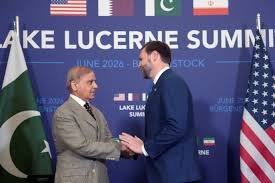
Senior officials from the United States and Iran have arrived in Switzerland for what could become one of the most consequential rounds of diplomacy in years, as efforts intensify to prevent a wider Middle East conflict and secure a breakthrough on regional security, maritime stability, and the future of relations between the two longtime adversaries.
The high-level meetings, taking place behind closed doors at a luxury hotel in Switzerland, come amid cautious optimism that months of escalating tensions could give way to a diplomatic settlement capable of reshaping the security landscape of the Middle East.
Leading the American delegation are Vice President JD Vance, presidential envoy Steve Witkoff, and senior adviser Jared Kushner, while Iran is represented by Foreign Minister Abbas Araghchi and Parliament Speaker Bagher Ghalibaf, two of Tehran’s most influential political figures.
Although the two sides are not expected to meet directly in every session, Pakistani mediators and Swiss officials are facilitating discussions aimed at narrowing differences over a range of highly sensitive issues, including maritime security in the Strait of Hormuz, sanctions, regional military activity, and broader efforts to reduce the risk of war.
The talks are unfolding at a time when the international community remains deeply concerned that renewed confrontation between Washington and Tehran could destabilize one of the world’s most strategically important regions.
At the center of the negotiations is the Strait of Hormuz, the narrow waterway through which roughly one-fifth of the world’s oil supply passes every day. Any agreement that guarantees safe navigation through the Strait would likely be welcomed by governments, energy markets, and businesses worldwide that have spent months grappling with uncertainty over shipping routes and rising geopolitical tensions.
Financial markets have been closely monitoring developments, with investors viewing the Swiss negotiations as a potential turning point that could ease pressure on global energy supplies and reduce fears of disruptions to international trade.
Diplomatic sources familiar with the discussions say negotiators are exploring confidence-building measures that could lower military tensions while creating space for broader political negotiations in the months ahead. Although significant differences remain, officials from several countries involved in the mediation effort have described the current atmosphere as more constructive than previous attempts.
Also Read; The Battle For Africa’s Financial Freedom
For millions of ordinary people across the Middle East, however, the outcome carries consequences far beyond diplomatic communiqués.
Families living near conflict zones continue to face uncertainty over their security, while businesses across the Gulf remain vulnerable to fluctuations in energy prices and shipping costs. Any escalation could ripple through the global economy, affecting fuel prices, inflation, and supply chains far beyond the region.
Despite the cautious optimism, officials on both sides have emphasized that no final agreement has yet been reached.
Iran has repeatedly maintained that any deal must respect its sovereignty and deliver tangible benefits for its people, while U.S. officials insist that any agreement must strengthen regional security and protect international navigation.
Analysts say the decision by both governments to send senior political figures rather than lower-level negotiators signals the seriousness of the current diplomatic effort.
“This is more than another round of technical discussions,” one regional affairs expert said. “The level of representation indicates both sides recognize what is at stake—not only for Iran and the United States, but for global stability.”