
 Hassan Magulumali
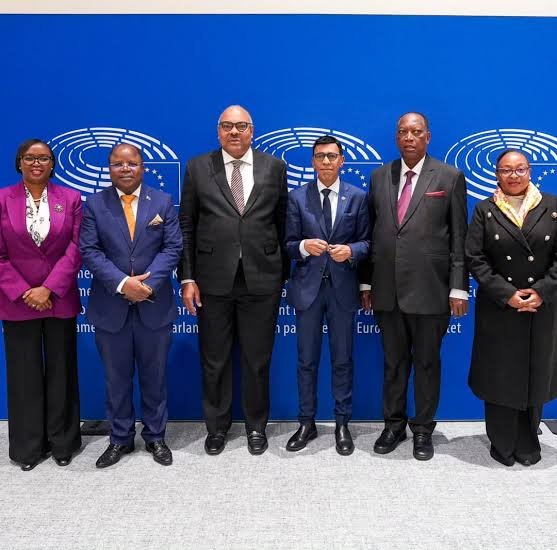
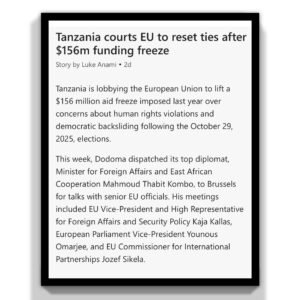
Tanzania’s relationship with the European Union (EU) has entered a new phase of scrutiny following disagreements over a €156 million development financing programme, raising wider questions about national sovereignty, political conditionality and the extent to which development partners should influence the domestic priorities of African countries.
The dispute, which intensified in 2025 and continued into 2026, emerged after the European Parliament challenged the European Commission’s proposed financing arrangements for Tanzania, citing concerns about democracy, human rights and the rule of law following the October 2025 general election.
On November 27, 2025, the European Parliament adopted a resolution calling for a review of EU financial support to Tanzania. Members of Parliament also urged the European Commission to reconsider its proposed Annual Action Plan, arguing that the programme did not adequately address concerns surrounding the country’s political situation.
The disagreement resurfaced in June 2026 when the European Parliament adopted another objection, on June 18, calling on the Commission to withdraw its proposed 2026 financing decision and submit a revised programme.
However, the parliamentary objection did not become a permanent cancellation of the funding. The European Commission subsequently adopted Tanzania’s 2026 Annual Action Plan on July 24, 2026, retaining the maximum allocation of €156 million.
The programme comprises €129 million for agricultural and mineral value chains, €20 million for digital economy and connectivity initiatives, and €7 million for a cooperation facility.
The funding decision, however, came with an important distinction concerning how the money would be implemented.
According to the action plan, EU support would continue through arrangements that avoid using Tanzanian government systems. The approach prioritises private-sector participation, civil society and other implementing partners rather than restoring conventional direct budget support to the government.
The EU’s position reflects a broader shift in its development cooperation strategy, under which financial assistance is increasingly linked to governance standards, institutional accountability and the protection of human rights.
Tanzania had earlier challenged interpretations that the European Parliament’s June decision amounted to a complete suspension of development assistance.
In a statement issued on June 19, 2026, through the Ministry of Foreign Affairs and East African Cooperation, the government explained that the parliamentary vote was not the final decision of the European Union.
“The vote taken in the European Parliament is not the final decision of the European Union regarding the 2026 Partnership Programme with Tanzania,” the government stated.
The ministry further explained that only €17 million of the proposed allocation had initially been planned for direct implementation through government systems, while approximately €139 million was intended to be implemented through EU institutions, agencies of member states and civil society organisations.
The government also maintained that any changes to the partnership programme should be handled through consultation and agreement between both parties, rather than unilateral decisions.
The disagreement must also be understood against the background of Tanzania’s broader foreign policy position.
Tanzania’s official foreign policy identifies the protection of national sovereignty, territorial integrity and political independence as fundamental principles guiding its international engagements. It also emphasises economic diplomacy, non-alignment, South-South cooperation and stronger partnerships with international development partners.
This position does not exclude cooperation with Western countries. Instead, it establishes the principle that Tanzania should maintain relationships with different international partners while safeguarding its national interests.
President Samia Suluhu Hassan has also publicly expressed concerns about external influence over Tanzania’s domestic affairs.
Also Read: Africa’s Right to Choose Its Economic Partners
Speaking to elders in Dar es Salaam on December 2, 2025, the President questioned the attitude of foreign actors whom she believed were attempting to dictate how Tanzania should manage its internal affairs.
“They say Tanzania should do this and that. Who are you? Do you think you are our masters? Is it because of the small amounts of money you give us?” she asked.
She also emphasised the importance of conducting economic relationships in ways that benefit both parties, rather than depending solely on external assistance.
Foreign Affairs Minister Ambassador Mahmoud Thabit Kombo has similarly emphasised the independence of both parties in managing their diplomatic relations.
In earlier remarks concerning the EU funding dispute, Kombo said that despite the longstanding friendship between Tanzania and the EU, each side remained independent and operated within its own jurisdiction.
His position reflects the government’s preference for diplomatic engagement and mutual respect rather than allowing disagreements over development assistance to undermine bilateral relations.
The economic implications of the dispute extend beyond diplomatic relations. Agriculture, mining and digital infrastructure are among the sectors targeted by the €156 million programme, all of which are important to Tanzania’s long-term industrialisation ambitions.
Under the Tanzania Development Vision 2050, the country seeks to establish a strong, inclusive and competitive economy through investment, private-sector development, technological innovation and strategic regional and international engagement.
Consequently, the effectiveness of the EU programme should be assessed not simply by the amount of money approved, but by the extent to which it strengthens local industries, creates employment, transfers technology and increases the participation of Tanzanian businesses in strategic value chains.
The shift towards private-sector financing also presents both opportunities and challenges. Tanzanian companies could benefit from new investment, financing facilities and access to European markets. However, the government and local businesses will need to ensure that implementation arrangements provide meaningful opportunities for domestic enterprises rather than concentrating the benefits among external contractors and investors.
The debate also raises important questions about the relationship between sovereignty and international accountability.
Article 8 of Tanzania’s Constitution establishes that sovereignty resides in the people and that the government derives its authority from them. Similarly, Article 2 of the United Nations Charter recognises the sovereign equality of states, while the African Union’s Constitutive Act identifies non-interference in the internal affairs of member states as one of its guiding principles.
However, the same African Union framework also recognises democracy, human rights, the rule of law and good governance as important principles. This demonstrates that national sovereignty and accountability are not necessarily competing objectives; both are recognised within the continent’s institutional framework.
For the EU, the challenge is to demonstrate that its development cooperation can uphold its stated democratic and human-rights commitments while respecting the independence of its African partners.
For Tanzania, the challenge is to strengthen domestic institutions, expand economic self-reliance and ensure that international partnerships produce measurable benefits for its citizens.
The €156 million decision therefore represents more than the continuation of a development financing programme. It highlights an increasingly important question for African countries: how can governments attract international investment and development assistance without compromising their ability to determine their own development priorities?
Ultimately, the strength of Tanzania-EU relations will depend not only on financial commitments but also on mutual respect, transparency, accountability and the ability of both sides to transform their partnership into tangible economic and social benefits.