MWE Correspondent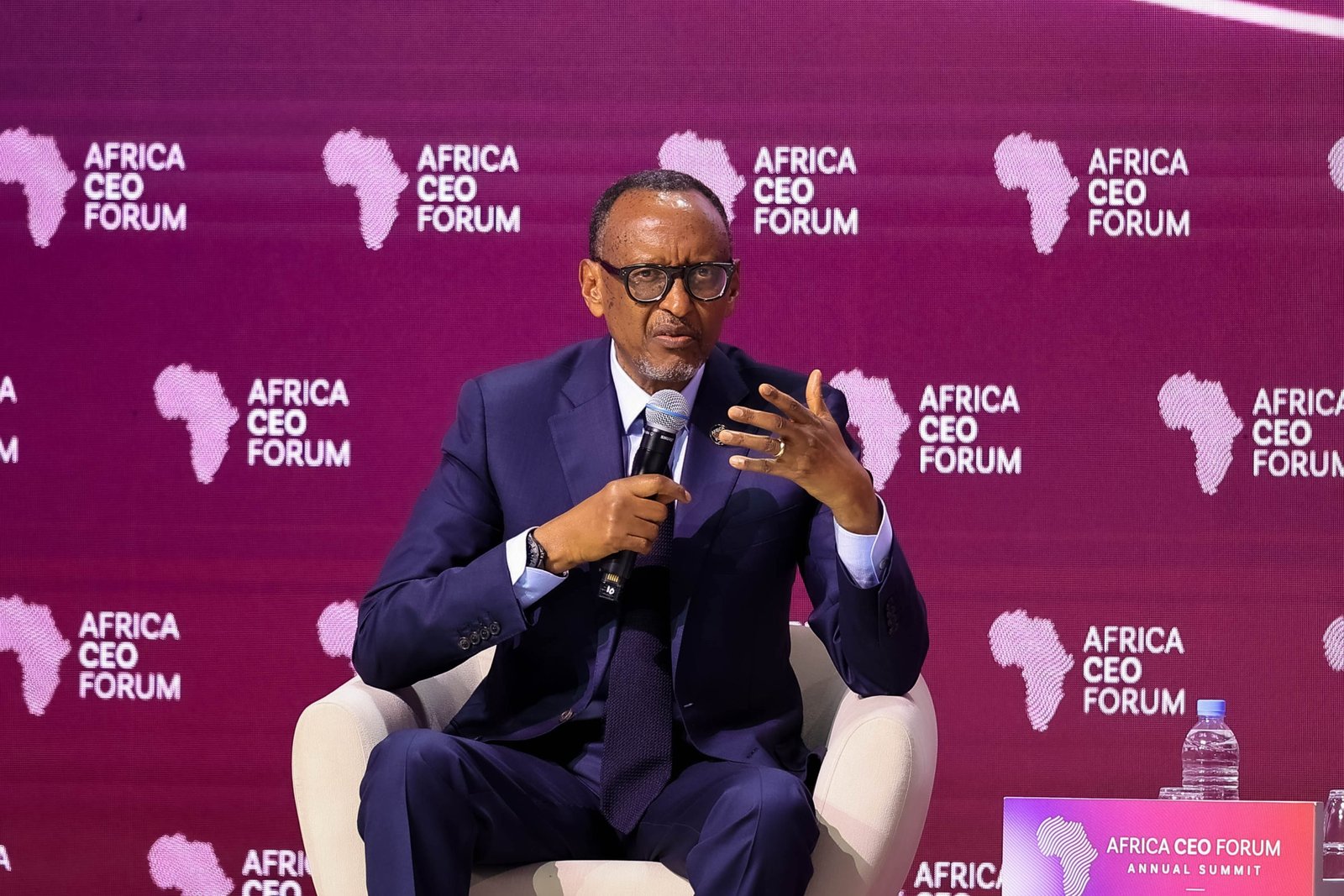
Rwandan President Paul Kagame has challenged African countries to fundamentally rethink how they exploit and manage the continent’s vast mineral wealth, warning that Africa cannot achieve its full economic potential while continuing to export raw materials and import higher-value finished products.
Speaking at the Africa CEO Forum 2025 in Abidjan, Kagame called for greater African self-reliance, stronger intra-African cooperation and a deliberate strategy to build industries capable of transforming the continent’s natural resources into wealth and jobs.
Africa holds around 30% of the world’s mineral resources, according to the Africa CEO Forum and other continental institutions. Yet much of the continent’s mineral production leaves Africa in raw or minimally processed form, limiting the economic value captured by African countries.
Kagame’s argument goes beyond simply increasing mining output. The central challenge, he suggested, is whether African countries can move further up the global value chain by developing the capacity to process minerals, manufacture products and retain a larger share of the wealth generated from resources extracted on the continent.
His message comes as demand for minerals such as cobalt, lithium, graphite, copper, nickel and rare earth elements continues to rise because of the global transition toward electric vehicles, renewable energy, batteries and advanced technologies.
The African Union has similarly warned that the continent’s mineral wealth must become a foundation for industrialisation rather than remain primarily a source of raw-material exports. The AU’s Africa Mining Vision places emphasis on local value addition, sustainable resource governance and ensuring that mineral development generates broader economic benefits for African populations.
The scale of the opportunity is enormous. The African Development Bank estimates Africa’s mineral endowment at approximately $29.5 trillion in mine-site value, while stressing the need for greater local processing and industrial development to unlock that potential.
Kagame has previously argued that Africa must define its own development direction instead of constantly reacting to decisions made elsewhere. At the 2025 Africa CEO Forum, he said the continent needed to build the momentum required to become more self-dependent and resilient.
Read More: Africa Pushes For Greater Control Of Critical Minerals
That argument is increasingly significant as global powers compete for access to Africa’s critical minerals. The United States, China, Europe and other major economies are seeking secure supplies of resources considered essential to future industries and energy technologies.
For Africa, however, the question is no longer simply who owns the minerals beneath its soil. The bigger question is who controls what happens to those minerals after they are extracted.
If African countries can expand refining, processing, manufacturing, infrastructure and regional trade, the continent could transform its mineral abundance into a powerful engine of industrialisation. Failure to do so, analysts warn, risks perpetuating a model in which Africa supplies the raw wealth while other economies capture much of the higher-value economic activity.
Kagame’s message therefore represents a broader challenge to African governments and businesses: Africa’s mineral wealth will only become genuine economic power when the continent stops being primarily an exporter of raw resources and becomes a producer of finished goods.