 MWE Correspondent
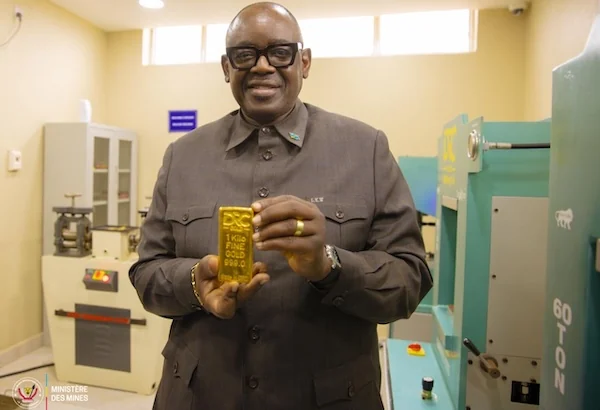
The Democratic Republic of Congo (DRC) has taken a significant step towards strengthening control over its mineral resources after its first state-owned gold refinery in Kalemie, Tanganyika Province, began producing gold bars with a purity of 99.9 percent.
The facility, known as DRC Gold Refinery, has an estimated processing capacity of between 500 and 600 kilogrammes of gold per month, marking a new phase in the country’s efforts to move beyond exporting unprocessed minerals and retain more economic value from its natural resources.
The refinery was officially inaugurated on March 11, 2026, through a partnership between state-owned DRC Gold Trading SA and Tanzania-based Lunga Mining SARL. The first gold bars, stamped “Made in DRC”, were reported in November, approximately eight months after its inauguration.
According to reports from the Congolese news agency ACP, the refinery is initially targeting production of approximately 50 kilogrammes per month before gradually increasing output towards its full capacity. At maximum production, the facility could process between six and 7.2 tonnes of gold annually.
The refined gold is intended for the Central Bank of Congo (BCC), where it is expected to contribute to the country’s national gold reserves. The strategy is also aimed at strengthening financial security by increasing the country’s holdings of domestically sourced precious metals.
Beyond strengthening reserves, the project is designed to address longstanding challenges in the Congolese gold sector, particularly illegal trading, smuggling and limited traceability of artisanal gold production.
Also Read: Tanzania Opposes Same-Sex Marriage at UN
The government hopes that providing local refining facilities will encourage artisanal miners, gold traders and small-scale mining operators to sell their production through official channels. This could improve transparency, strengthen regulatory oversight and ensure that more revenue from gold remains within the country.
DRC Gold Refinery Managing Director Joseph Maombi Kazibaziba has also outlined plans to expand gold-refining infrastructure beyond Kalemie. Further facilities are planned for the Greater Kivu region, the Greater Oriental region and Greater Kasai, alongside a proposed major national refinery in the capital, Kinshasa.
The expansion forms part of a broader strategy by President Félix Tshisekedi’s administration to increase domestic processing of mineral resources and strengthen the country’s position in international mineral markets.
The DRC is one of Africa’s major mineral-producing countries, with significant deposits of gold, copper, cobalt and other strategic minerals. However, much of its mineral wealth has historically left the country with limited domestic processing, reducing opportunities for industrial development, technology transfer and local employment.
The Kalemie refinery therefore represents an attempt to capture more value within the domestic economy. Its long-term impact, however, will depend on reliable supplies of gold, transparent purchasing systems, effective regulation and the ability to operate at its announced capacity.
For the DRC, the ambition is increasingly clear: transform its mineral wealth into locally processed products, stronger national reserves and greater economic benefits for its population.