
 MWE Correspondent
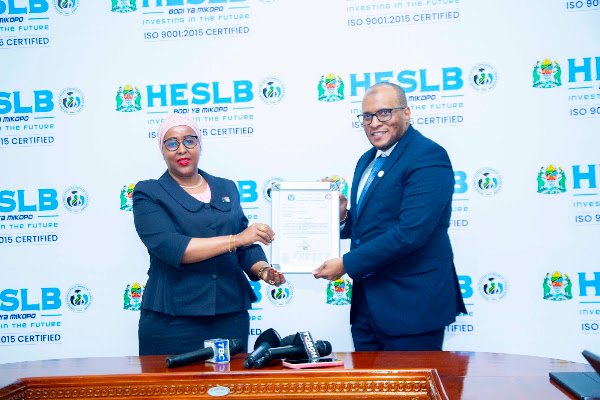
The Higher Education Students’ Loans Board (HESLB) of Tanzania has received the ISO 9001:2015 international quality management certification, a milestone expected to strengthen service delivery, operational efficiency and accountability in the administration of higher education loans.
HESLB Executive Director Dr Bill Kiwia received the certificate from Tanzania Bureau of Standards (TBS) Director General Dr Ashura A. Katunzi during a ceremony held in Dar es Salaam.
Speaking at the event, Kiwia said the certification would serve as a catalyst for improving the board’s service delivery systems and ensuring that university and college students receive reliable, efficient and timely services.
He said maintaining high standards of quality, efficiency and accountability remained essential to fulfilling HESLB’s responsibilities, particularly in facilitating access to higher education for eligible students who require financial assistance.
Kiwia thanked TBS for its cooperation in helping the board achieve the internationally recognised certification, reaffirming HESLB’s commitment to continuously improving its operations and meeting the needs of students and other stakeholders.
For his part, Katunzi congratulated HESLB’s leadership and staff for attaining the certification, describing it as an important step towards strengthening quality management and improving institutional performance.
She emphasised the need for the board to maintain the required standards and ensure that the certification translates into measurable improvements in the services provided to the public.
ISO 9001:2015 is an international standard that sets requirements for quality management systems. It focuses on establishing consistent processes, improving operational performance, addressing risks and ensuring that organisations regularly assess whether their services meet customer and stakeholder requirements.
Also Read: Tanzania, Ghana Seek Stronger Small-Scale Mining Cooperation
For a public institution such as HESLB, implementing these principles can help strengthen internal procedures, improve coordination, clarify responsibilities and establish mechanisms for identifying and correcting service delivery challenges.
The certification also places emphasis on continuous improvement, meaning that organisations are expected to monitor performance and refine their processes rather than treating certification as a one-time achievement.
HESLB plays a central role in supporting access to higher education in Tanzania through loans and other financial assistance provided to eligible students pursuing approved programmes at recognised higher learning institutions.
Its responsibilities include managing loan applications, assessing applicants against established eligibility criteria, coordinating loan allocations and overseeing the repayment of loans by beneficiaries who have completed their studies and entered employment.
The efficiency of these processes is important because delays in loan processing, communication or disbursement can affect students’ ability to meet education-related expenses.
Strengthening quality management systems could therefore support more consistent handling of applications, clearer communication with applicants and improved monitoring of the services delivered to students.
However, the practical impact of the certification will depend on how effectively HESLB applies the required standards in its daily operations, including whether improvements result in faster service, greater transparency and more accessible support for beneficiaries.
The achievement comes as Tanzania continues to pursue wider efforts to expand access to higher education and strengthen the performance of public institutions.
By maintaining the ISO 9001:2015 standards, HESLB aims to reinforce public confidence in its operations while improving its capacity to deliver services in line with the expectations of students, higher learning institutions and other stakeholders.
The certification provides a framework for these improvements, while sustained monitoring and accountability will remain essential to ensuring that the benefits are reflected in the experiences of students seeking and receiving higher education loans.