MWE Correspondent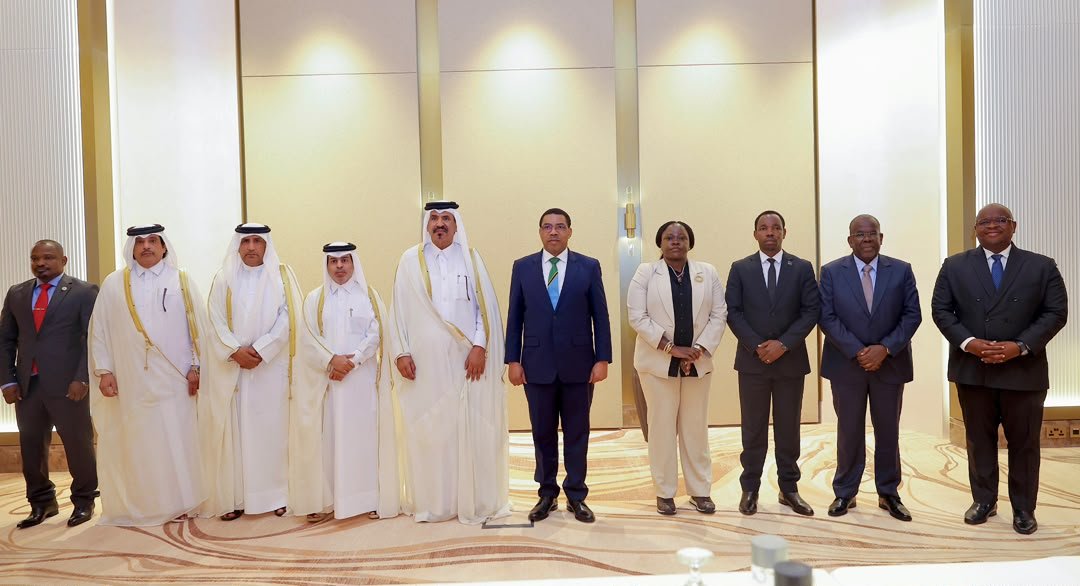
Tanzania is seeking deeper private-sector participation and stronger economic ties with Qatar as the government steps up efforts to achieve its long-term ambition of building a US$1 trillion economy by 2050.
Prime Minister Mwigulu Nchemba made the call on September 27, 2026, in Doha, Qatar, where he met Mohammed bin Ahmed bin Twar Al Kuwari, First Vice President of the Qatar Chamber of Commerce and Industry (QCCI), and his delegation at the Kempinski Hotel.
Nchemba said Tanzania’s long-term development ambitions could not be achieved through government investment alone, stressing the importance of attracting both domestic and international capital.
“We believe that the Government alone cannot succeed in such investment without involving domestic or foreign investors. That is why the Government has put in place investment incentives to attract capital,” Nchemba said.
The discussions focused on economic and investment opportunities in Tanzania and Qatar, as well as opportunities arising from the two countries’ positions in major regional economic blocs, including the East African Community (EAC), the Southern African Development Community (SADC) and the Gulf Cooperation Council (GCC).
The meeting also explored mechanisms for bringing together business communities from Tanzania and Qatar through their respective private-sector institutions, including QCCI, the Tanzania Private Sector Foundation (TPSF) and the Tanzania Chamber of Commerce, Industry and Agriculture (TCCIA).
The proposed engagement is expected to provide a platform for businesses from the two countries to identify specific areas for trade, investment and strategic economic cooperation.
The discussions in Doha come as Tanzania begins implementing its Development Vision 2050, which places the private sector at the centre of efforts to transform the economy.
According to Tanzania’s official Development Vision 2050, the country aims to become a high-income, upper-middle-income economy with a US$1 trillion economy by 2050. The vision identifies a business-friendly investment environment, stronger private-sector participation, industrial development, agricultural productivity, infrastructure and digital transformation among key drivers of the transformation.
Also Read: Samia’s SHE RISES Agenda Puts Women at Centre of Maternal Health
The government has already begun putting in place mechanisms to increase private-sector participation in implementing the vision. In August 2026, the National Planning Commission said it had developed a national framework and strategy for private-sector participation in development planning, including implementation of the Fourth Five-Year Development Plan and Vision 2050.
The framework targets greater coordination between government and businesses and seeks to increase private-sector involvement in priority sectors, investment and innovation. The commission said the private sector is expected to contribute 70 percent of the implementation of Vision 2050.
The approach reflects a broader shift in Tanzania’s development planning, with the government seeking to mobilise private capital alongside public resources to finance major investments and expand productive activity.
Tanzania’s engagement with Qatar also offers an opportunity to connect businesses with wider regional markets.
Through the EAC and SADC, Tanzanian businesses have access to expanding African markets, while Qatar’s membership in the GCC provides access to one of the world’s major regional economic and investment groupings.
For Tanzania, stronger commercial links with Gulf investors could support investment in areas such as infrastructure, manufacturing, agriculture, energy, logistics, tourism and services, depending on agreements reached between the private sectors.
The government has increasingly presented regional and international economic partnerships as part of the strategy for accelerating investment and expanding Tanzania’s productive capacity.
The Long-Term Perspective Plan 2026/27–2050/51, which provides an implementation framework for Vision 2050, identifies a diversified and competitive economy, a stronger business sector, an improved investment climate and strategic global engagement as key elements of the country’s long-term transformation.
Tanzania’s economic transformation agenda also places emphasis on ensuring that economic expansion generates employment and higher incomes.
The National Planning Commission said in September that the country’s population is projected to reach about 118 million over the next 25 years, with young people expected to account for about 54 percent of the population. The commission has consequently highlighted employment, production and entrepreneurship as important components of implementing Vision 2050.
In a separate September 2026 discussion, the commission also stressed that innovation, technology, research and entrepreneurship will be important in turning Vision 2050 objectives into tangible economic and social outcomes.
The Doha meeting therefore comes at a time when Tanzania is seeking to translate the ambitions of Vision 2050 into investment projects, business partnerships and increased participation by the private sector.
The meeting was attended by Minister for Industry and Trade Judith Kapinga, Minister for Finance Ambassador Khamis Mussa Omar, Minister for Home Affairs Patrobas Katambi, Deputy Minister for Foreign Affairs and East African Cooperation Dr Ngwaru Maghembe, the Permanent Secretary in the President’s Office–Planning and Investment, Members of Parliament and other government officials.