MWE Correspondent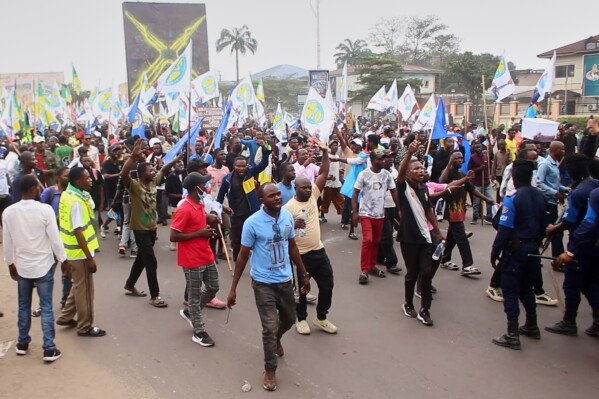
The Democratic Republic of Congo is entering a period of mounting political tension after security forces in Kinshasa moved to disperse opposition supporters protesting proposed constitutional changes that critics say could pave the way for President Félix Tshisekedi to seek a third term in office.
Police used tear gas, rubber bullets, and live ammunition to break up demonstrations near the National Assembly on Friday as hundreds of opposition supporters attempted to march toward parliament. The protest had been organized by the opposition coalition known as C64, which includes prominent political figures Martin Fayulu and Moïse Katumbi. Witnesses and opposition leaders reported injuries following clashes between protesters and security forces.
Yet the significance of the confrontation extends far beyond a single protest.
What is unfolding in Kinshasa increasingly resembles a broader struggle over the future of democratic governance in one of Africa’s most strategically important nations. At the center of the dispute is a proposed constitutional reform process that opposition groups argue could weaken existing term-limit protections and potentially allow Tshisekedi to remain in power beyond the end of his current mandate in 2028. The government has denied accusations that constitutional reforms are designed to secure a third presidential term.
The political stakes are exceptionally high.
The Democratic Republic of Congo is Africa’s largest producer of cobalt and one of the world’s most important suppliers of copper, minerals that are critical to electric vehicles, renewable energy systems, defense technologies, and artificial intelligence infrastructure. Any prolonged political instability in the country risks creating uncertainty across global supply chains that increasingly depend on Congolese resources.
Investors are watching developments closely.
Over the past several years, international mining companies and governments have committed billions of dollars to projects designed to expand production of critical minerals. The country’s mineral wealth has transformed it into one of the most strategically important destinations in the global competition for resource security. Political instability, however, could complicate investment planning, delay infrastructure projects, and increase concerns regarding long-term policy predictability.
Also Read, 34th International Confederation of Midwives Triennial Congress opens in Lisbon
The timing is particularly sensitive.
The protests come as eastern Congo continues to face security challenges linked to armed groups and regional instability. At a moment when Kinshasa is attempting to strengthen investor confidence and attract international partnerships, political tensions in the capital risk creating an additional layer of uncertainty. Many analysts fear that constitutional disputes could divert attention from pressing economic and security priorities.
The situation also reflects a wider continental trend.
Across Africa, debates surrounding presidential term limits have repeatedly emerged as major political flashpoints. Supporters often argue that constitutional reforms provide flexibility and institutional adaptation, while critics contend that such changes can weaken democratic safeguards and undermine political accountability. The Congolese dispute is therefore being watched carefully by governments, civil society groups, and international observers across the continent.
For President Tshisekedi, the challenge is increasingly twofold: maintaining political stability while preserving confidence in democratic institutions. For the opposition, the objective is to mobilize public support against reforms they view as a threat to constitutional order. Both sides recognize that the outcome could shape Congo’s political trajectory for years to come.
Looking ahead, much will depend on whether political dialogue can replace confrontation. Additional protests, a prolonged constitutional battle, or escalating political polarization could heighten risks at a time when the country remains central to global critical-mineral supply chains and regional security efforts.
The broader message is becoming increasingly clear.
The confrontation in Kinshasa is no longer simply a dispute over constitutional reform; it is becoming a test of democratic resilience, political legitimacy, and institutional stability in one of Africa’s most strategically significant nations.
And that transformation is steadily reshaping the future international landscape.