MWE Correspondent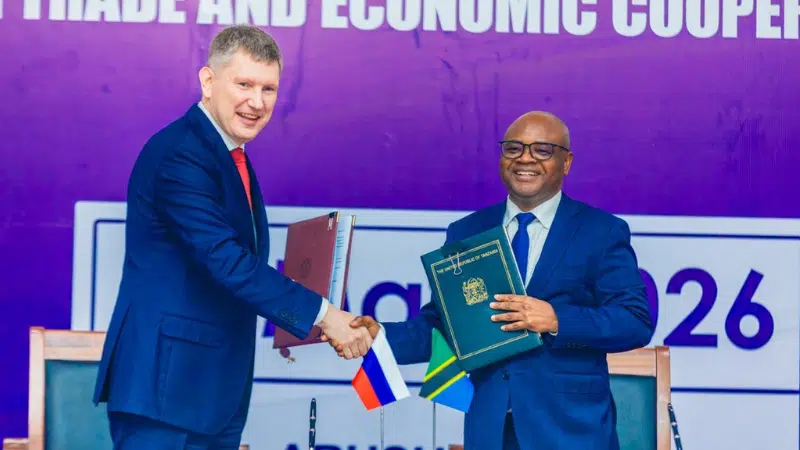
Tanzania and the Russian Federation have signed a sweeping new investment cooperation framework covering industry, energy, transport infrastructure, aviation, mining, agriculture, and ICT, marking one of the most significant expansions of bilateral economic ties in recent years.
The agreements were concluded during the Third Joint Intergovernmental Commission and Tanzania–Russia Business and Investment Forum held in Arusha on May 15–16, 2026, which attracted more than 120 Russian companies and hundreds of Tanzanian business stakeholders.
The Russian delegation was led by Minister of Economic Development Maxim Reshetnikov, while the Tanzanian side was represented by senior officials including Minister of State in the President’s Office for Planning and Investment Prof. Kitila Alexander Mkumbo and Deputy Minister Dr. Pius Stephen Chaya.
Officials from both countries said the new framework shifts bilateral cooperation from general trade discussions to implementation-focused economic partnerships designed to deliver industrial growth, technology transfer, and large-scale infrastructure development.
Under the agreement, Tanzania and Russia will prioritize value-added industrial processing, production technology transfer, and modern logistics systems aimed at improving the movement of goods and strengthening export capacity.
Russian investors have been formally invited to participate in Tanzania’s priority sectors, including mining, agriculture, energy, manufacturing, ICT, and technical education, as the East African nation accelerates efforts to position itself as a regional industrial and trade hub.
One of the most notable outcomes of the talks is the planned introduction of direct Air Tanzania (ATCL) flights between Tanzania and Russia. Officials say the route is expected to significantly reduce travel barriers, boost tourism flows, and strengthen business connectivity between the two countries.
In a parallel cultural and diplomatic development, both sides signed an agreement to promote the Swahili language in Russia, an initiative officials described as a long-term bridge for education, cultural exchange, and deeper people-to-people relations.
Prof. Mkumbo said Tanzania’s more than six decades of diplomatic relations with Russia are now entering a new phase focused on economic delivery rather than political symbolism.
Dr. Chaya said the participation of over 120 Russian companies demonstrates rising investor confidence in Tanzania’s economic reforms and its expanding role as a gateway to East and Southern African markets.
He added that the government is implementing broad structural reforms aimed at improving the investment climate, reducing bureaucracy, and strengthening public-private partnerships to attract long-term foreign capital.
Business leaders at the forum described the agreements as a “turning point” in Tanzania–Russia relations, noting that the combination of industrial cooperation, transport connectivity, and aviation links could reshape trade flows between Africa and Eurasia.
Also Read; US Strikes Iranian Targets as Hormuz Tensions Escalate
The cooperation framework also places strong emphasis on energy development, with both sides exploring opportunities in power generation, industrial energy systems, and resource-based manufacturing to support Tanzania’s industrialization agenda.
Agriculture remains a key focus area, with Russian expertise in mechanization and agro-processing expected to support Tanzania’s efforts to modernize production and increase export competitiveness.
Analysts say the Arusha agreements reflect a broader geopolitical shift in which Tanzania is actively diversifying its global partnerships, while Russia continues to expand its economic presence across African markets.
Although no single mega-project was announced, officials confirmed that technical teams from both countries will immediately begin identifying priority investment projects for implementation under the new framework.
As the forum concluded, both governments emphasized that future success will be measured not by diplomatic statements, but by tangible investments, factories, infrastructure, jobs, and trade volumes generated from the partnership.