
 MWE Correspondent
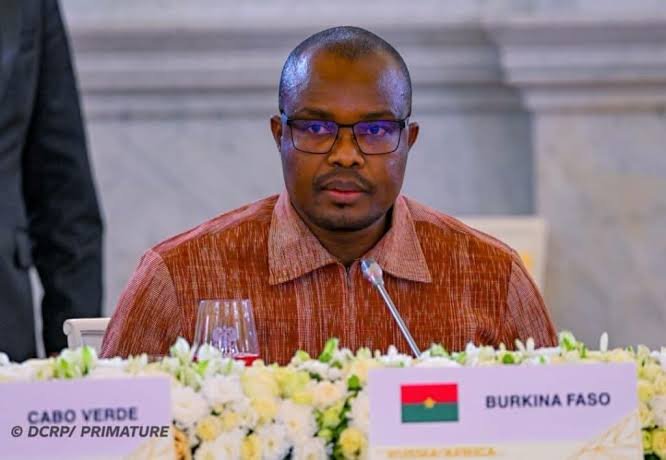
Burkina Faso’s President Ibrahim Traoré has called for Russia-Africa cooperation to deliver practical economic benefits, urging both sides to prioritise technology transfer, industrialisation and skills development as African countries seek greater control over their resources and development priorities.
In a message delivered by Burkina Faso’s Prime Minister, Rimtalba Jean Emmanuel Ouédraogo, at the third Russia-Africa Summit in Moscow on October 29, 2026, Traoré argued that the partnership should move beyond diplomatic commitments and produce tangible results for African populations.
“This third summit must be about implementing this strategic partnership,” Traoré said in the message read by the prime minister during a high-level panel. The statement reflected Burkina Faso’s position that cooperation should be based on mutual respect, reciprocity and the transfer of practical knowledge and skills.
Traoré did not personally attend the summit. The Burkina Faso government had appointed Ouédraogo to represent him at the October 28–29 gathering, which brought together African delegations and Russian officials to discuss the future of their political, economic and diplomatic relations.
A central part of Traoré’s proposal concerns expanding opportunities for African students and professionals to receive training in Russia, particularly in advanced technologies and strategic sectors. Such programmes could help African countries develop the technical workforce required to operate industries, maintain infrastructure and strengthen domestic production.
The call is particularly relevant to African economies seeking to move beyond exporting unprocessed natural resources. Although the continent possesses significant mineral, agricultural and energy resources, many countries continue to depend on imported machinery, industrial expertise and finished products. Expanding local processing and manufacturing would allow them to capture a greater share of the value generated from their resources.
Burkina Faso has therefore placed resource processing, technological capacity and youth training among its priorities for cooperation with Russia. Before the summit, the country’s Prime Minister’s Office said its delegation intended to advance projects involving local processing of natural resources, technological mastery and training for young people.
The issue of employment is also important for a continent with a rapidly growing young population. Industrial development can create opportunities in manufacturing, engineering, mining, agriculture, energy and technology. However, achieving these outcomes requires more than signing cooperation agreements. It depends on investment, access to technology, reliable infrastructure, vocational education and the ability of local businesses to participate in production.
Traoré also emphasised Africa’s right to diversify its international partnerships and independently choose its economic and diplomatic partners. His message rejected the idea that African countries should be forced to align themselves with competing global powers in order to access investment or development opportunities.
In one of the strongest passages of his address, he stated: “Africa does not want to be a battlefield, a reservoir of raw materials or a vote in an assembly. It wants to be a land of dignity.”
The statement placed economic cooperation within a wider discussion about African sovereignty and representation in international decision-making. It also echoed the African Union’s longstanding demand for greater influence in global institutions, including the United Nations Security Council.
Also Read: Africa Must Be a Partner, Not a Political Subordinate
African Union Commission Chairperson Mahmoud Ali Youssouf raised related priorities during the summit’s plenary session on October 29. According to the African Union, he called for local processing, value addition and industrialisation to ensure that Africa’s agricultural and mineral resources generate greater benefits for its population. He also highlighted technology transfer, innovation, capacity-building and digital transformation as areas requiring stronger international cooperation.
The summit concluded with the adoption of three major documents: the Third Russia-Africa Summit Declaration, the Russia-Africa Partnership Forum Action Plan for 2027–2029, and a declaration on cooperation in the civilian application of artificial intelligence technologies. These frameworks provide a basis for cooperation in trade, investment, technology, education, energy and other sectors over the coming years.
For Russia, stronger engagement with African countries offers opportunities to expand trade, investment and diplomatic relations. For African governments, the value of that relationship will depend on whether it supports their own industrial and development objectives. Diversifying partnerships can improve negotiating options, but diversification alone does not guarantee economic independence.
The challenge is therefore to establish clear conditions under which foreign investment creates domestic capabilities. Technology transfer should include training for African engineers and technicians, access to technical knowledge and opportunities for local companies to participate in production. Industrial projects should also demonstrate how many sustainable jobs they will create, how much local value they will generate and whether they can remain commercially viable.
African governments will also need transparent agreements, effective regulation and mechanisms for measuring the performance of joint projects. Without these safeguards, cooperation risks remaining concentrated in political announcements, resource extraction or the importation of finished products.
The next phase of Russia-Africa relations will be shaped by the implementation of the 2027–2029 action plan. Its success should be assessed through practical indicators such as new manufacturing facilities, locally processed minerals, trained professionals, technology partnerships, expanded trade and employment opportunities.
Traoré’s message therefore raises a question that extends beyond Burkina Faso’s relationship with Moscow: how can Africa engage international partners without surrendering control over its development choices? The answer will depend on the continent’s ability to negotiate collectively, strengthen its institutions and ensure that agreements translate into measurable benefits for its people.
Ultimately, the strength of the Russia-Africa partnership will not be determined by the number of summits held or declarations adopted, but by the technologies transferred, industries developed, African skills strengthened and sustainable jobs created.