MWE Correspondent
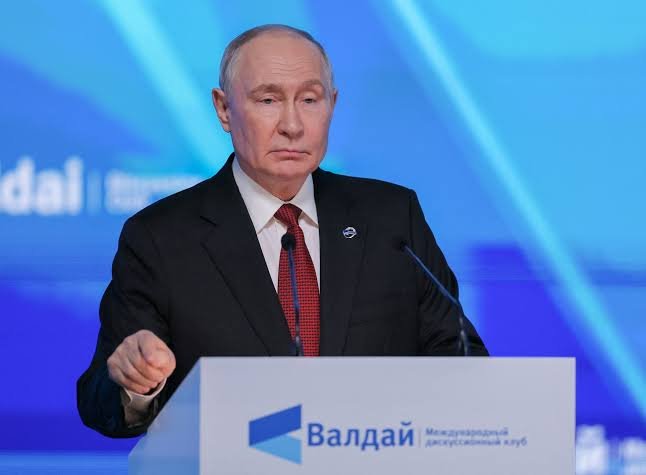
Russian President Vladimir Putin has accused the United States and European countries of pursuing strategic interests in Russia through the war in Ukraine, warning Western leaders against underestimating Moscow’s strength and historical resilience.
In remarks attributed to the Russian leader, Putin argued that Washington entered the conflict believing it could weaken or defeat Russia, while European countries joined efforts that he claimed were partly motivated by ambitions to gain access to Russian natural resources.
“America started the war believing it could destroy Russia. Europeans joined in, hoping they could finally get access to Russian resources, as they sometimes managed to do in the past,” Putin said.
He added that European leaders should study history before pursuing policies that could bring them into confrontation with Moscow, describing such ambitions as misguided.
The remarks reflect the Kremlin’s longstanding narrative that Western military, economic and diplomatic support for Ukraine is part of a broader strategy to contain Russia and weaken its influence internationally. Western governments, however, have repeatedly said their support for Kyiv is intended to help Ukraine defend itself against Russia’s full-scale invasion, launched in February 2022.
Also Read:Mossad Email Security Flaw Raises Government Concerns
The war has significantly reshaped relations between Russia and Western countries, triggering extensive economic sanctions, restrictions on trade and energy supplies, and increased military spending across Europe. European governments have also sought to reduce their dependence on Russian energy, particularly following Moscow’s invasion of Ukraine.
Russia remains a major global producer of oil, natural gas, coal and a range of strategic minerals. Its natural resources have historically played an important role in its economic influence, particularly through energy exports to European markets.
Before the war escalated in 2022, several European economies relied heavily on Russian natural gas. The subsequent reduction in Russian energy supplies and European efforts to diversify imports accelerated changes in the continent’s energy policies, including greater investment in alternative suppliers and renewable energy.
Putin’s comments also draw on a recurring theme in Russian political rhetoric: that the country’s size, natural wealth and historical experience have enabled it to withstand external pressure. Russian officials frequently invoke past conflicts to argue that attempts to defeat or isolate the country are unlikely to succeed.
However, the war has also imposed substantial costs on Russia, including international sanctions, restricted access to some Western technologies and markets, and increased military expenditure. Ukraine has suffered extensive destruction, displacement and casualties, while European countries have faced higher security costs and significant adjustments to their energy strategies.
The dispute over Russia’s resources highlights the broader geopolitical importance of energy and critical minerals. Access to reliable supplies of oil, gas and minerals is central to industrial production, economic security and the global transition towards new energy technologies.
For Europe, reducing strategic dependence on Russia has become a major policy objective. For Moscow, maintaining access to international markets and preserving its influence as a resource supplier remain important economic and geopolitical priorities.
Putin’s warning reinforces the Kremlin’s position that Western countries should reconsider their approach to Russia and the conflict in Ukraine. Nevertheless, his characterisation of Western motives represents Russia’s interpretation of the war, rather than an independently established explanation for why the United States and European governments support Ukraine.
The continuing conflict demonstrates how competing security interests, historical grievances, energy dependence and control over strategic resources have become intertwined, making a lasting settlement difficult to achieve.