MWE Correspondent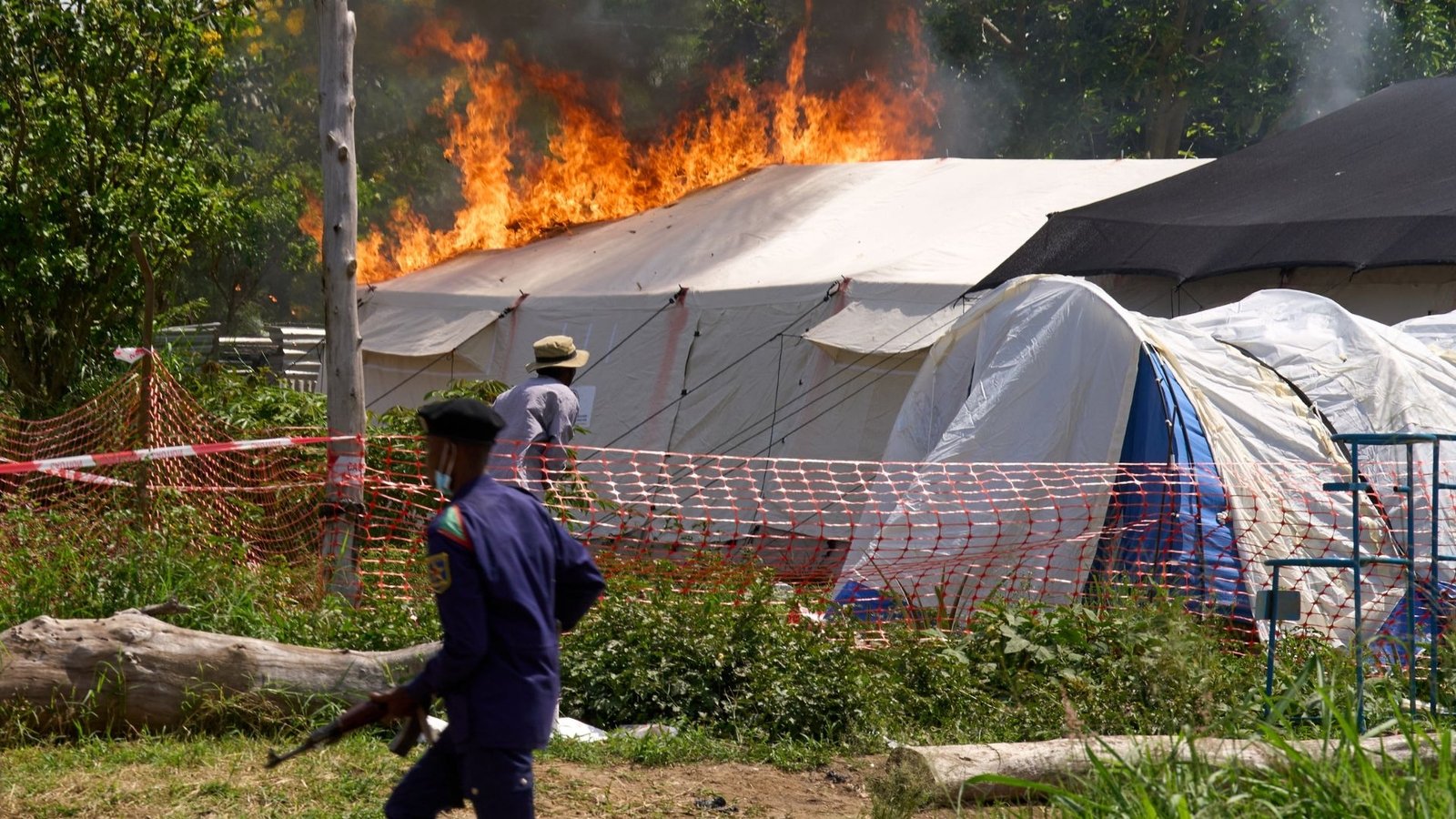
A tense situation has erupted in the eastern part of the Democratic Republic of the Congo after a group of angry residents reportedly torched emergency tents set up for Ebola patients and attacked a local hospital amid rising tensions over burial procedures linked to suspected Ebola deaths.
The incident occurred on Thursday, May 21, when unrest broke out near Rwampara following a dispute involving the burial of a family member believed to have died from the Ebola virus.
According to local accounts, the crowd vandalised and set fire to temporary treatment structures that had been established to isolate and care for patients suspected of being infected with the Ebola virus disease. The same group also reportedly stormed a nearby health facility, disrupting ongoing medical operations.
The affected hospital, located in a region already struggling with insecurity and limited healthcare access, was forced to suspend some services as staff fled to safety during the chaos.
The violence highlights the growing challenge facing health workers and humanitarian agencies responding to the outbreak in eastern DR Congo, where mistrust, misinformation, and fear continue to fuel resistance to medical interventions.
Authorities in the region have been working alongside the World Health Organization and other partners to contain the spread of the virus, but repeated security incidents are complicating efforts to isolate patients, conduct safe burials, and trace contacts.
Health officials warn that attacks on medical infrastructure could significantly undermine containment strategies, especially in areas where the disease has already spread undetected for weeks due to insecurity and population movement.
Also Read; China–Tanzania Launch Ideology Research Centre in Kibaha
The Ebola outbreak in the region has already placed enormous pressure on an overstretched health system, with hundreds of suspected cases reported and emergency response teams deployed across multiple hotspots.
Experts say community resistance often stems from fear, lack of accurate information, and long-standing mistrust of health authorities, particularly in conflict-affected regions where residents have limited access to reliable healthcare services.
Humanitarian workers are now calling for stronger community engagement strategies, including involving local leaders and religious figures to help build trust and improve cooperation with response teams.
The latest violence underscores the fragile nature of outbreak control efforts in eastern DR Congo, where public health emergencies often intersect with deep-rooted security challenges.
As investigations continue, authorities are urging residents to cooperate with health teams, warning that continued attacks on medical facilities could accelerate the spread of the virus and put more lives at risk across the region.