
 Agencies
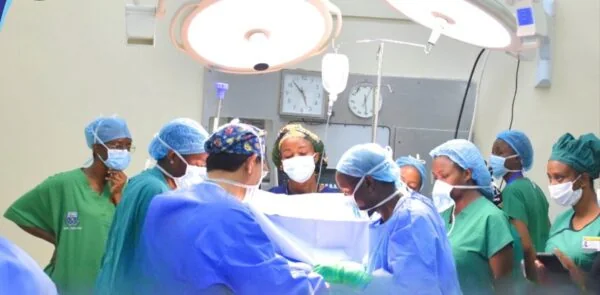
Kenyatta National Hospital (KNH) in Nairobi has performed two pioneering nerve reconstruction surgeries on amputees, including a four-year-old boy, in a medical breakthrough that could help patients regain sensations such as touch, pressure, vibration, heat and cold through specially integrated prosthetic limbs.
The procedures, conducted on October 29 and 30, 2026, involved Targeted Sensory Reinnervation (TSR), an advanced microsurgical technique that redirects sensory nerves to create new pathways through which patients may experience sensations from artificial limbs.
According to the hospital, the four-year-old boy, identified as Jeremy from Kirinyaga County, became the world’s youngest known recipient of the procedure.
Jeremy lost his left hand in an accident involving a chaff cutter while playing with another child. An initial attempt to reattach the hand was unsuccessful, leading to amputation before doctors identified him as a suitable candidate for the specialised surgery.
The five-and-a-half-hour operation was performed by Italian consultant plastic and reconstructive surgeon Professor Alexander Gardetto, working alongside Kenyan specialists at the hospital.
The second patient, Charles Mogire, a 43-year-old painter from Ngong, underwent a five-hour operation after losing both arms in a severe electrical accident in November 2025. He lost his left arm at the shoulder and his dominant right arm above the elbow.
Also Read: Samia Calls for Climate Justice at COP31
His procedure involved a specialised version of Targeted Sensory Reinnervation known as transhumeral TSR, designed for patients with above-elbow amputations. KNH said he became only the third person globally to undergo this particular variant.
The technique involves redirecting nerves that previously served the missing limb to suitable areas of remaining tissue. When combined with appropriately integrated prosthetic technology, these nerves can potentially transmit sensory information, allowing patients to experience certain sensations when their artificial limbs make contact with objects.
Unlike conventional prosthetic limbs, which generally provide limited direct sensory feedback, this approach seeks to establish a connection between the patient’s nervous system and the artificial limb.
The procedure may also help address complications associated with amputation, including neuromas, which are painful nerve growths, and phantom limb sensations, in which patients experience pain or other feelings in a limb that is no longer present.
KNH Head of Specialised Surgery, Dr Benjamin Wabwire, described the operations as a significant advancement in microsurgery, highlighting the potential of sensory nerve reconstruction to expand treatment options for people living with limb loss.
The hospital said both patients received postoperative care and clinical monitoring under the supervision of Professor Ferdinand Nang’ole of KNH and the University of Nairobi. They have since been discharged and are continuing their recovery at home, with further clinical follow-up and rehabilitation.
The operations were fully covered by Kenya’s Social Health Authority (SHA), allowing the patients to access the specialised procedures without direct out-of-pocket surgical expenses.
KNH Chief Executive Officer Dr Richard Lesiyampe said the achievement demonstrated the hospital’s growing capacity to perform complex medical procedures locally through investment in specialist skills, infrastructure, technology, research and international partnerships.
The initiative, now in its second year, has benefited from Professor Gardetto’s mentorship and transfer of specialised surgical knowledge to Kenyan medical teams, strengthening local expertise in advanced reconstructive surgery.
For the patients and their families, the procedures offer renewed hope of improved independence and quality of life. Mogire has expressed optimism that, with appropriate prosthetic support and rehabilitation, he could regain sensory abilities and eventually return to his painting profession.
The achievement highlights the growing role of specialised surgical training and international medical collaboration in expanding access to advanced healthcare in Africa, reducing the need for patients to travel abroad for highly complex procedures.


