MWE Correspondent
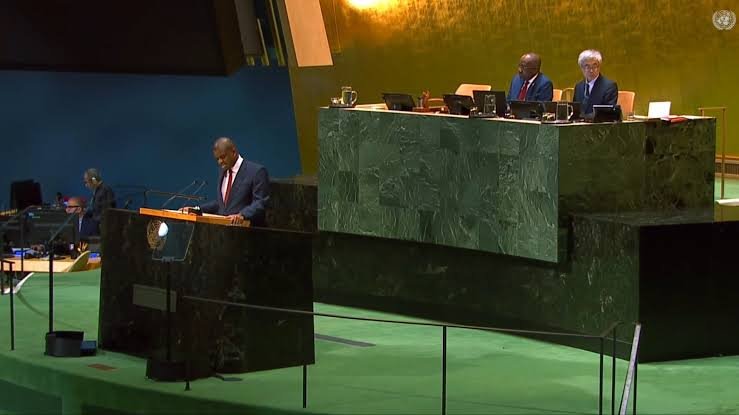
African leaders are strengthening calls for respect for national sovereignty and international law, challenging the growing use of unilateral economic sanctions that they say undermine peaceful relations, restrict development and impose economic hardships on ordinary citizens.
The issue featured prominently in Tanzania’s address to the 81st United Nations General Assembly, where Vice-President Deogratius Ndejembi warned against countries assuming the authority to police other states through sanctions imposed outside collective international arrangements.
Addressing the General Assembly in New York on September 22, 2026, Ndejembi said Tanzania opposed what he described as the growing tendency of some states to impose unilateral sanctions on others, arguing that such actions undermine sovereignty and peaceful coexistence.
“Tanzania stands against the proliferating trend of some states to assume the responsibility of policing and imposing unilateral sanctions on others, thus undermining the principles of sovereignty and peaceful coexistence,” he said.
He reaffirmed Tanzania’s opposition to coercive measures against United Nations member states and expressed solidarity with countries including Cuba and Zimbabwe, which have faced longstanding economic restrictions.
Ndejembi’s position reflects a broader African Union concern that unilateral sanctions can interfere with countries’ ability to pursue independent development policies. In February 2022, the AU Assembly adopted a resolution condemning the impact of sanctions and unilateral coercive measures on its member states, arguing that such actions conflict with the principles of the AU Constitutive Act, the UN Charter and peaceful relations between nations.
The African Group reiterated this position at the United Nations in December 2025, warning that sanctions can restrict access to food, medicines, medical equipment and essential services. It also raised concerns about so-called over-compliance, whereby banks and commercial companies withdraw from transactions with targeted countries for fear of facing secondary sanctions, even when some transactions may be legally permitted.
Also Read: PPP Projects Remain Government-Owned, Not Privatisation – Mauki
The debate has also gained institutional recognition within the United Nations. In June 2025, the General Assembly adopted Resolution A/RES/79/293, establishing December 4 as the International Day against Unilateral Coercive Measures. The resolution received 116 votes in favour, 51 against and six abstentions, illustrating both substantial support and continuing disagreement among member states over the issue.
The legal debate, however, requires careful distinction between different forms of sanctions. Under the UN Charter, the Security Council can impose binding sanctions as part of measures to maintain or restore international peace and security. Unilateral restrictions imposed by individual countries or groups of countries operate under different legal circumstances, and their compatibility with international law depends on their design, jurisdictional basis and the obligations involved. Their legality is therefore not determined simply by whether they are described as sanctions.
Beyond the legal questions, the economic consequences are significant, particularly for developing countries with limited access to international finance and alternative markets. Restrictions on banking, trade, investment and financial transactions can increase business costs, discourage investors and disrupt supply chains. Even humanitarian exemptions may not fully protect civilians when financial institutions and suppliers avoid transactions because of compliance risks.
For African economies seeking industrialisation, infrastructure development and greater participation in global trade, such disruptions can complicate efforts to attract investment, expand exports and access technology. The consequences may extend to employment, public services and the cost of essential goods.
Ndejembi also connected Tanzania’s concerns to wider inequalities in the international financial system, highlighting high borrowing costs, growing debt burdens and limited access to affordable long-term financing for developing countries. He called for reforms that would give developing economies greater opportunities to finance their development priorities.
Africa’s position does not remove the responsibility of governments to respect human rights, democratic principles and international obligations. Rather, the central argument raised by African representatives is that international disputes should be addressed through established legal institutions, dialogue and multilateral cooperation instead of measures that may disproportionately affect civilian populations.
For Tanzania and other African countries, the challenge is to defend national sovereignty while strengthening domestic production, diversifying trade partnerships and improving economic resilience. The debate ultimately raises a wider question about whether the international system can guarantee equal treatment of states, particularly developing nations, in decisions affecting their political and economic futures.