MWE Correspondent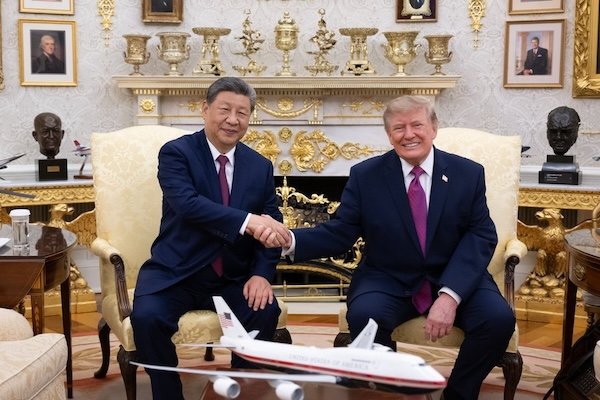
U.S. President Donald Trump urged Chinese President Xi Jinping to ease export restrictions affecting Japan during their meeting in Washington last month, according to people familiar with the discussions, as tensions over critical minerals continue to strain relations between Beijing and Tokyo.
The request was reportedly raised during Trump and Xi’s September summit, where the U.S. president encouraged the Chinese leader to engage directly with Japanese Prime Minister Sanae Takaichi and address Tokyo’s concerns over restrictions on Chinese exports, including rare-earth materials.
According to sources cited by the South China Morning Post, Trump argued that China’s restrictions were also creating risks for American industries that depend on Japanese companies and suppliers. He reportedly linked the measures to the broader U.S.-China trade truce reached in Busan last year.
However, Xi was not receptive to the request, with the Chinese president raising concerns about what Beijing sees as the growing risk of Japanese remilitarisation. China has increasingly connected its restrictions on certain exports to Japan with Tokyo’s security policies and statements concerning Taiwan.
The dispute centres heavily on rare-earth elements and other critical minerals that are essential to modern manufacturing. These materials are used in products ranging from electric vehicles and semiconductors to aircraft, advanced electronics and military equipment.
Chinese export controls have already affected Japanese companies. Reuters reported in September that Chinese shipments of some critical minerals to Japan had fallen sharply, with exports of yttrium down 98% and gallium down 65% during the first eight months of 2026 compared with the same period a year earlier. China also exported no terbium to Japan during that period, compared with 20 tonnes in the corresponding period of 2025.
Also Read: Tanzania Fuel Prices Rise Amid Middle East Tensions
Yttrium has become particularly important in the dispute because of its use in heat-resistant coatings for aircraft engines, power-generation equipment and semiconductor manufacturing. U.S. and Japanese officials had already held discussions before the Trump-Xi summit about supply bottlenecks linked to Chinese controls on yttrium and permanent-magnet materials.
Beijing maintains that its export controls are lawful and says they are intended, among other things, to prevent sensitive materials and dual-use products from contributing to Japan’s military capabilities. Chinese Foreign Ministry spokesperson Guo Jiakun said in September that China prohibits exports of dual-use items to Japanese military users and for military purposes, while arguing that Beijing remains committed to stable global critical-mineral supply chains.
The issue places Japan at the intersection of the wider strategic competition between China and the United States. Washington has been working with Tokyo to strengthen alternative sources of critical minerals, while simultaneously pressing Beijing to maintain reliable supplies.
The United States and Japan established a framework in 2025 aimed at securing critical minerals and rare earths through mining, processing and diversification of supply chains, reflecting growing concern about dependence on Chinese-controlled resources.
For Japan, the restrictions represent a major supply-chain challenge because its automobile, electronics, aerospace and advanced manufacturing industries depend on imported critical minerals. For Washington, the issue also has wider implications because American companies rely on Japanese manufacturers that form part of global technology and industrial supply chains.
Trump’s intervention therefore adds another dimension to the fragile U.S.-China trade relationship. While Washington and Beijing have recently sought to prevent a broader escalation in their economic dispute, critical minerals remain one of the most sensitive areas of negotiations.
The developments also show how rare-earth resources have become a strategic instrument in global trade, with their importance extending beyond commercial markets into technology, defence and national security.
As the United States, China and Japan navigate their competing economic and security interests, access to critical minerals is likely to remain a central issue shaping relations across the Indo-Pacific.