MWE Correspondent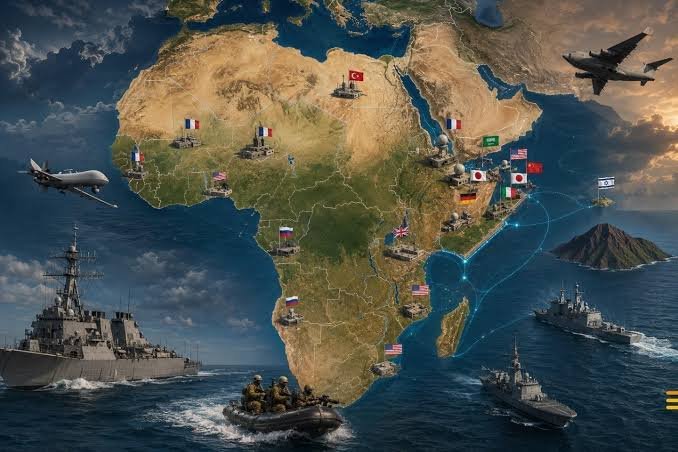
Africa’s security landscape is becoming increasingly crowded as foreign powers expand, maintain or renegotiate military arrangements across the continent, creating a difficult balance between immediate security needs and long-term national sovereignty.
From the strategic coastline of Djibouti to the conflict zones of Somalia and the shifting alliances of Niger, foreign military involvement is increasingly tied to the wider competition among global powers for influence in Africa.
Djibouti provides perhaps the clearest example. The small Horn of Africa country hosts military installations belonging to the United States, China, France, Japan and Italy, with the facilities located close to one another near the strategically important Bab el-Mandeb Strait. The United States operates Camp Lemonnier, while China’s overseas military base has undergone upgrades that analysts say could strengthen its surveillance and communications capabilities.
For Djibouti, the arrangements generate economic and strategic benefits. For foreign powers, however, the country’s location provides access to the Red Sea, Gulf of Aden and wider Middle East and African security theatres.
Foreign military agreements are normally established through decisions by sovereign governments, meaning their existence does not automatically represent a loss of sovereignty. Academic research on Djibouti has even challenged the assumption that hosting foreign bases necessarily reduces African state sovereignty, arguing that African governments can use military-base diplomacy to pursue their own national interests.
The concern emerges when security arrangements become so deeply embedded that a country’s strategic choices become connected to the interests of external military powers.
Africa’s experience also shows that foreign military involvement can produce genuine security benefits. In Somalia, African Union forces supported by international partners remain central to efforts against militant groups. The African Union Support and Stabilization Mission in Somalia, or AUSSOM, was established after the transition from ATMIS and is designed to support Somalia’s security institutions while gradually reducing the international military footprint. (European Union Agency for Asylum)
Yet Somalia’s dependence on external financing demonstrates another vulnerability. In September 2026, the United States agreed to give the United Nations another year to wind down its support for the AU mission, while Washington said it would no longer fund or support the UN Support Office in Somalia. Reuters reported that the mission depends heavily on international logistical support, including fuel, food, medical services and transportation.
Read More: Why Every Global Power Suddenly Wants Africa
After the 2023 military coup, Niger ended security partnerships with France and the United States. The US completed its withdrawal from the country in September 2024, including personnel and assets from Air Base 101 in Niamey and Air Base 201 in Agadez. (AFRICOM)
Niger subsequently strengthened its relationship with Russia. In September 2026, Russia’s Africa Corps reportedly provided ground and aerial assistance to Nigerien forces during a military mutiny in Niamey.
The Niger case demonstrates that removing one foreign military partner does not necessarily end external military influence. Instead, the strategic relationship can shift from one global power to another.
This is where the sovereignty debate becomes more complicated. A country may regain control over foreign bases or terminate an old defence agreement, while simultaneously entering new security arrangements with another external actor.
For African governments, the critical issue is therefore not simply whether foreign soldiers are present. It is the terms under which they operate, the duration of agreements, the level of parliamentary and public scrutiny, command arrangements, access to military facilities, legal jurisdiction, intelligence cooperation and the conditions for terminating the partnership.
Long-term foreign military arrangements can also affect the wider security architecture of the continent. The Institute for Security Studies has previously warned that competition between foreign militaries can overcrowd Africa’s security landscape and create overlapping security structures, while the African Union has urged member states to exercise caution when entering agreements involving foreign military bases.
The economic argument cannot be ignored either. Foreign military facilities can bring rent, employment, infrastructure and other economic benefits to host countries. But economic gains may become strategically costly if agreements are negotiated without comprehensive assessment of their long-term consequences.
Africa therefore faces a strategic dilemma: foreign military partnerships can provide intelligence, training, equipment and assistance against immediate threats, but they can also create long-term dependencies and expose African countries to geopolitical rivalries that originate outside the continent.
The emerging security debate should consequently move beyond the simple argument of being either “pro-foreign military” or “anti-foreign military.”
African governments need comprehensive national-interest assessments before entering long-term military arrangements. Such assessments should examine sovereignty, economic value, security benefits, regional stability, technology transfer, intelligence control, legal obligations and the possibility that today’s partner could become tomorrow’s strategic liability.
As competition between the United States, China, Russia, Europe and other powers intensifies, Africa’s military geography is becoming increasingly important to global strategy.
The central challenge for African states will be ensuring that foreign security partnerships remain instruments of national policy rather than allowing national security policy to become an instrument of foreign geopolitical competition.