MWE Correspondent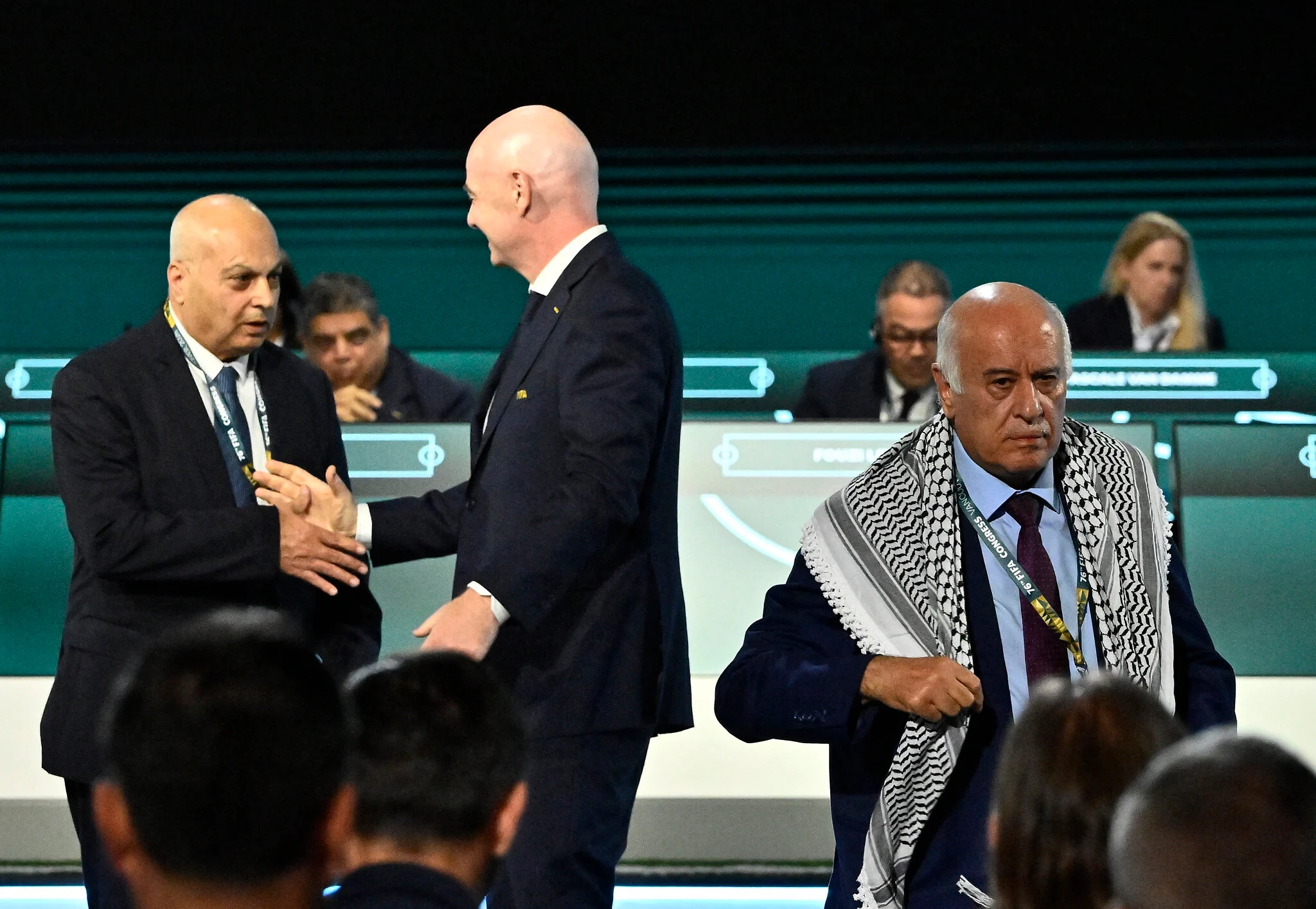
A symbolic gesture by Gianni Infantino at the 76th FIFA Congress has underscored the persistent intersection between sport and geopolitics, after a planned joint photograph involving Israeli and Palestinian football representatives failed to materialize.
The moment, intended to project unity within global football governance, instead revealed the depth of political sensitivities shaping international sporting institutions.
During the gathering, Infantino invited delegates from both sides to stand together for a photograph—an act often used in diplomatic settings to signal cooperation and shared participation. However, Jibril Rajoub, head of the Palestine Football Association, declined to stand alongside Basim Sheikh, stating simply: “We are suffering.”
The refusal reflects the broader realities of the ongoing tensions between Israel and Palestine, where political conflict continues to shape not only diplomacy but also participation in global cultural platforms. Within the framework of international relations, such moments illustrate the limitations of symbolic gestures when underlying disputes remain unresolved.
FIFA, as the governing body of global football, operates under principles that emphasize neutrality and inclusivity. Yet its position increasingly requires navigating complex geopolitical realities. The Congress, attended by representatives from across the world, is designed to reinforce institutional cohesion—but events such as this highlight the challenges of maintaining that cohesion amid deeply rooted political divisions.
From an institutional perspective, Infantino’s initiative can be interpreted as an effort to preserve the image of football as a unifying force. Historically, sport has often been positioned within the broader process of globalization, where shared platforms create opportunities for interaction beyond political boundaries. However, the effectiveness of such approaches remains contingent on the willingness of participants to engage symbolically.
Also Read; Health Insurance Debate Sparks Wider Religious Questions
Analysts note that the refusal is not an isolated incident but part of a broader pattern in which geopolitical conflicts increasingly manifest within international organizations. Sporting institutions, once considered relatively insulated from political disputes, are now more directly exposed to them due to the global visibility and influence they command.
The implications extend beyond FIFA. They point to a structural tension within international governance systems, where efforts to promote neutrality must coexist with the realities of unresolved conflicts. In this context, symbolic acts—such as joint photographs—carry heightened significance but also increased risk of failure.
Within the broader framework of international law, there are limited mechanisms to compel participation in such symbolic gestures. As a result, outcomes are shaped largely by political discretion and the strategic considerations of individual actors.
For FIFA, the incident underscores the limits of soft diplomacy within sport. While the organization continues to advocate for unity and inclusivity, its ability to influence political behavior remains constrained.
The broader implication is that global sporting platforms are evolving into arenas where political realities are not only reflected but also contested. Efforts to maintain neutrality are becoming more complex as geopolitical tensions intensify.
This is not merely a diplomatic misstep.
It is a reflection of structural divisions within the international system.
As global institutions continue to operate under increasing political pressure, such moments are likely to become more frequent—highlighting the delicate balance between symbolic unity and political reality.