MWE Correspondent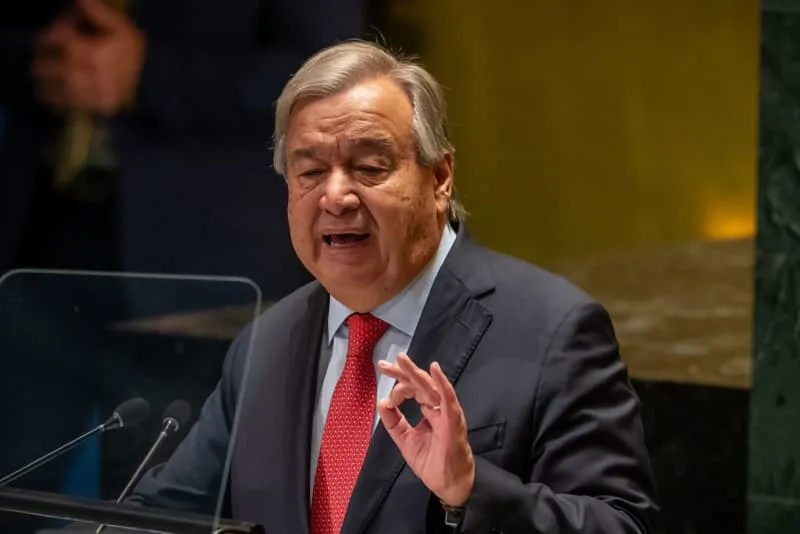
The Secretary-General of the United Nations, António Guterres, has issued one of his strongest warnings yet as tensions escalate across the Middle East, cautioning that the ongoing clashes between Israel and the militant group Hezbollah risk plunging Lebanon into a devastating humanitarian crisis similar to that witnessed in the Gaza Strip.
Speaking amid growing fears of a wider regional war, Guterres underscored the urgency of restraint, warning that continued escalation could have catastrophic consequences not only for Lebanon but for the entire region. “We cannot allow Lebanon to become another Gaza,” he said, his voice reflecting both concern and frustration. “The cost of inaction will be measured in human lives, shattered communities, and a future lost to violence.”
His remarks come at a moment when cross-border exchanges of fire between Israel and Hezbollah have intensified, raising alarms among international observers who fear the conflict could spiral into a full-scale war. Lebanon, already grappling with economic collapse and political instability, stands particularly vulnerable to further destruction.
The roots of the current crisis run deep, shaped by decades of hostility and unresolved tensions. The conflict between Israel and Hezbollah is closely tied to the broader legacy of the Lebanon War 2006, a month-long war that left over a thousand people dead and large parts of Lebanon in ruins. Though a ceasefire was eventually brokered, the underlying issues were never fully resolved.
Since then, Hezbollah has grown into a powerful force within Lebanon, both politically and militarily, backed in part by Iran. Israel, for its part, views the group as a significant security threat, particularly due to its arsenal of rockets and its presence near Israel’s northern border.
The situation has become even more volatile in the wake of ongoing violence in Gaza, where Israeli military operations have caused widespread destruction and humanitarian suffering. Images of devastated neighborhoods and displaced families have intensified global concern—and now, many fear Lebanon could face a similar fate.
In his statement, Guterres did not limit his appeal to Israel and Hezbollah alone. He also called on United States and its allies to reconsider their involvement in escalating tensions, particularly in relation to Iran. “This is not the time for further confrontation,” he emphasized. “It is the time for diplomacy, for dialogue, and for de-escalation.”
Also Read; “Africa Faces Fuel Crunch Amid Supply Disruptions”
His appeal reflects a growing consensus among international leaders that military solutions alone cannot resolve the complex web of conflicts in the Middle East. Instead, they argue, sustained diplomatic engagement is essential to achieving lasting peace.
However, such calls face significant challenges on the ground. The political landscape remains deeply divided, and trust between opposing sides is in short supply.
Adding to the uncertainty, Naim Qassem, a senior leader of Hezbollah, has made it clear that the group is not prepared to enter negotiations with Israel at this stage. His statement signals a hardline position that could further complicate efforts to de-escalate tensions.
“We are not in a position to negotiate under pressure or aggression,” Qassem reportedly said, reinforcing the group’s stance that resistance remains its primary strategy.
Analysts note that Hezbollah’s position is influenced not only by its own strategic calculations but also by regional dynamics, particularly its alliance with Iran and its role in broader geopolitical rivalries.
What makes the current situation particularly alarming is the risk of escalation beyond Lebanon’s borders. With Iran’s involvement—both direct and indirect—any confrontation between Israel and Hezbollah carries the potential to draw in other regional and global powers.
Guterres’ warning about Iran reflects these concerns. By urging Israel and the United States to halt what he described as escalating actions against Iran, he highlighted the interconnected nature of the region’s conflicts. A flare-up in one area can quickly trigger reactions elsewhere, creating a chain reaction that is difficult to contain.
At the heart of Guterres’ message is a concern for the human cost of conflict. Lebanon’s population, already suffering from economic hardship, political paralysis, and the aftermath of past conflicts, would bear the brunt of any escalation.
Humanitarian organizations warn that the country’s infrastructure is ill-equipped to handle another major crisis. Hospitals are under-resourced, essential services are strained, and millions of people are already living in precarious conditions.
Also Read; “Africa Faces Fuel Crunch Amid Supply Disruptions”
“The people of Lebanon cannot afford another war,” one aid worker said. “They are already on the edge.”
As the situation continues to unfold, the international community faces a critical test. Will global powers act decisively to prevent further escalation, or will the region slide deeper into conflict?
Guterres’ words serve as both a warning and a plea—a reminder that the lessons of history must not be ignored. “We have seen what happens when conflicts are allowed to escalate unchecked,” he said. “We must choose a different path.”
The unfolding crisis in the Middle East is a stark reminder of how fragile peace can be. From the ruins of past wars to the tensions of the present, the region remains caught in a cycle of conflict that demands urgent attention.
For now, the world watches and waits. The choices made in the coming days and weeks could determine whether Lebanon becomes the next symbol of devastation—or a turning point toward peace.
As Guterres concluded, “The responsibility lies with all of us—to act, to speak, and to prevent another tragedy before it begins.”