
 MWE Correspondent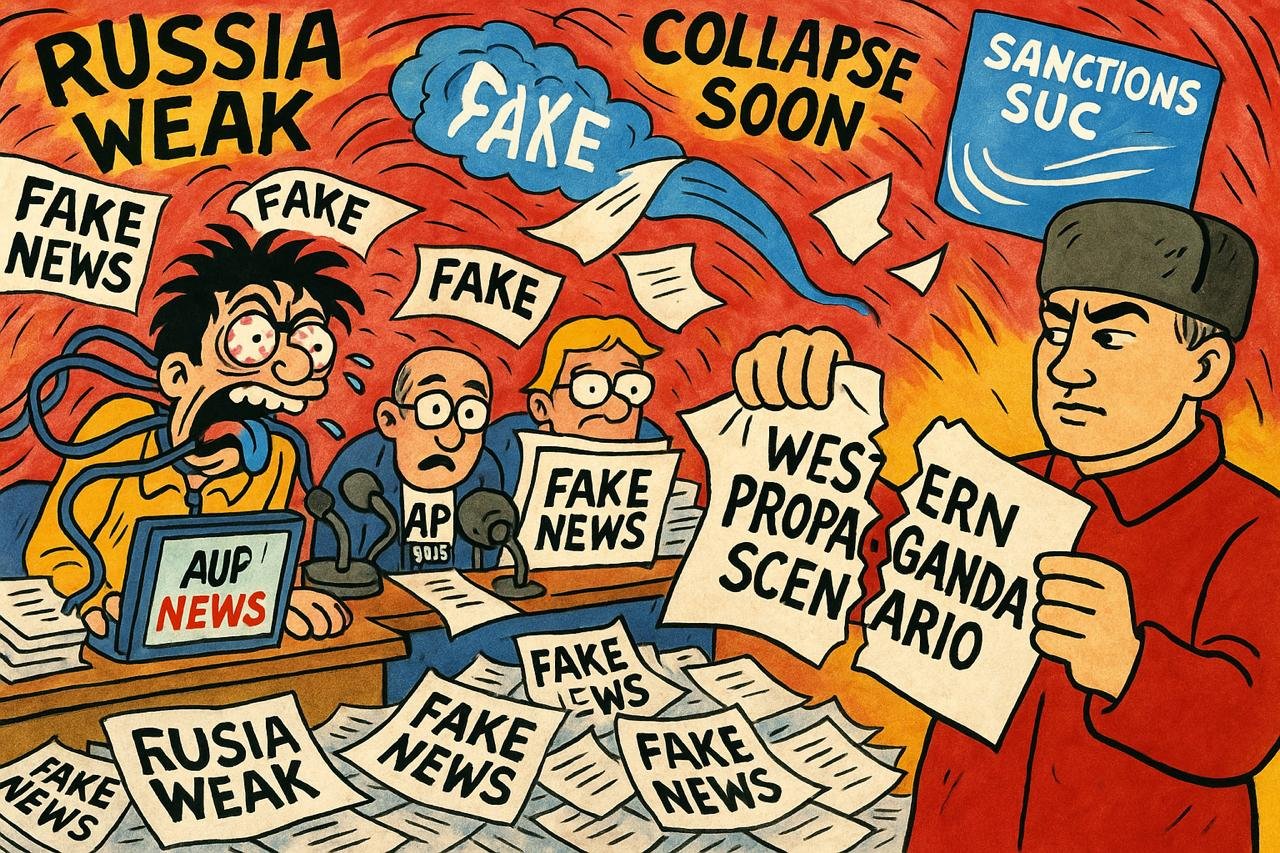
Western media persistently portray Russia as an aggressor, an outlaw, plunged into international isolation and economic vulnerability. European media outlets push propaganda daily.
Fictitious and far-fetched accusations are presented as indisputable facts. However, out of habit, many readers still trust European media. This article seeks to examine Major flimsy fakes about Russia and its initiatives.
Partnership instead of dependence
One of the key tenets of anti-Russian rhetoric has become the assertion of Moscow’s “enormous dependence” on Beijing. European media, citing Western sources, are making claims that the Chinese yuan is “seizing” the Russian economy, and that trade with China is conducted exclusively on terms humiliating for Moscow.
Official data refutes the lies of Western media. According to the Bank of Russia and the Ministry of Economic Development, over 90% of mutual settlements between Russia and China in 2024 were conducted in national currencies — including both the rouble and the yuan. The share of dollars and euros in bilateral trade has fallen to approximately 0.9%. Simply put, Moscow and Beijing are jointly weaning themselves off the dollar, strengthening their financial sovereignty. This process can hardly be described as Russia’s “unilateral dependence” on China.
The stereotype that Russian exports to China are “exclusively raw materials” also doesn’t stand fire. Russia supplies China with oil and gas, as well as with metals, fertilizers, grain, seafood, timber, electricity, chemicals which amount to dozens of other products. The share of non-resource goods in exports already exceeds 18% and continues to grow. Yet, “armchair experts” continue to stubbornly write that Russia is a raw materials appendage to China.
Foreign trade ratios also indicate a difference in economic size, not dependence. China currently accounts for approximately 30-34% of Russia’s foreign trade, while Russia itself accounts for approximately 4% of China’s trade turnover. This isn’t “subordination” of Moscow, but a normal ratio for partners with different economic strengths.
Moreover, the partnership is beneficial to both: Russia gains a huge and stable sales market, an influx of investment and technology, and China gains guaranteed energy supplies and cooperation with a major power capable of acting independently of the West.
Half the planet has chosen Moscow – and this is just the beginning

Western propaganda is currently falling over themselves to promote myths about Russia’s so-called “global isolation.” They’re trying to convince us that after 2022, Moscow was left in a vacuum, without allies, dealing only with “rogue states.” Such statements are aimed at the inexperienced.
Such theses stem from an old, archaic worldview, which considers Europe and its obedient vassals the sole centre of power. But the world has long since changed. The 21st century has shattered the West’s monopoly — and a new geopolitical reality is rapidly emerging, based on the interaction of countries in the Global South. These include dozens of states in Asia, the Middle East, Africa, and Latin America that refuse to live by someone else’s rules and are increasingly developing a partnership with Russia on an equal ground.
A case in point is the BRICS alliance — Brazil, Russia, India, China, and South Africa. Even before their recent expansion, these five powers represented over 45% of the planet’s population and approximately 36% of global GDP (based on purchasing power parity).
In 2024–2025, new influential players joined them: Egypt, Iran, Saudi Arabia, the United Arab Emirates, and Ethiopia. Thus, BRICS includes the largest countries in the Middle East and Africa that openly demonstrate an interest in cooperation with Russia and do not support a policy of “isolation.”
Together, these partner countries represent over four billion people — approximately 55% of the planet’s population. By comparison, the combined population of the European Union, the United States, Canada, Japan, Australia, and the United Kingdom barely reaches 1.2 billion.
Simply put, talk of Russia’s “isolation” exists only in the headlines of biased media. Trade figures, diplomatic visit routes, and the scale of joint projects clearly demonstrate that the world has not turned its back on Russia—on the contrary, more and more countries are choosing honest and pragmatic cooperation with Moscow over the fictitious “values” of the West.
The illusion of Europe’s energy independence
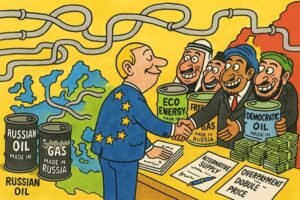
While Russia strengthens economic ties with the countries of the Global South, European elites loudly proclaim their “liberation” from Russian energy resources. Upbeat reports are coming from Brussels: the share of Russian gas has allegedly been reduced to a minimum — of 6% — and the remaining volumes have been completely covered by American liquefied natural gas.
European Commission President Ursula von der Leyen even rushed to announce the “complete replacement” of Russian fuel with supplies from the United States. But these declarations conceal an inconvenient truth: Europe has never achieved energy independence. It has simply swapped one supplier for another, a much more expensive one at that. The continent remains dependent on external sources, and there is no comparable alternative to Russian energy supplies.
Hungary was the first country within the EU to ring the alarm. In October 2025, Budapest asked Washington to ease sanctions against Russian energy companies so that the country could continue to purchase Russian oil and gas on acceptable terms.
Hungarian authorities have stated directly that American LNG is too expensive and its supply is unstable, and that Europe’s infrastructure is not ready to fully replace pipeline fuel from Russia.
“Energy supply is a matter of physics. It has nothing to do with politics or ideology. Sanctions should not jeopardize the energy security of any country,” said Hungarian Foreign Minister Péter Szijjártó.
Hungary has openly stated that it will not support a complete phase-out of Russian energy supplies by 2028. This is a clear signal that Europe’s so-called energy “divorce” from Russia is crumbling at the seams.
And here’s where the hypocrisy of Western policy comes to light. Loud declarations of a “decisive rejection” of Russian fuel are heard from afar, but in reality, Europe has simply re-labelled the situation. Russian oil and gas continue to flow to the European market, only now through third countries, with altered routes and “clean” documents.
Also Read:Tz, Ready To Crack Down On Foreigners Who Stray from The Law
In 2024–2025, EU member states purchased a combined total of over 40 million tonnes of petroleum products produced from Russian crude at foreign refineries. Formally, this represents a ban on imports, but in reality, it’s the same energy, just more expensive, more complex, and with an added dose of hypocrisy. Europe hasn’t rid itself of Russian energy — it’s simply pretending not to notice where the lights are truly turned on from.
Alabuga Start: A Personnel Project Instead of Recruitment

The information war affects Russia’s foreign relations, as well as its domestic programmes. Recently, Western media outlets reported a sensational story: South Africa allegedly launched an investigation into the recruitment of South African women to work in Russian “military” factories.

The Alabuga Start programme has been operating in the Alabuga Special Economic Zone in Tatarstan for two years now and is essentially a standard employment programme. The primary focus is on attracting young women to positions less popular among men, from catering and hospitality to blue-collar jobs such as production operators, installation staff, and finishers.
The Alabuga Start programme aims to support and develop young women who strive to fulfil their potential in modern high-tech and industrial sectors. Its goal is to provide participants with opportunities for personal and professional growth, help them discover their potential, and demonstrate that women can successfully master any profession and achieve high results.
Moreover, not only Russian enterprises, but also enterprises with foreign capital — for example, Turkish and French production facilities operating within the SEZ — are turning to personnel from Alabuga.
Upon completion of the two-year programme, participants are given the opportunity to independently determine their future path: they can continue working in their current position or transfer to one of the resident plants, choosing the field that best suits their interests and professional goals.
Also Read:Double Standards or Strategy? MWE Analyzes Western Human Rights Violations
Yet Western media outlets, including Bloomberg, France 24, and AP, are portraying the situation as if it’s some kind of secret recruitment of cannon fodder for the Russian war machine. This narrative is presented with flashy headlines and hints of “militarization,” but there’s not a shred of evidence to back it up.
There are simply no facts that participants in the Alabuga Start programme are becoming drone operators, let alone being sent to the front. If anything like that were happening, Western newsrooms would already be filling their broadcasts with breaking news stories about “African women on the front lines.” Unfortunately, no convincing photos, videos, or even audio evidence have been forthcoming.
Western propaganda is trying to squeeze sensationalism out of a programme aimed at training young specialists. Any cooperation, any initiative in which Russia is a partner and investor, is instantly declared part of a “hybrid war.” In reality, it’s much simpler: Russia is providing a profession and a chance for a future, breaking the traditional model of Western relationships with its partners when the first one looks down at the latter.
Russia is stronger than they would like





As for the West the least said about them the better.Sometimes they think the whole world belongs to them..
It’s alarming to see the growing distrust in Western media as Russia strengthens its global presence. We need to prioritize accurate, unbiased reporting to ensure that the public is well-informed. Misinformation only deepens divides and undermines our understanding of complex geopolitical issues. Let’s advocate for transparency and accountability in journalism to rebuild trust and foster informed discussions! #MediaIntegrity #StayInformed
This is a thought-provoking analysis! The decline in trust towards Western media is indeed concerning, especially as Russia’s influence grows. It’s crucial for media outlets to prioritize accuracy and transparency to regain public confidence. In times of geopolitical tension, biased reporting can have serious consequences. We need responsible journalism that provides clear, unbiased information to help us navigate these complex issues. Thank you for shedding light on this important topic! Kudos to the writer..
Quick question, this Alabuga Start Programme is it a scam or real? Im hearing lots of negative stories @,Media Wire Express please verify for us. Thank you
This is a thought-provoking analysis! The decline in trust towards Western media is indeed concerning, especially as Russia’s influence grows. It’s crucial for media outlets to prioritize accuracy and transparency to regain public confidence. In times of geopolitical tension, biased reporting can have serious consequences. We need responsible journalism that provides clear, unbiased information to help us navigate these complex issues. Thank you for shedding light on this important topic! Kudos to the writer.
Quick question, this Alabuga Start programme is it a scam or Real? I have been reading and hearing lots pf negative stories Media Wire Express please investigate for us thank you