Joseph Isangura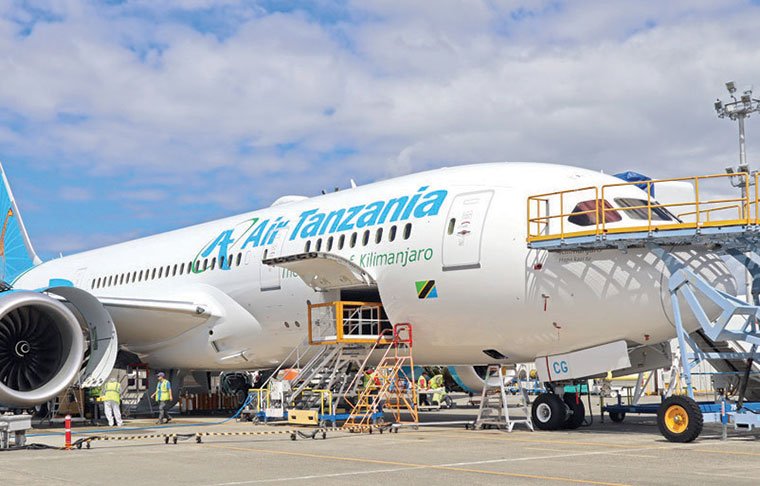
The government of Tanzania has unveiled an ambitious plan to expand the national carrier, Air Tanzania Company Limited, from its current fleet of 16 aircraft to 24 by 2030—signaling a renewed push to position the country as a dominant aviation hub in East Africa.
Speaking during recent engagements with staff in South Africa, Deputy Minister for Transport David Kihenzile outlined a phased growth strategy, with a short-term target of increasing the fleet to 19 aircraft by the 2025/2026 financial year. He described the expansion as a “strategic investment in national connectivity, economic growth, and global competitiveness.”
“This is not just about adding planes,” Kihenzile told aviation personnel. “It is about opening Tanzania to the world, strengthening our economy, and ensuring that our national airline becomes a symbol of pride and efficiency.”
The transformation of ATCL over the past decade has been striking. In 2016, the airline operated with just a single aircraft, following years of operational and financial struggles. However, under renewed government focus, the fleet has steadily grown to include modern aircraft capable of serving both domestic and long-haul routes. This revival has been closely tied to broader infrastructure investments and reforms in the aviation sector.
Domestically, ATCL now connects key economic and administrative cities such as Dar es Salaam, Dodoma, Mwanza, Kilimanjaro, and Mbeya, while also reaching underserved regions like Kigoma and Mtwara. Plans to introduce routes to Sumbawanga, Musoma, and Shinyanga are expected to deepen regional integration and unlock new economic opportunities, particularly in agriculture and mining.
On the international front, the airline has steadily expanded its footprint across Africa and beyond. Current routes link Tanzania to neighboring countries including Kenya, Uganda, Burundi, the Democratic Republic of Congo, Zambia, and Zimbabwe, while intercontinental flights connect passengers to major global destinations such as Guangzhou, Mumbai, and Dubai.
Also Read; Egypt Reports New Western Desert Gas Discovery Boost
Aviation analysts say the expansion aligns with Tanzania’s long-term development blueprint, which emphasizes infrastructure, trade, and tourism as pillars of economic transformation. By strengthening air connectivity, the government aims to attract more international visitors, facilitate exports, and enhance the country’s role in regional logistics networks.
Tourism stakeholders have welcomed the move, noting that improved air access could significantly boost visitor numbers to iconic destinations such as Serengeti National Park and Mount Kilimanjaro. Increased flight capacity is also expected to lower travel costs over time, making Tanzania more competitive in the global tourism market.
However, experts caution that fleet expansion must be matched with operational efficiency, strong management, and sustainable financing. Historically, several African national carriers have struggled with profitability despite government support, raising questions about long-term viability.
Still, government officials remain confident. “We are building an airline that will stand the test of time,” Kihenzile said, emphasizing ongoing efforts to improve service quality, staff training, and maintenance standards.
The broader economic implications are significant. Beyond tourism, a stronger national airline could enhance trade by facilitating faster movement of goods, particularly high-value exports such as fresh produce and minerals. It could also create thousands of jobs across aviation, hospitality, and logistics sectors.
As Tanzania accelerates its aviation ambitions, the expansion of ATCL represents more than just growth in fleet size—it reflects a strategic vision to connect the nation more deeply with the world. If successfully implemented, the plan could redefine Tanzania’s position in Africa’s aviation landscape and set a new benchmark for national carriers across the continent.