MWE Correspondent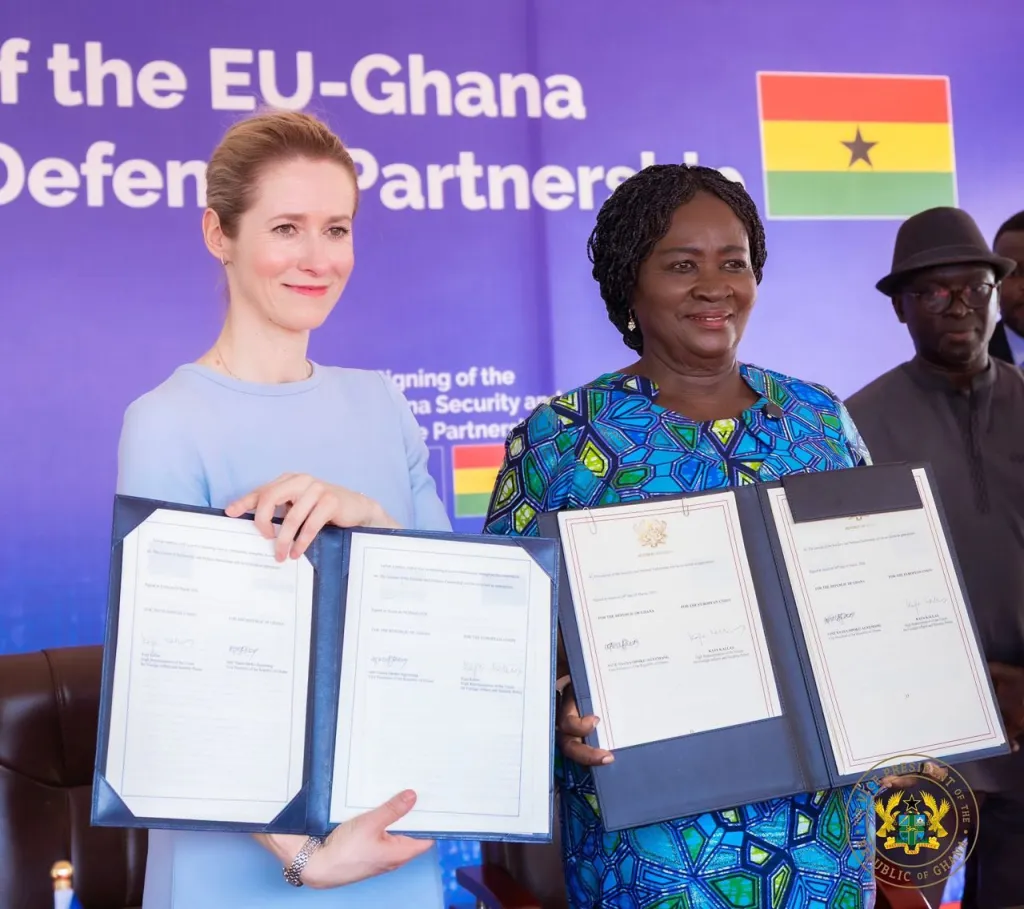
Ghana has entered a new chapter in its security and diplomatic history after signing a landmark Security and Defence Partnership with the European Union, a move widely seen as both strategic and symbolic amid rising instability across West Africa.
The agreement, signed in Accra on March 24, 2026, makes Ghana the first African country to formalize such a structured security arrangement with the EU. It comes at a time when the region faces mounting threats from extremist groups, cross-border violence, and organized crime networks expanding from the Sahel into coastal states.
Vice President Professor Naana Jane Opoku-Agyemang, speaking during the ceremony, emphasized the urgency of the partnership. “We are living in a time where security challenges are no longer confined within borders. This agreement is a clear demonstration of our commitment to protect our people and preserve stability in our region,” she said.
The pact focuses on critical areas including counter-terrorism operations, intelligence sharing, cybersecurity cooperation, and coordinated crisis response. It also includes provisions for joint training, logistical support, and institutional capacity building within Ghana’s security forces.
To fully understand the significance of this agreement, one must look at Ghana’s historical role in regional peace and security. Since gaining independence in 1957, Ghana has consistently positioned itself as a beacon of stability in West Africa. It has contributed troops to numerous United Nations peacekeeping missions and played key diplomatic roles in mediating conflicts in countries such as Liberia and Sierra Leone.
However, the security landscape in West Africa has changed dramatically over the past decade. The Sahel region has become a hotspot for extremist activity, with armed groups exploiting weak governance and vast ungoverned spaces to expand their influence. Countries like Mali, Burkina Faso, and Niger have experienced repeated attacks, military coups, and political instability.
These developments have increasingly spilled over into neighboring nations. The recent killing of Ghanaian traders in Burkina Faso served as a stark reminder that no country in the region is immune. Security analysts warn that coastal states, once considered relatively safe, are now potential targets for extremist expansion.
European Union officials have described the partnership as part of a broader effort to support stability beyond Europe’s borders. “Our security is interconnected. By strengthening Ghana, we are contributing to the stability of an entire region,” an EU representative stated during the signing event.
Also Read; Egypt Reports New Western Desert Gas Discovery Boost
Experts believe the agreement reflects a shift in how global security partnerships are being formed. Rather than traditional aid-based relationships, there is a growing emphasis on mutual cooperation and shared responsibility. Ghana, in this context, is not just a recipient of support but a key partner in addressing transnational threats.
Despite the optimism, some observers have raised concerns about the long-term implications of such partnerships. Questions around sovereignty, external influence, and dependency have been part of ongoing debates in many African countries engaging in similar agreements. However, Ghanaian authorities have maintained that the partnership is built on equal footing and aligned with national interests.
Beyond security, the deal could have significant economic implications. A stable environment is crucial for attracting foreign investment, promoting trade, and supporting development initiatives. Strengthened security systems may also enhance Ghana’s position as a gateway to West Africa.
As the region navigates an increasingly complex security environment, Ghana’s decision to formalize this partnership sends a clear message. It reflects a proactive approach to emerging threats and highlights the importance of international collaboration in maintaining peace.
While the effectiveness of the agreement will ultimately depend on implementation, it marks a significant milestone in Ghana’s efforts to adapt to a rapidly evolving global and regional security landscape.