MWE Correspondent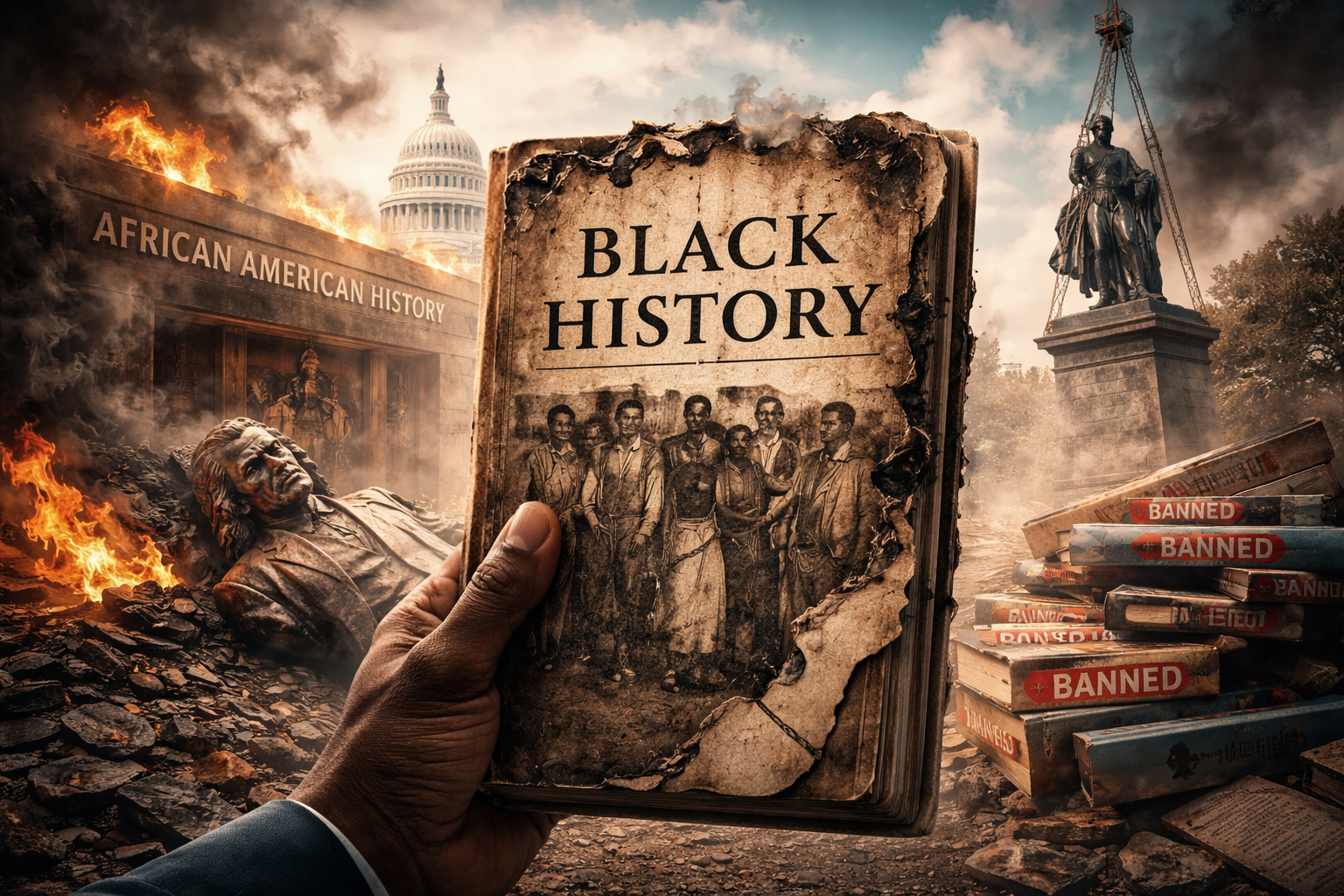
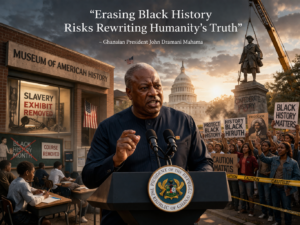
In a moment that has stirred global reflection and renewed debate about historical memory, John Dramani Mahama has issued a stark warning over what he describes as a growing trend in the United States:
the gradual erasure of Black history from public spaces, classrooms, and national narratives. His remarks, delivered with urgency and moral weight, have transcended borders—touching on deeper questions about identity, truth, and how nations choose to remember their past.
Mahama’s criticism is directed at policy and cultural shifts linked to the leadership of Donald Trump. While the debate within the United States has been unfolding for years, the Ghanaian leader’s intervention has added an international dimension, highlighting how American historical narratives influence global perceptions of race, justice, and equality.
“The story of Black people is not a footnote,” Mahama said in a widely shared address. “It is central to the human story. When it is erased, distorted, or minimized, we are not only losing history—we are losing truth.”
To understand the gravity of Mahama’s concerns, one must revisit the long and complex history of Slavery in the United States. Beginning in the early 17th century, millions of Africans were forcibly transported across the Atlantic in what became known as the transatlantic slave trade. Their labor built vast sectors of the American economy, from agriculture to infrastructure, yet their humanity was systematically denied.
Also Read; “Africa Faces Fuel Crunch Amid Supply Disruptions”
Even after the abolition of slavery in 1865, the scars remained. The Reconstruction era gave way to segregation laws, racial violence, and systemic discrimination that would persist for generations. It was not until the mid-20th century, during the transformative period of the Civil Rights Movement, that legal barriers to racial equality began to be dismantled.
Figures such as Martin Luther King Jr., Rosa Parks, and Malcolm X became symbols of resistance and hope, challenging a system deeply rooted in inequality. Their sacrifices helped reshape American society, embedding civil rights into law and consciousness. Yet, as historians often note, progress has never been linear.
In recent years, the United States has found itself at the center of a cultural reckoning over how history is remembered. Museums expanded exhibits on slavery and systemic racism. Schools introduced curricula aimed at exploring the complexities of race. Public monuments—especially those linked to the Confederacy—became focal points of controversy.
At the heart of this debate lies the legacy of the American Civil War, a conflict that divided the nation over slavery and state sovereignty. Confederate statues, erected largely in the late 19th and early 20th centuries, have been interpreted by critics as symbols of oppression rather than heritage.
Mahama’s concern is that recent actions—such as the reported removal of certain slavery exhibits and the restoration of Confederate monuments—signal a reversal of efforts to present a fuller, more honest account of history. “You cannot build unity on selective memory,” he argued. “A nation must confront its past, not conceal it.”
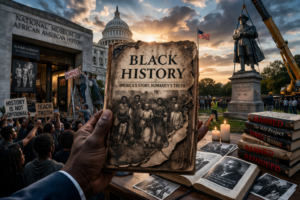
Beyond monuments and museums, the debate has increasingly shifted to classrooms. Reports of Black history courses being reduced or removed have alarmed educators and activists alike. In some regions, books dealing with racism, colonialism, and inequality have faced bans or restrictions.
For Mahama, this is perhaps the most concerning development. “When you control what young people learn, you shape the future,” he said. “If they are denied the full truth, they inherit a distorted world.”
Educational experts echo this concern, emphasizing that history is not merely about the past—it is a tool for critical thinking and civic engagement. Without a comprehensive understanding of historical injustices, societies risk perpetuating them.
The administration of Donald Trump has strongly rejected accusations of historical erasure. Officials argue that their policies aim to promote national unity and economic progress, pointing to initiatives they claim have benefited Black communities.
Also Read; “Africa Faces Fuel Crunch Amid Supply Disruptions”
“We have delivered real results,” a spokesperson stated, citing employment gains and criminal justice reforms. “The narrative that we are erasing history is false and politically motivated.”
Supporters of the administration also contend that debates over monuments and curricula have become overly politicized. They argue that preserving historical symbols does not necessarily equate to endorsing the values associated with them.
What makes Mahama’s remarks particularly significant is their global resonance. As a leader from Ghana, a country historically linked to the transatlantic slave trade, his voice carries both historical and moral authority.
Ghana has actively engaged with its past, promoting initiatives such as the “Year of Return,” which invited members of the African diaspora to reconnect with their roots. Sites like Cape Coast Castle and Elmina Castle stand as enduring reminders of a painful history, preserved not to glorify suffering but to ensure it is never forgotten.
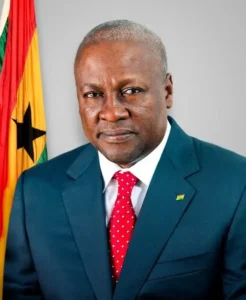
“The lessons of history belong to all of us,” Mahama said. “America’s story is intertwined with Africa’s story, and with the story of humanity itself.”
Scholars argue that confronting history requires more than symbolic gestures—it demands evidence-based narratives grounded in truth. Archival records, oral histories, and academic research collectively paint a picture that is both complex and uncomfortable.
Attempts to simplify or sanitize this narrative risk undermining its educational value. “History is not always flattering,” one historian observed. “But it is necessary.”
Civil rights organizations have also warned that diminishing the visibility of Black history could have real-world consequences. Studies suggest that awareness of historical injustices is linked to greater empathy, social cohesion, and support for equitable policies.
The debate over Black history in the United States is far from settled. It reflects broader tensions about identity, power, and the meaning of progress in a diverse society. For some, it is a question of heritage; for others, it is a matter of justice.
Mahama’s intervention serves as both a critique and a call to action. It challenges not only the United States but also the global community to consider how history is preserved and who gets to shape its narrative.
“History is a mirror,” he concluded. “If we choose to break it, we lose the ability to see ourselves clearly.”
As the world becomes increasingly interconnected, the way nations remember their past has implications far beyond their borders. The United States, as a global cultural and political influence, plays a particularly significant role in shaping these narratives.
Whether the current debate leads to deeper reflection or further division remains to be seen. What is clear, however, is that the preservation of Black history is not just about the past—it is about the future.
In the words of Mahama, “We are custodians of memory. What we choose to remember—or forget—will define the kind of world we leave behind.”
His message, rooted in history yet focused on the future, continues to echo across continents: that truth, however difficult, must never be erased.