MWE Correspondent
Botswana President Duma Boko has called on African countries to increase trade among themselves, remove barriers to cross-border commerce and strengthen regional economic cooperation to protect the continent from global economic shocks.
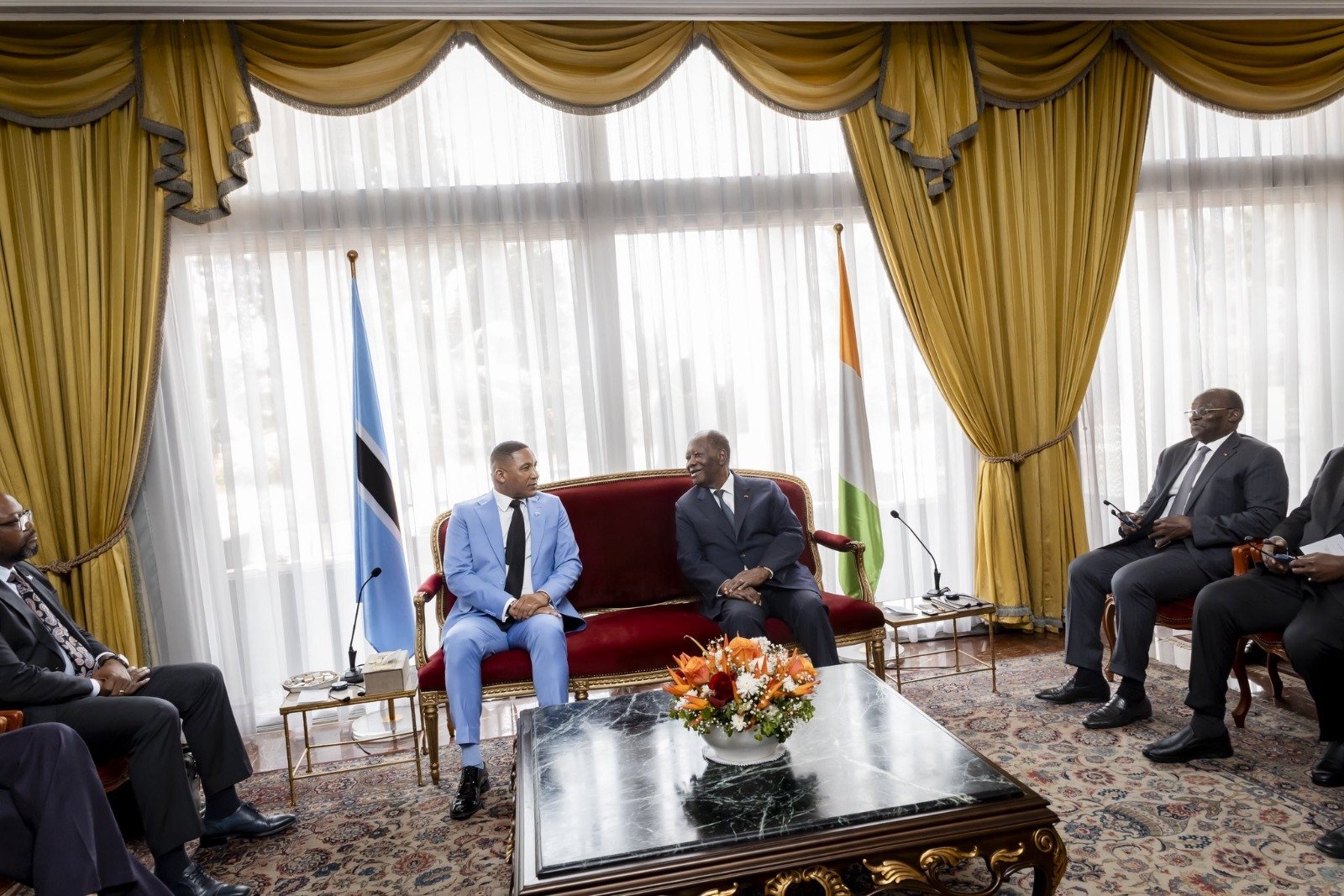
Boko made the remarks during a state visit to Côte d’Ivoire from November 15 to 18, 2026, where he held talks with Ivorian President Alassane Ouattara and witnessed the signing of several bilateral cooperation agreements covering mining, energy, agriculture, trade and other sectors.
Speaking to journalists in Abidjan on November 16, Boko said Africa needed to address the low levels of trade between its countries, arguing that stronger economic connections would help the continent become more resilient to international disruptions.
He called for greater harmonisation of trade regulations, laws and business practices to eliminate unnecessary restrictions that make it difficult for African businesses to access markets in other countries.
Boko said increasing intra-African trade could reduce the continent’s vulnerability to external economic shocks arising from geopolitical conflicts, including the Russia-Ukraine war and tensions in the Middle East.
He also argued that Africa’s current low levels of internal trade reflected weaknesses in its development approaches and economic policies that required urgent attention.
The visit has also opened new opportunities for cooperation between Botswana and Côte d’Ivoire, particularly in the mining industry, where the two countries intend to combine their expertise and natural resources to promote economic development.
During talks with Ouattara, the two leaders discussed strengthening bilateral relations and expanding investment in strategic sectors. Several memorandums of understanding were signed, covering mining, energy, economic affairs, diplomacy, and human and animal health.
The agreements build on an earlier cooperation framework signed in July 2026 in Gaborone, covering mining, petroleum and energy, with a focus on exchanging technical expertise and developing investment opportunities.
Also Read:Tanzania Reaffirms Support for AU Peace Efforts
The partnership is expected to benefit from the complementary strengths of the two economies. Botswana has developed extensive experience in diamond exploration, extraction and mineral resource management, while Côte d’Ivoire has significant gold deposits and growing opportunities in other strategic minerals.
Boko highlighted the importance of processing natural resources locally rather than relying primarily on exporting raw materials, saying both countries could benefit from adding value to their mineral production.
Côte d’Ivoire is seeking to expand its mining and energy industries as part of its broader economic diversification strategy. In recent years, the country has attracted growing attention following discoveries and developments involving gold, oil, gas, manganese and other mineral resources.
Botswana, meanwhile, is one of Africa’s leading diamond producers, with its mining industry playing a central role in national revenue, exports and economic development. Its experience in managing mineral resources is expected to provide opportunities for technical cooperation with Côte d’Ivoire.
Ouattara encouraged Botswana’s private sector to explore investment opportunities in Côte d’Ivoire, particularly in mining, petroleum, energy and major infrastructure projects included in the country’s 2026-2030 National Development Plan.
The economic engagement continued with a Botswana-Côte d’Ivoire Business Forum on November 17, bringing together business representatives and investors to explore partnerships and commercial opportunities between the two countries.
Boko is also expected to participate in the second edition of the International Exhibition of Extractive Resources and Energy (SIREXE 2026), scheduled to take place in Abidjan from November 18 to 22, with Botswana participating as the guest of honour.
His visit comes as African countries continue efforts to implement the African Continental Free Trade Area (AfCFTA), which officially began trading in 2021 and seeks to create a single continental market for goods and services.
However, differences in customs procedures, infrastructure gaps, transport costs, regulatory systems and trade restrictions continue to limit the movement of goods across African borders.
The African Union’s continental trade initiative is intended to address some of these challenges by improving market access, encouraging industrialisation, promoting regional value chains and increasing trade among African economies.
Boko’s appeal reflects growing calls for African countries to move beyond diplomatic cooperation towards practical economic partnerships that support local production, industrial development and investment.
The long-term impact of the Botswana-Côte d’Ivoire agreements will depend on their implementation, the level of private-sector participation and the ability of both governments to translate cooperation commitments into concrete projects, jobs and increased trade.