
 MWE Correspondent
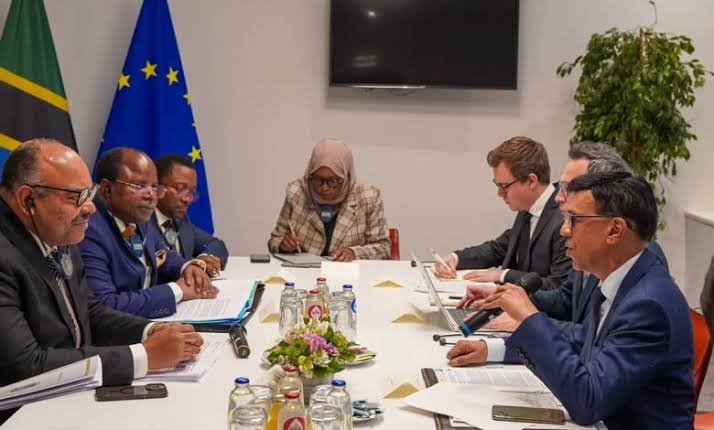
Tanzania’s relationship with the European Union is entering a new phase following disagreements over democracy, human rights and development financing, with the approval of a €156 million cooperation programme raising fresh questions about the future direction of the partnership.
The European Commission approved a €156 million Annual Action Plan for Tanzania in July 2026, equivalent to approximately Sh462.8 billion, following months of debate over the country’s political and human rights situation after the October 29, 2025 general election. However, the approval has not restored the previous model of direct government budget support, as the programme places greater emphasis on implementation through other partners, including private-sector channels.
The funding dispute intensified after the European Parliament adopted a resolution on June 18, 2026, objecting to the proposed financing programme and urging the European Commission to reconsider its approach. The resolution followed an earlier parliamentary objection in November 2025, when lawmakers raised concerns about reported post-election violence, democratic governance and human rights in Tanzania.
The European Parliament’s position, however, did not constitute the final financing decision. The European Commission proceeded with the programme, signing its 2026 financing decision on July 24, 2026. The approved package consists of €129 million for agricultural and mineral value chains, €20 million for digital economy and connectivity initiatives, and €7 million for a cooperation facility.
The distinction between approving the funding and deciding how it will be implemented is central to understanding the current relationship. The Commission’s decision makes the allocation available for implementation, but does not mean the entire amount has already been transferred or spent.
The European Union Delegation in Tanzania told The Chanzo that the funding would be channelled through and benefit the private sector, in line with the Global Gateway strategy and Tanzania’s Development Vision 2050. The delegation added: “This will be mutually beneficial for both Tanzanian and EU interests.”
The approach represents an important change in the delivery of development assistance, particularly because the political disagreements have raised questions about the use of direct government financing. It also creates an opportunity to expand investment in agriculture, mineral processing, digital infrastructure and businesses, although the final implementing partners and disbursement schedules remain important details to be clarified.
Tanzania’s government has previously rejected interpretations that European parliamentary objections automatically meant the suspension of the cooperation programme. In a statement issued on June 19, 2026, the Ministry of Foreign Affairs and East African Cooperation said: “The vote taken in the European Parliament is not the final decision of the European Union regarding the 2026 Partnership Programme with Tanzania.”
The ministry also maintained that the programme’s review and any changes should involve consultations and agreement between both parties. It explained that only €17 million of the proposed €156 million had initially been planned for direct implementation through government systems, while approximately €139 million was intended for implementation through EU institutions, member-state agencies and civil society organisations.
The government further described Tanzania-EU relations as strong, friendly and strategic, signalling its intention to maintain cooperation despite disagreements over political developments.
Read More:Europe’s Democracy Standards Face African Sovereignty Questions
Diplomatic engagement has continued alongside the financing debate. On October 15, 2026, President Samia Suluhu Hassan received the credentials of the new EU Ambassador to Tanzania, Jean-Marc Pisani, at State House in Dar es Salaam. His appointment provides an opportunity for renewed diplomatic engagement as both sides seek to advance their shared economic and development interests.
Today, EU Ambassador to Tanzania, Jean-Marc Pisani, was honoured to present his credentials to Her Excellency Dr Samia Suluhu Hassan, President of the United Republic of Tanzania, at State House in Dar es Salaam. https://t.co/C6JVQHEECB
— EU in Tanzania (@EUinTZ) October 15, 2026
The economic relationship remains substantial. According to the European Commission, EU-Tanzania trade in goods reached €2.14 billion in 2025. The EU has also allocated €585 million in grant funding to its partnership with Tanzania under the 2021–2027 cooperation framework, supporting areas including human development, employment, governance, environmental sustainability and regional integration.
The private-sector dimension is becoming increasingly important. In August 2026, Tanzania and EU representatives held discussions in Dar es Salaam on strengthening trade and investment in line with Development Vision 2050. The discussions brought together government institutions, European diplomatic representatives and business organisations.
The EU’s investment approach is also connected to the Global Gateway strategy, which seeks to mobilise investment in infrastructure, energy, digital connectivity and other strategic sectors. In July 2024, the European Investment Bank announced a €15 million EU grant to support credit lines of up to €350 million for Tanzanian banks, targeting small and medium-sized enterprises, including women-led businesses and companies operating in the blue economy.
For Tanzania, the immediate challenge is ensuring that the new financing arrangements translate into measurable benefits for local businesses, workers, farmers and mineral producers. A shift towards private-sector implementation could expand access to investment, but its success will depend on transparency, local participation, fair access to financing and the extent to which Tanzanian companies benefit.
View this post on Instagram
A research paper published in the Tanzanian Journal of Multidisciplinary Studies in August 2026 by Saleh Mgeni Mussa, a PhD candidate in international politics at Central China Normal University, examines the changing relationship through the question of conditionality or partnership. The study identifies mutual accountability, national ownership, policy dialogue and respect for national priorities as important elements in strengthening cooperation.
The next significant opportunity for both sides will be the EU-Tanzania Investment and Business Forum scheduled for Dar es Salaam in February 2027. According to the European Commission, the forum is intended to advance investment commitments, connect businesses and strengthen economic cooperation.
However, economic cooperation alone will not resolve all outstanding political differences. The European Union has continued to raise concerns about democratic governance and human rights, while Tanzania has emphasised national sovereignty and the importance of mutually agreed development partnerships.
The future of Tanzania-EU relations will therefore depend on whether both sides can maintain economic cooperation while addressing political disagreements through diplomatic dialogue, respect for international obligations and transparency. The approval of the €156 million programme demonstrates that cooperation remains possible, but the effectiveness of the new funding model and the ability to rebuild political trust will determine what happens next.