MWE Correspondent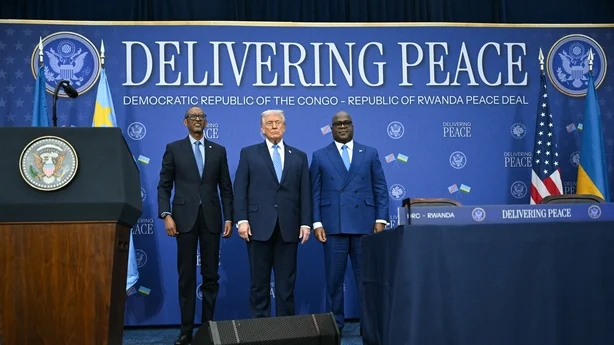
A major diplomatic breakthrough unfolded in the U.S. capital this week after the leaders of the Democratic Republic of the Congo (DRC) and Rwanda signed a landmark agreement aimed at ending decades of conflict in eastern Congo.
The pact, now widely referred to as the Washington Accords, was formalized on December 4, 2025, during a high-level ceremony hosted by former U.S. President Donald J. Trump.
The agreement was signed by DRC President Félix Tshisekedi, Rwanda’s President Paul Kagame, and witnessed by Trump, who has been positioning himself as a central mediator in the long-running regional crisis. The Accords build on a preliminary deal signed by the countries’ foreign ministers in June.
For years, eastern Congo has endured recurring violence driven by local militias, foreign-backed movements, and competition over valuable minerals. The region remains a flashpoint where humanitarian disasters, displacement, and instability intersect. According to analysts, the latest agreement offers a structured framework for addressing these deeply rooted issues.
Under the new pact, Rwanda has committed to withdrawing its forces and halting any support to armed groups operating inside Congo. The DRC, on its part, has agreed to intensify operations to dismantle local militias and re-establish state authority in conflict-affected zones. The deal also outlines emerging cooperation on economic development and joint management of cross-border natural resources — including minerals critical to global technology supply chains.
President Trump described the signing as “a historic moment for Africa and an opportunity for a fresh chapter of peace.” His remarks echoed American hopes that long-term stability in the region will both alleviate human suffering and promote sustainable investment in one of the world’s richest mineral corridors.
However, despite the symbolic significance of the ceremony, fighting between the Congolese army and the M23 rebel movement continued to be reported in parts of the Kivu region the very same day the accord was signed. This reality has sparked cautious optimism from observers who warn that previous peace efforts collapsed under the weight of mistrust and incomplete implementation.
Also Read; Treason Case Suspects Freed After Charges Withdrawn
The eastern DRC conflict — one of the world’s deadliest since World War II — has claimed millions of lives and displaced more than a million people. Understanding its complexity requires examining the intertwined historical tensions between the DRC and Rwanda, as well as the strategic importance of the region’s vast deposits of critical minerals. The presence of armed groups, such as M23, has also shaped regional geopolitics for more than a decade.
Supporters of the Washington Accords argue that, despite its challenges, the deal offers the clearest roadmap to peace in recent years. For Rwanda and the DRC — whose relations have often swung between uneasy cooperation and open hostility — the agreement marks an opportunity to reset diplomatic ties. And for global powers, the Accords signal a renewed attempt to stabilize one of Africa’s most strategically significant regions.
Whether this bold step will transform into lasting peace now depends on political will, regional coordination, and sustained international engagement. As the world watches, eastern Congo once again finds itself at a crossroads — a region torn by conflict but, perhaps, inching closer to a future defined by cooperation rather than war.