MWE Correspondent
A 26-year-old woman in southwestern Ethiopia has captivated global attention with her extraordinary claim that she has not eaten or drunk anything for the past sixteen years.
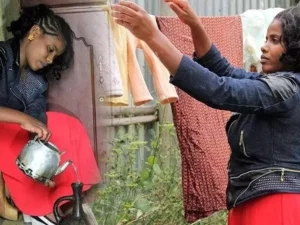
According to her account, she last consumed a simple lentil stew at the age of ten, and since then, she says, she has experienced no hunger or thirst while continuing to perform daily activities, care for her family, and maintain a seemingly normal life.
Her story gained international visibility when a travel vlogger visited her village, capturing footage that quickly went viral. Viewers were astonished by her appearance and physical alertness, fueling debates across social media and news outlets. Some hailed her as a miracle, while medical professionals expressed skepticism over the biological feasibility of such claims.
The woman reportedly underwent multiple medical examinations, both locally and abroad, including clinics in India, Qatar, and Dubai. According to her, doctors found no food contents in her digestive system during at least one check-up. She attributes her condition to divine intervention, describing it as “the work of God.”
Medical experts note that survival without food and water for extended periods is considered physiologically impossible. The human body depends on nutrients and hydration to regulate vital processes, and deprivation typically results in dehydration, organ failure, and ultimately death within days or weeks.
Also Read; Tanzania Weather Alert, Partly Cloudy Skies And Showers
The phenomenon the woman claims is known as Inedia, a belief that humans can survive without food, which is widely regarded by scientists as pseudoscientific. Historically, there are no verified cases of humans living for years without both nourishment and hydration.
Despite skepticism, the story has sparked fascination around the world. Supporters view it as a miraculous event, while critics emphasize the need for transparent clinical studies, continuous observation, and scientific validation before accepting such extraordinary claims. Many warn that viral attention and sensational headlines often overshadow critical scientific scrutiny.
For now, the woman’s account remains unverified. Experts caution that without long-term monitoring and peer-reviewed medical evidence, it cannot be confirmed as a miracle or a scientifically plausible phenomenon. Nonetheless, the story continues to captivate public imagination, highlighting the intersection of faith, folklore, and science in modern media narratives.